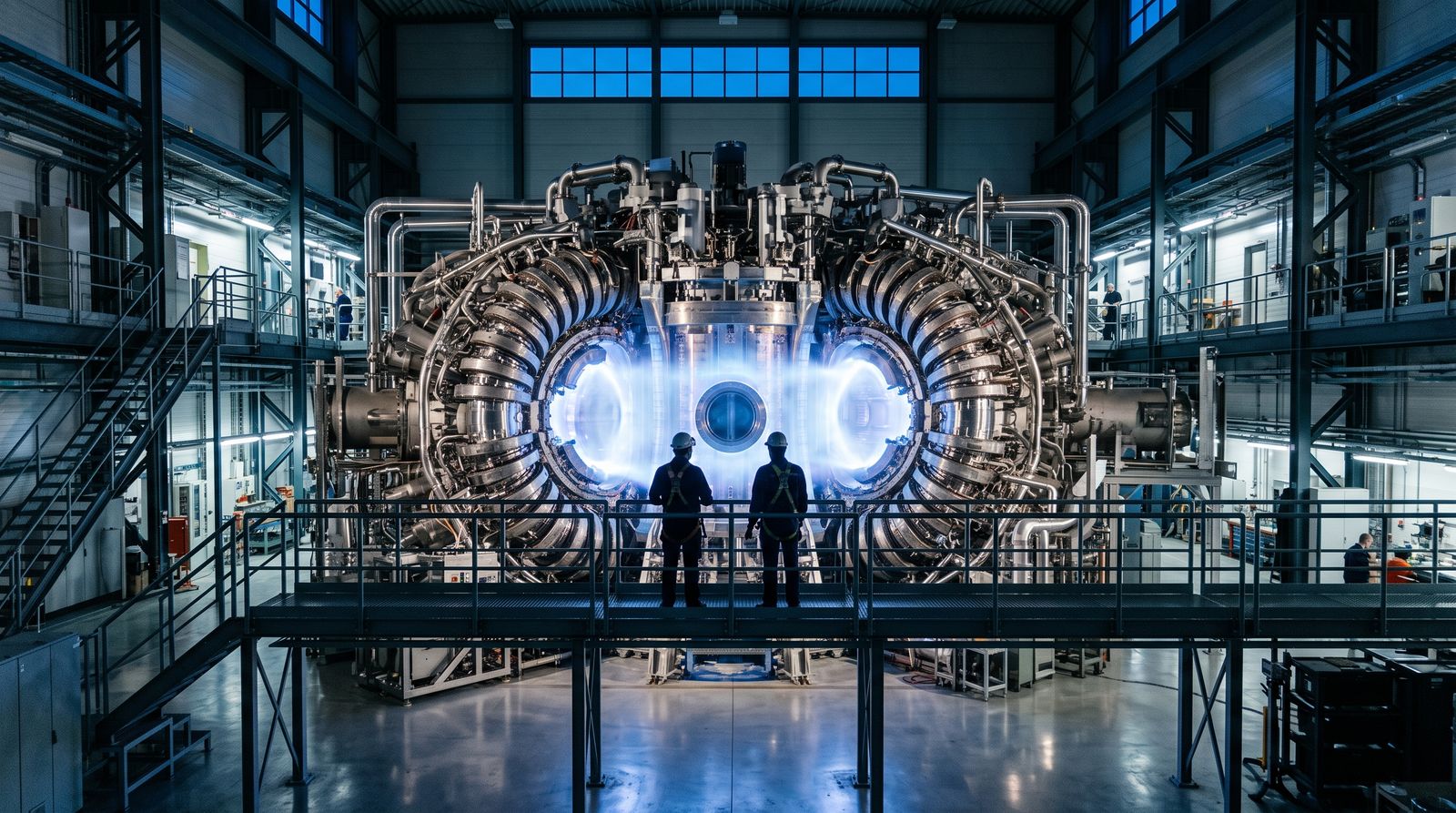
Proxima Fusion, a three-year-old spin-out of Germany's Max Planck Institute for Plasma Physics, said Tuesday it raised €411 million — roughly $470 million — in a Series B that values the company at €2.4 billion. XTX Ventures and East X Ventures led the round. But the strategic names are the story: Google parent Alphabet and German power giant RWE, which put in €25 million, according to Reuters. New backers KfW Capital, SPRIND and Burda joined a roster that already included Balderton, Lightspeed, DST Global and Brevan Howard.
It is, by the company's account and outside trackers alike, the largest private fusion investment Europe has ever seen — and Alphabet's first fusion bet on the continent. The cash funds Alpha, a demonstrator Proxima wants to prove can do the one thing no fusion machine has done commercially: put out more energy than it takes in. A full power plant, planned with RWE in Gundremmingen, Bavaria, is the prize for the 2030s.
Proxima is chasing it with a stellarator — a fiendishly complex, twisted magnetic bottle that's harder to build than the more common tokamak but, in theory, easier to run around the clock. Just over a year ago the company was raising a €130 million Series A. This round came in more than three times bigger.
Our take: This is the AI-power trade going long — really long. The same electricity crunch that has Anthropic signing 20-year power leases and Google's utility bill up 37% in a year is now pulling patient capital toward a technology that won't put a commercial watt on the grid for years. Alphabet isn't buying fusion because it's ready. It's pre-funding the one input AI can't manufacture — clean, always-on power — long before it needs it. The signal for investors isn't "fusion is here." It's that the smartest money now treats energy, not silicon, as the AI bottleneck worth paying up for.
That reframes a market that spent last week arguing about whether AI capex pays off. If the constraint is chips, you buy Nvidia. If the constraint is the grid, you buy megawatts — and, apparently, the moonshots that might one day print them.
What to watch
- Alpha's milestones. A firm build date and a credible net-energy timeline are the difference between a science project and an asset. Watch for a first-plasma target.
- The Gundremmingen plant. A utility committing to a real grid site — not a lab — is the tell that RWE sees a business, not a press release.
- Who follows Alphabet. A second hyperscaler backing European fusion would turn "power is the bottleneck" from thesis into consensus.
- Valuation gravity. €2.4 billion with no commercial revenue is a venture bet. A delay or a down round would cool Europe's fusion momentum as fast as this raise heated it.
Fusion has been "thirty years away" for fifty years. What changed isn't the physics. It's that the buyers of future electricity just got bigger, richer, and a lot more desperate.