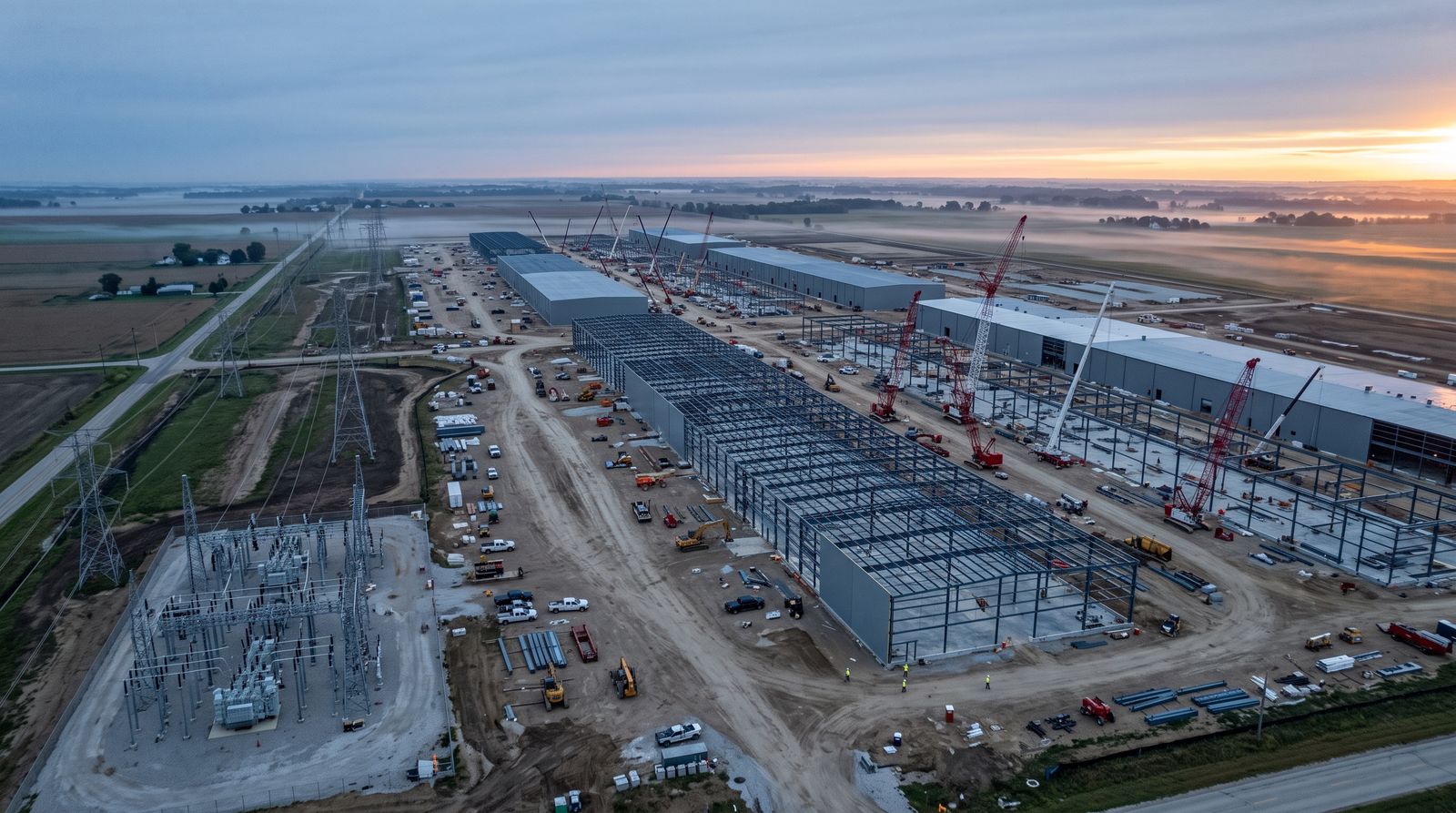
Nvidia is in talks to guarantee roughly $250 billion of financing so that OpenAI can lease a data center it will never own, on land the federal government controls, built by a Japanese conglomerate’s energy arm. That sentence is the 2026 AI economy in miniature.
The Wall Street Journal reported the discussions late Sunday. The guarantees would backstop OpenAI’s lease obligations and the construction debt behind a 10-gigawatt campus that SB Energy — a SoftBank subsidiary — is developing in southern Ohio, on the site of the shuttered Portsmouth uranium enrichment plant in Pike County. That plant produced weapons-grade material during the Cold War and stopped operating in 2001. Fully built, the campus would pull roughly the output of ten large nuclear reactors and cost more than $500 billion including the silicon inside it, which would make it the largest data center project ever announced.
The $250 billion does not cover the chips. Nvidia is reportedly in a separate conversation about financing up to $350 billion of GPU purchases for the same site. Reuters said it could not immediately confirm the Journal’s reporting, and both sets of talks are early enough that the numbers could move or evaporate entirely.
Why a chip company is co-signing a lease
Because OpenAI cannot sign it alone. The company has no investment-grade credit rating, and a twenty-year lease beginning in 2028 on a half-trillion-dollar campus is not something a lender underwrites on subscription revenue. Nvidia’s balance sheet is the collateral. In exchange, Nvidia locks in a customer for ten gigawatts of its own hardware — the same figure in the letter of intent the two companies signed in September 2025, when Nvidia said it would invest up to $100 billion in OpenAI as capacity came online.
Michael Burry’s response to the report was four words: “Around and around we go.” Oracle, OpenAI’s other landlord, rose about 1.4% in overnight trading — the market reading a guarantee on a rival developer’s project as a vote of confidence in its own book of OpenAI contracts.
Our take: A guarantee is not revenue and it is not capex, which is exactly what makes it attractive. Nvidia gets to make its largest customer bankable without booking a purchase; OpenAI gets investment-grade borrowing costs without an investment-grade rating. The risk doesn’t disappear, it just moves to a line most investors never read. Ask what happens if demand disappoints in 2029 and the answer is that a chip company owns the obligations on a building it cannot run and does not want.
What to watch
- Nvidia’s next earnings call. Whether it confirms anything, and what it discloses about total customer guarantees outstanding. This structure is now a pattern, not a one-off.
- The chip tranche. $350 billion of vendor-financed GPU sales is a very different accounting question from $250 billion of lease guarantees, and it lands closer to revenue recognition.
- Ratings agencies. Moody’s has already flagged off-balance-sheet lease commitments as the underpriced risk in the AI buildout.
- Ohio power. Ten gigawatts on a federal site means the interconnect timeline is a political problem as much as an engineering one.
None of this is signed. What matters is that the shape keeps repeating: the chipmaker underwrites the customer who buys the chips, and each version of the deal is larger than the last.