Oklo reported its second quarter Friday, and the top line contained a number the company had never printed before: $1.21 million of revenue. Analysts had modeled roughly $0.1 million. A year ago the line was zero.
Every other number got bigger too, in the other direction. The net loss widened to $48.5 million from $24.7 million in the year-ago quarter. Research and development spending rose to $39.5 million from $11.5 million. Loss per share landed at $0.28 against a $0.16 consensus — a miss of about 75%. Shares still went up, quoted around $44 in the premarket, roughly 4% higher.
The number that actually describes this company is not on the income statement. Oklo ended the quarter with about $3.0 billion in cash and marketable securities — $1.6 billion in cash and equivalents, $1.4 billion in securities. Roughly $1.9 billion of that arrived in the first two quarters of this year, through at-the-market equity offerings. Cash used in operations year to date was $65.5 million.
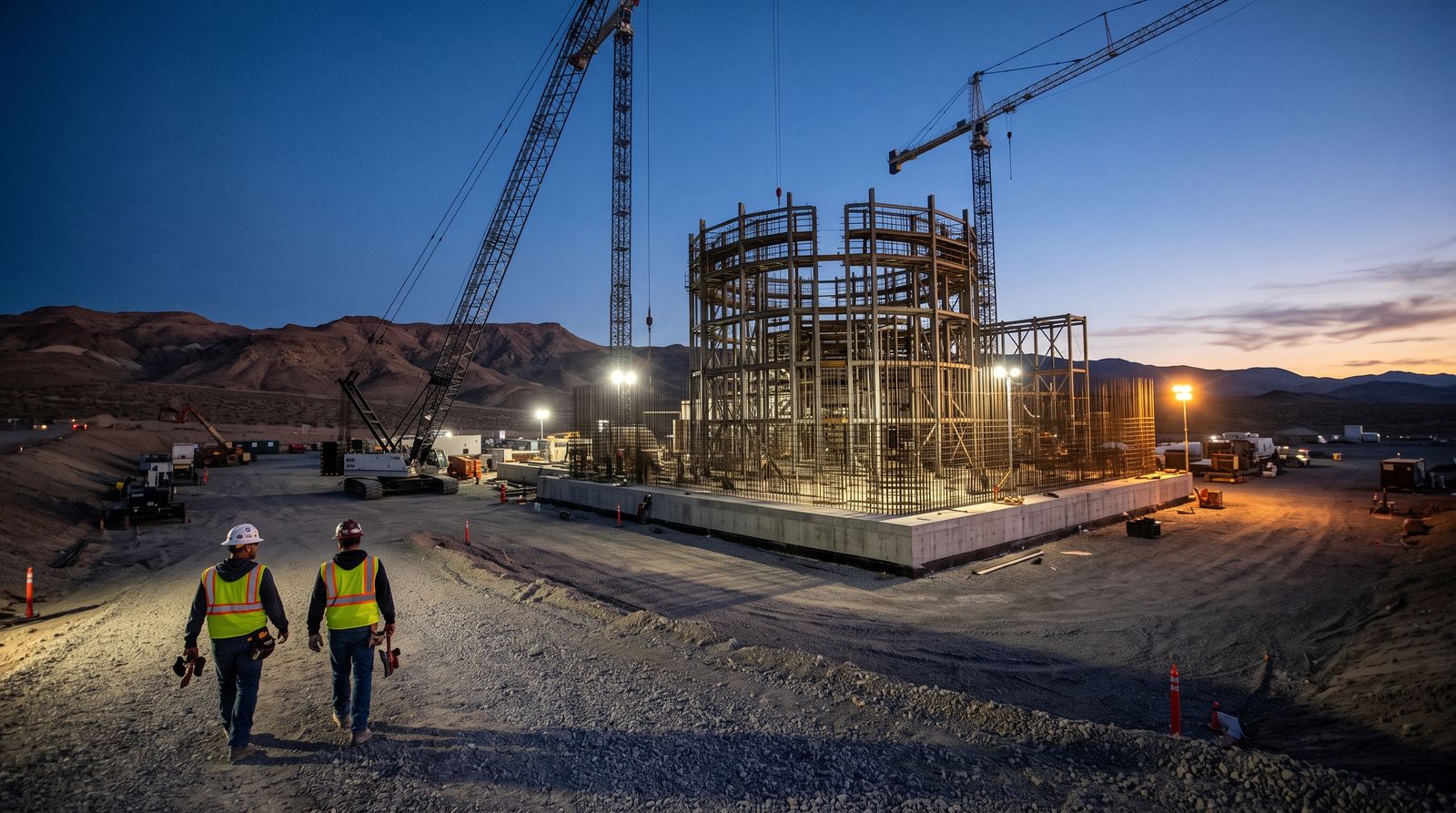
Our take: A $1.1 million revenue beat is a rounding error and everyone on the call knew it. What got repriced Friday was execution risk. Oklo’s Groves isotope facility reached first criticality in early August — 11 months after groundbreaking, across 229 days of substantial construction, which the company describes as the fastest privately funded, privately sited reactor build in history. That is the product. The $3 billion is the fuel. The operating model right now is converting a rising share price into poured concrete, and poured concrete into a 2028 startup date. Both conversions have to keep working, and only one of them is under management’s control.
The guidance that went up was the spending
Management raised full-year capital expenditure guidance to $400–500 million from a prior $350–450 million, and full-year operating cash outflow to $120–150 million from $80–100 million. The stated reason is accelerated procurement and grid interconnection work at Aurora-INL, pulled forward to protect the 2028 startup target. Oklo also cleared a regulatory step on that project, receiving Department of Energy approval for its preliminary documented safety analysis.
Raising your own burn rate is usually a confession. Here it reads as a deliberate trade. In advanced nuclear the scarce resource is schedule, not capital — interconnection queues, fuel fabrication and licensing run on calendars that money shortens only if you spend early. Oklo is buying time with the balance sheet while the balance sheet is full. Isotope revenue is not expected until early 2027, and the first of it is expected from the Idaho lab rather than Groves.
The pattern is not unique to nuclear
Capital-first, revenue-later is the dominant shape of this cycle’s industrial buildout. Lucid found $1.4 billion earlier this year with only $200 million of it coming from actual cost cuts. SpaceX beat by $900 million and then disclosed $18.4 billion of capex against it. And the demand pull is real enough that contractors are already booking it — IES Holdings doubled its profit wiring data centers as its backlog grew 91%.
The distinction that matters is who pays. SpaceX and IES fund construction out of customer revenue. Oklo funds it out of the equity market. That is not a criticism — it is how first-of-a-kind infrastructure has always been built — but it makes the share price an input to the business rather than an output of it. A pre-revenue builder with $3 billion is early. A pre-revenue builder with $3 billion and a closed equity window is late.
What to watch
- The ATM cadence. $1.9 billion raised against $65.5 million of operating burn means the issuance funds capex and optionality, not payroll. Continued heavy selling into strength would say management reads the window as temporary.
- Aurora-INL milestones, not press releases about them. The DOE safety-analysis approval is real; the 2028 startup is a target. Fuel fabrication equipment entering manufacturing for planned 2027 installation is the next checkable step.
- First isotope revenue in early 2027. If it slips, the financing question gets asked at a less friendly moment.
- Whether capex guidance rises again. One acceleration is a strategy. Two in a row starts to look like cost discovery.