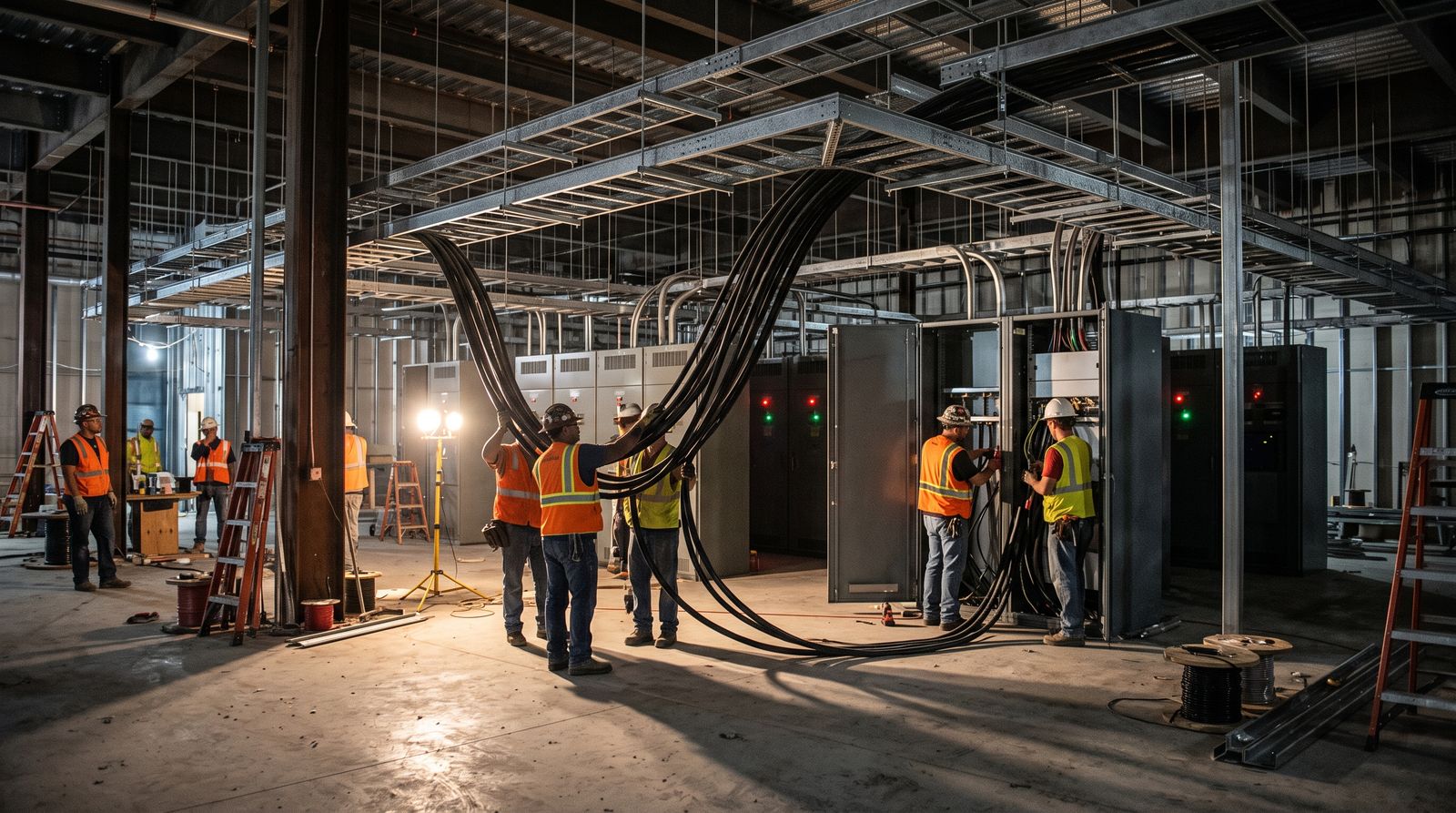
The AI trade has a physical layer, and it is deeply unglamorous. Somebody has to pull the cable, wire the switchgear, and build the power equipment that sits between the utility feed and the racks. IES Holdings does that work. On Friday it reported a quarter that makes the arithmetic of the buildout very hard to argue with.
Revenue for the fiscal third quarter ended June 30 was $1,243 million, up 40% from $890 million a year earlier. Operating income rose 60%. Net income attributable to IES came in at $153.0 million against $77.2 million — a 98% increase — and diluted earnings per share hit $7.57 versus $3.81. Adjusted earnings of $6.70 a share cleared the consensus estimate of $4.51 by $2.19. In a contracting business, a beat that size is not a rounding error.
The mix is where the story lives. Communications revenue rose 51% year over year and Infrastructure Solutions rose 73%. The segments serving data centers produced 92% of segment operating income before corporate costs. And backlog reached roughly $4.5 billion as of June 30, up 91% since the end of fiscal 2025 — nine months. The stock rose 25% on the print.
Our take: Backlog is the number that matters. Hyperscaler capex guidance is a promise; a contractor’s signed backlog is that same promise after somebody’s lawyer has been through it. IES nearly doubling its book in three quarters is a harder data point about 2027 spending than any earnings call transcript. The risk runs in exactly the same direction: 92% of segment profit from one end market is not diversification, it is a single bet with good current odds.
The split is a tell, not a catalyst
The board approved a two-for-one split on July 29. Holders of record on August 14 receive one additional share for each share held, distributed after the close on August 21. A split creates exactly zero value — it divides the same company into smaller pieces. What it signals is a board that expects the share price to stay high enough that per-share liquidity matters. That is a mild vote of confidence and nothing more. Do not confuse the split with the earnings; only one of them moved money.
What to watch
- Backlog conversion. Growing the book 91% is one problem. Staffing enough electricians to burn it down at margin is a different and harder one. Labor, not demand, is the binding constraint in this trade.
- Segment margins as the mix shifts. Beats this size attract competitors who bid more aggressively on the next round of work.
- The residential business, levered to housing and running on a completely different clock than the data center work.
- Post-split float and index eligibility — the only mechanical consequence a split actually has.
The picks-and-shovels version of the AI trade keeps printing better numbers than the customers buying the picks and shovels. Eaton said much the same thing this week. So did the power names. Somebody is eventually going to be wrong about 2027 — but for now the contractors are getting paid in cash rather than in narrative.