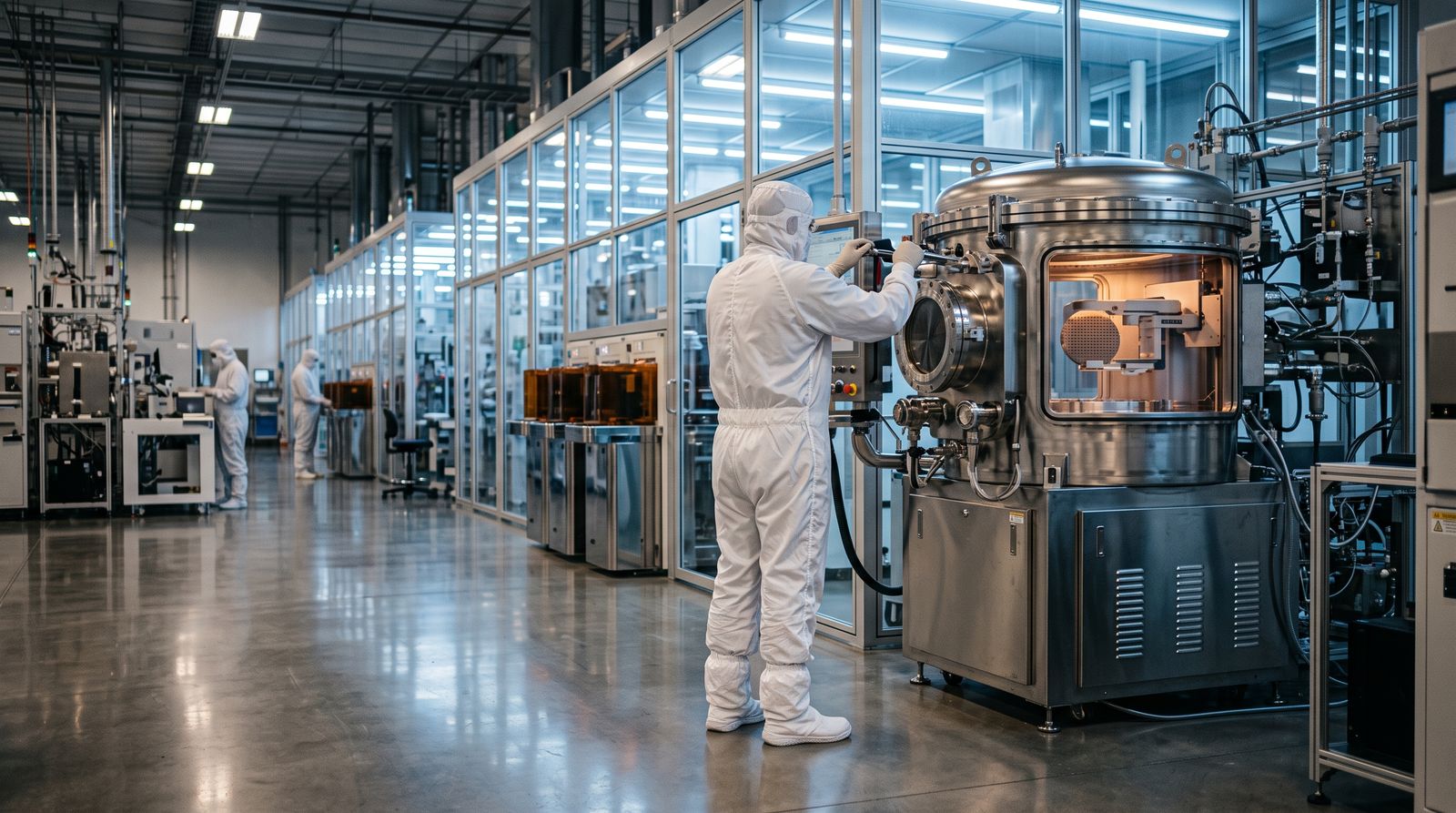
Lam Research closed its fiscal year Wednesday afternoon with the best quarter it has ever reported. Revenue of $6.72 billion for the three months ended June 28, up 15% from the March quarter and 30% from a year ago. Record diluted earnings of $1.82 a share against a street near $1.69. Gross margin of 52% — the company’s highest in 20 years, up from 49.9% in the prior quarter. Operating margin hit a record 38.4%, up from 35%.
None of that is why the stock moved. This is: management guided the September quarter to $8.10 billion in revenue, plus or minus $400 million, against a consensus around $7.1 billion. That is roughly a billion dollars of revenue analysts had not modeled, and a $1.4 billion sequential jump from a quarter that was already a record. Earnings guidance came in at $2.15 a share, give or take fifteen cents.
Shares jumped about 20% Thursday morning, trading near $303. HSBC raised its price target to $333 from $247. Evercore ISI went to $355 from $300.
Our take: Every memory story this week has been about who pays for the shortage. SK hynix earned a 76% operating margin and fell 9.6%. Samsung posted all-time record profit and its phone division lost money. Qualcomm beat on revenue and cut its guidance on memory costs. Lam sells the machines that end the shortage — and its order book is the first hard number on how fast the industry is actually trying to end it. Equipment revenue leads wafer output by roughly a year, so a September guide of $8.10 billion is a statement about 2027 supply, not 2026. Samsung said this week the crunch runs into 2028. Both can be true at once: capacity is being ordered at a pace nobody had modeled three months ago, and it still arrives late.
NAND is the tell
Memory was 46% of systems revenue, a record share for Lam, with foundry at 44% and logic and other at 10%. Inside that, NAND alone was 23% of systems revenue — and NAND dollars more than doubled sequentially.
That number is the interesting one. For most of the AI buildout, “memory demand” has meant high-bandwidth memory and DRAM — the expensive stuff that sits next to the GPU. NAND doubling in a single quarter means the spending has moved down the stack into storage: the flash that holds training data, checkpoints and inference caches, plus the upgrade cycle into 200-plus-layer architectures. Storage was supposed to be the boring, oversupplied end of the memory market. It is now growing faster than the glamorous end.
For anyone reading the AI trade through chip names alone, that is the broadening signal. The capital is no longer just chasing accelerators.
What to watch
- Whether the $8.10 billion holds. A 21% sequential guide is easy to celebrate and hard to deliver. The December-quarter commentary tells you whether this is a step up or a spike.
- The rest of the equipment complex. Lam, ASML, Applied Materials and KLA sell into the same fabs. If the read-through is real, their order books move together — and ASML already raised guidance by $6 billion.
- Memory pricing in 2027. Equipment bought now becomes supply in roughly a year. The bull case for memory margins assumes the fix stays slow. This order book argues it does not.
- Who funds the fabs. Micron’s $250 billion U.S. commitment is the demand behind numbers like these. Watch for the next one.
The through-line of the week is simple. When a shortage gets this profitable, the market stops paying for the profit and starts paying for the cure.