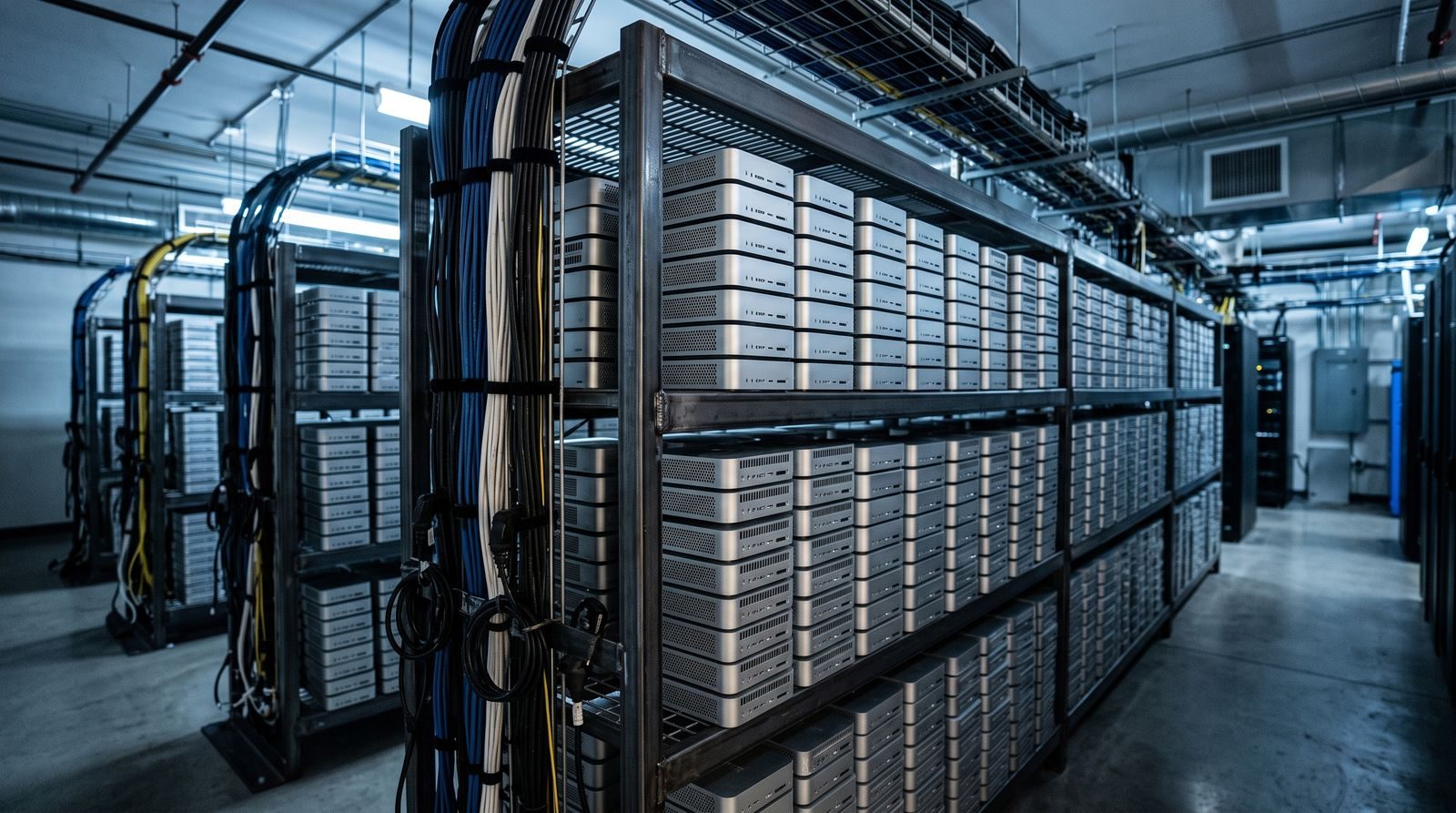
Multiple outlets reported this week that OpenAI has purchased tens of thousands of Mac minis and Mac Studios over recent months. The machines are said to be bought without displays or keyboards and racked as dedicated hardware inside OpenAI’s own infrastructure. Anthropic is reported to be doing something similar by renting Mac mini capacity through AWS rather than buying outright.
These are reports, not company statements, and neither lab has published numbers. Treat the scale as approximate. The direction is consistent across sources, and the stated purpose is specific: reinforcement learning for computer-use agents.
That purpose explains a purchase that otherwise looks eccentric. A computer-use agent is trained to do what a person does — move through interfaces, click things, edit and test code, work through email, complete multi-step tasks. Reinforcement learning means doing that over and over, failing, getting a signal, and trying again. To generate that signal you need the agent to actually be inside an operating system, watching a screen and acting on it.
Our take: The industry spent three years describing the constraint on AI as FLOPs. For this class of model the constraint is environments. If you want an agent that is good at the software people actually use, you need enormous numbers of real machines running real desktop operating systems, in parallel, cheaply, for months. You cannot synthesise your way around that, and for macOS specifically you cannot virtualise your way around Apple’s licensing either. So a frontier lab ends up buying consumer desktops by the pallet. That is not a workaround — it is what the training data for agents looks like now.
Why Apple hardware, of all things
Two reasons, per the reporting. The first is architectural: Apple’s unified memory pools RAM across CPU and GPU on a single chip, which suits workloads that are less about raw matrix throughput and more about running a whole interactive system responsively. The second is that these agents are being trained partly on macOS software, and the practical way to run macOS at scale is on Apple machines.
There is a supply wrinkle attached. The reporting notes that the most powerful configurations have been sold out for months, a consequence of the memory-chip shortage we covered when it started showing up in consumer device pricing. If AI labs are now a meaningful buyer of a consumer desktop SKU, the queue behind them is everyone else.
What to watch
- Confirmation. This is currently reporting, not disclosure. A supply-chain or earnings-call acknowledgement would move it from plausible to established.
- Lead times on high-memory configurations. The cleanest public signal of whether lab demand is material rather than anecdotal.
- Buy versus rent. OpenAI reportedly owning and Anthropic reportedly renting is a genuine strategic split, and one of them will look obviously right in eighteen months.
- Whether cloud providers productise it. Managed desktop-environment fleets for agent training is an obvious service to sell, and nobody has really sold it yet.
The bottleneck moved. It is now a shelf of small silver boxes, and there are not enough of them.