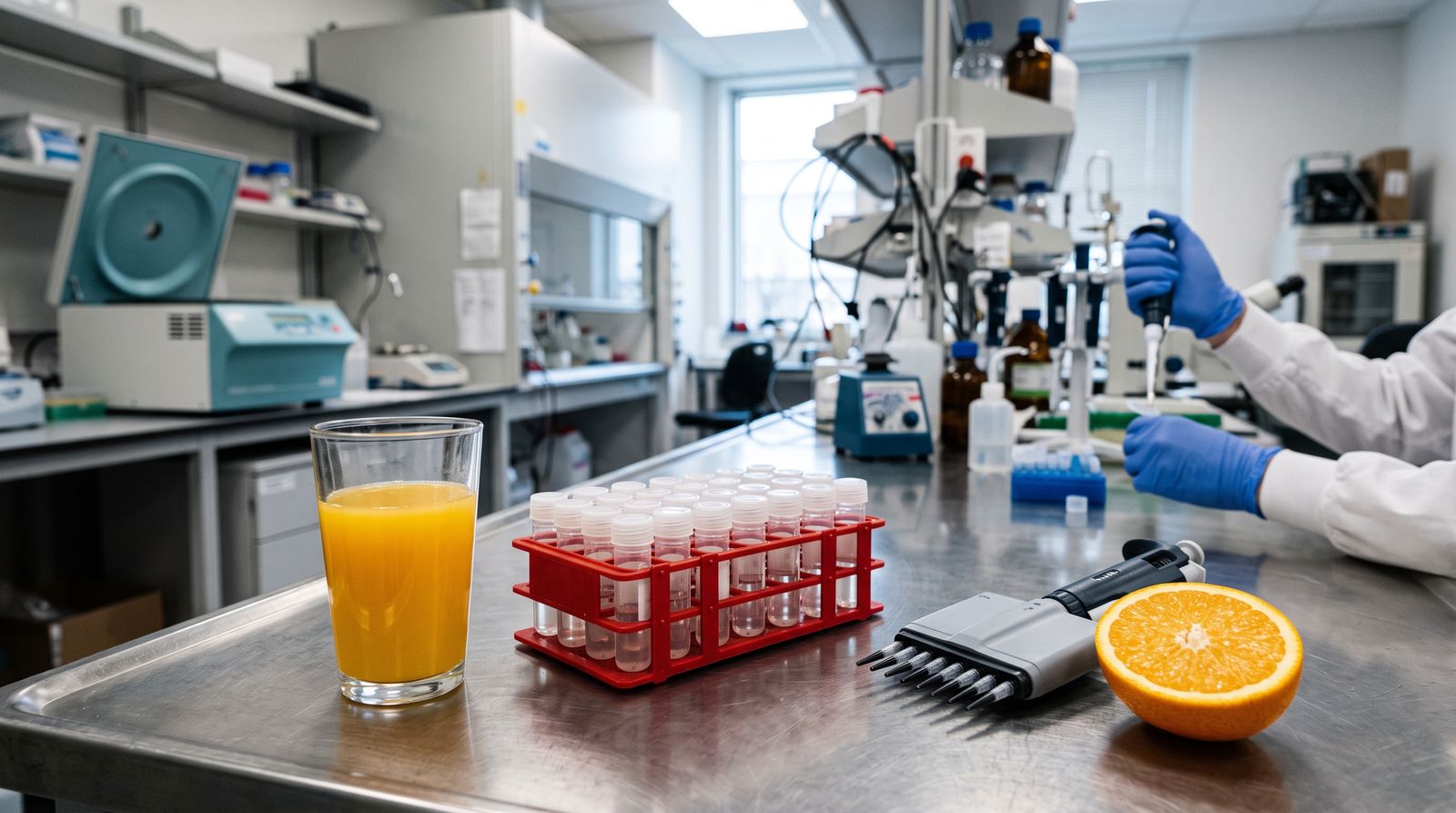
A nutrigenomics study out of the University of São Paulo, circulated this week by ScienceDaily, reports that two months of daily orange juice shifted the activity of 1,705 genes in volunteers’ peripheral blood mononuclear cells — the immune cells that circulate in your blood. Genes tied to inflammation and blood-pressure regulation, including IL6, IL1B, NLRP3 and NAMPT, were less active at the end. The paper, by Fraga and colleagues in Molecular Nutrition & Food Research, also logged changes in 66 microRNAs, 19 long non-coding RNAs and 67 small nucleolar RNAs.
That is a genuinely large molecular footprint for a breakfast drink, and it is not a fishing expedition dressed up as a finding: the same trial previously reported reductions in blood pressure and body-fat percentage on the same protocol, and this analysis was a hunt for the mechanism behind it. The researchers point at hesperidin and the other citrus flavanones as the likely active compounds, and found the response differed between normal-weight and overweight volunteers.
Now the part the headline leaves out. Twenty people were analysed — ten men and ten women, aged 21 to 36, drawn from the 85 enrolled in the parent trial. Everyone drank the juice: 500 mL a day for 60 days, measured at day zero and day 60. There was no control arm and no placebo, which means everything else that changed across those two months rides along with the juice in the result. Volunteers were also told to cut citrus, strawberries, passion fruit, coffee, chocolate, wine and tea before the study and to keep avoiding citrus foods throughout, so part of the contrast is juice against an unusually flavanone-free baseline.
Mechanism is not outcome
Gene expression in blood cells is a marker, not an endpoint. Nobody’s cardiac event was prevented in this study, and a quieter IL6 transcript at day 60 is a hypothesis about long-run risk, not a measurement of it. The funding was public — Brazil’s FAPESP, CNPq and CAPES, plus a USDA-NIFA Hatch project for one author — and the authors declare no conflicts of interest. The juice itself came from Fundecitrus, a Brazilian citrus growers’ research fund. That is not a disqualifier, but it belongs in the sentence.
Then there is the dose. Half a litre is a bit over two cups. The USDA puts a cup of orange juice at about 112 calories and roughly 21 grams of sugar, so the protocol is somewhere near 230 calories and 40-plus grams of sugar a day, every day, on top of everything else you eat. Any real-world verdict on drinking it has to net that against a set of transcript changes whose clinical value is still unproven.
Our take: This is a good study being read as a recommendation, which it is not. If you already enjoy orange juice, nothing here says stop. If you don’t drink it, this is a weak reason to start — the same flavanones arrive in whole oranges with fibre attached and far less sugar per serving. The transferable habit is how you read the next nutrition headline: check the arms before the adjectives. Was there a control group? How many people? Was the outcome something that happens to a person, or something that happens to a transcript? A study with 20 participants and no control arm can be interesting and still be nowhere near actionable.
What to watch
- A randomised replication with a matched-sugar comparison drink. Without one, sugar load and flavanone dose cannot be separated.
- Whether the body-weight split — different responses in normal-weight versus overweight volunteers — survives a larger sample, or dissolves as a small-n artefact.
- Isolated hesperidin trials. If the flavanone is doing the work, it should work without the calories.
- Hard endpoints. Blood pressure and body composition were measured in the parent trial; those numbers, replicated at scale, would matter far more than the gene count.