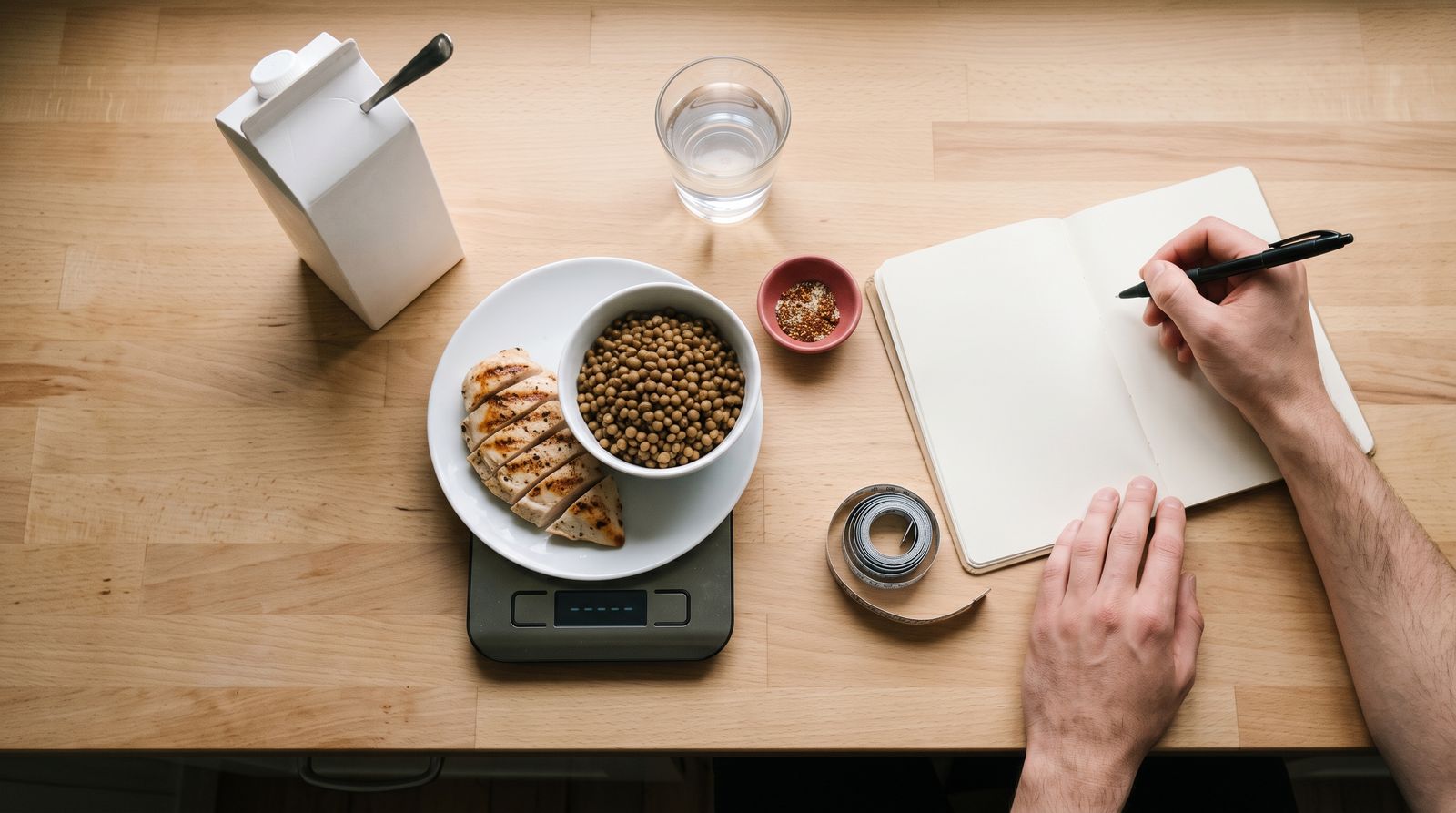
Most people arguing about protein are arguing about the wrong quantity. They debate the target — 0.8 grams per kilogram, 1.2, 1.6, “a gram per pound, bro” — without ever measuring what they currently eat. That is like debating your budget without opening your bank statement. The number in your head and the number on your plate are usually different by 40 grams in one direction or the other, and you cannot fix a gap you have not measured.
This playbook does the measurement first, the target second, and the adjustment last. It takes about 45 minutes of actual work spread over four days. At the end you will have a defensible personal number and a short list of changes to reach it, instead of a vague sense that you should probably buy more Greek yogurt.
What this is and isn’t: this is a self-audit framework, not medical advice. Kidney disease, liver disease, pregnancy, diabetes and several medications all change protein requirements in ways a spreadsheet cannot model. If any of those apply, run your numbers past a clinician or a registered dietitian before you change anything. The audit is still useful — it just means the last step is a conversation, not a decision.
Step 1: Measure the baseline (three days, ~10 minutes a day)
Log everything you eat for three days — two weekdays and one weekend day. The weekend day is not optional; it is usually where the pattern breaks and it is the day people conveniently forget when they estimate.
Use any tracking app or a notes file. Precision matters less than honesty. Two rules that fix 90% of bad logs:
- Log at the moment of eating, not at the end of the day. Retrospective logs lose 15–25% of intake, and the losses are not random — they are disproportionately the things you would rather not have eaten.
- Weigh the protein sources, eyeball everything else. A kitchen scale costs about $15 and you only need it for the three or four foods carrying most of your protein. Everything else can be estimated; the error does not compound enough to matter for this exercise.
At the end, compute your daily average protein in grams, then divide by your body weight in kilograms. Pounds ÷ 2.2 = kilograms. That quotient — grams per kilogram — is your current dose. Write it down before you read the next section, because reading the targets first will bias what you record.
Worked example
A 175 lb (79.5 kg) office worker logs three days and averages 96 grams of protein. 96 ÷ 79.5 = 1.21 g/kg. He assumed he was “probably around 70 grams, I should eat more.” He was already at the bottom of the new federal range and had been about to add a 30-gram shake to a diet that did not need one.
Step 2: Score your actual activity (10 minutes, and be brutal)
This is the step that determines everything else, and it is the step people fudge. The July 2026 Wisconsin review of protein restriction made the argument explicitly: the same protein intake behaves differently in a body that trains and a body that doesn’t, and the leading hypothesis is that exercise routes protein into building muscle rather than into growth signaling. Athletes eating enormous amounts of protein do not develop the metabolic problems the mechanism would predict. That is the divide.
So score honestly, using the last eight weeks, not your intentions:
| Tier | What it actually means | Where you sit in the range |
|---|---|---|
| Sedentary | Desk job. No structured resistance training. Under ~3,000 steps a day. Occasional walks. | Bottom of the range or below it |
| Active | Deliberate exercise 2–4 sessions a week, or a physically demanding job. Some resistance work. | Middle of the range |
| Training | Resistance training 3+ times a week with progressive load, or endurance training with real volume. You have a program, not a vibe. | Top of the range |
| Cutting or 60+ | In a deliberate calorie deficit, or an older adult defending muscle mass — both raise the requirement independent of tier. | Push up one tier |
Two disqualifiers people talk their way past. “I’m on my feet all day” is not resistance training. “I used to lift” is not the last eight weeks. If you would be embarrassed to have someone read your training log out loud, you are one tier lower than you just wrote down.
Step 3: Set the target and find the gap
The 2025–2030 Dietary Guidelines for Americans, released in January 2026, put the range at 1.2–1.6 g/kg per day for adults — roughly 0.5–0.7 grams per pound. Use that range as the frame and let your Step 2 tier place you inside it. A sedentary adult sitting at the top of the range is the specific case the Wisconsin review is arguing against; a training adult sitting at the bottom is the case the guidelines were written to fix.
Now compute the gap: target g/kg − current g/kg, multiplied by your weight in kilograms. That is your daily gram delta, and it is the only number you need to act on.
Three worked gaps
- Sedentary, over-supplied. 79.5 kg, currently 1.21 g/kg, sedentary tier → target ~1.2. Gap: zero. Action: stop buying the shake. Reallocate that spend to fiber and vegetables, which almost every audit comes back short on.
- Training, under-supplied. 68 kg, currently 0.9 g/kg (61 g), lifting four days a week → target 1.6. Gap: (1.6 − 0.9) × 68 = +48 g/day. That is real and worth fixing.
- Active, mid-range, fine. 90 kg, currently 1.35 g/kg, three sessions a week → target ~1.4. Gap: +5 g. Action: none. Noise. Go work on sleep instead.
Most audits land in the third bucket, which is the point. The audit’s highest-value outcome is usually finding out you do not have a protein problem and can stop spending attention on it.
Step 4: Close the gap with structure, not products
If your gap is under 15 grams, change nothing and re-audit in a quarter. If it is larger, close it in this order:
- Fix the low meal first. Almost everyone has one meal carrying 8–12 grams — usually breakfast or lunch. Bringing that single meal to 25–30 grams closes most gaps by itself and requires zero new habits, only a different default order.
- Change the default, not the recipe. Swap the base ingredient in a meal you already eat weekly: Greek yogurt instead of regular, lentils into the soup you already make, an extra egg in the scramble, cottage cheese instead of the second slice of toast. Habits that survive are edits to existing routines, not new routines.
- Diversify the sources. The Wisconsin review narrowed much of the mechanism to three amino acids — methionine, isoleucine and valine. The research is far from settled enough to prescribe from, but the directionally safe move is well established anyway: spread your protein across animal and plant sources rather than concentrating it in one. Doing this also fixes the fiber shortfall the audit uncovered.
- Supplement last, and only for the residual. Powder is a tool for the final 20 grams when whole food has genuinely run out of room. It is not a strategy. If your plan collapses the week you run out of powder, you built the plan wrong.
Failure modes
Auditing during an unusual week
Traveling, sick, on vacation, on deadline. Any of those and the log describes a week you don’t live in. Audit a boring week or don’t bother.
Confusing food weight with protein weight
The single most common arithmetic error. 100 grams of chicken breast is not 100 grams of protein — it is roughly 30. People who make this error routinely believe they are eating twice what they are.
Chasing the top of the range because more sounds safer
The entire content of the July review is that more is not free. Growth signaling that is permanently switched on is the mechanism it is worried about. If your tier says middle of the range, take the middle of the range.
Treating the audit as permanent
Your tier changes. An injury, a new job, a training block, a birthday — each moves the number. Re-audit quarterly; it takes 45 minutes and it is the cheapest data you will collect all quarter.
Solving the wrong problem entirely
If your gap comes back near zero and you still feel flat, protein was never the constraint. It is almost always sleep, total calories, or the fact that you have not lifted anything heavy in a year. Protein is a supporting input. It cannot substitute for the stimulus.
The 45-minute version
- Days 1–3, 10 min/day: log everything. Two weekdays, one weekend day. Weigh only the protein sources.
- Day 4, 10 min: average the grams, divide by kilograms, get your current g/kg. Score your tier off the last eight weeks.
- Day 4, 5 min: place yourself in the 1.2–1.6 range by tier, compute the gap in grams.
- Day 4, 10 min: if the gap exceeds 15 g, identify the one low meal and write down the swap. Set a calendar reminder to re-audit in 90 days.
The output is one sentence you should be able to say out loud: “I currently eat X grams per kilogram, my activity tier is Y, my target is Z, and the gap is closed by changing one meal.” Anyone who cannot finish that sentence is guessing — and the aisle full of fortified cereal is priced for exactly that person.