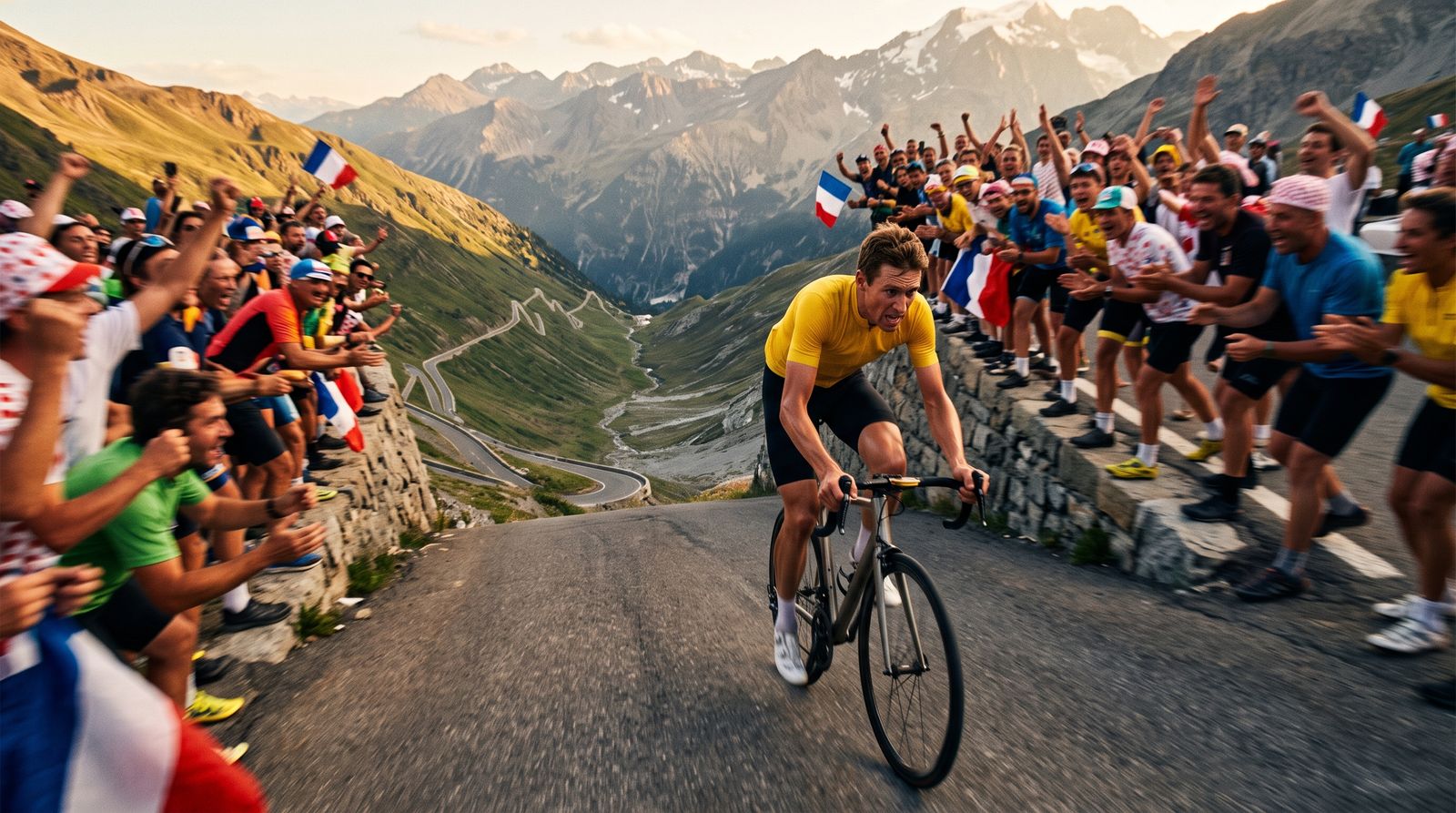
The most famous climb in cycling has a new fastest time. On the 127.9 km stage 19 from Gap to Alpe d’Huez, Pogačar dropped every general-classification rival on the final mountain, then reeled in the last survivors of the day’s breakaway — Lenny Martinez and Richard Carapaz — and rode past them inside the final kilometer to win by six and nine seconds. His time up the Alpe’s 21 hairpins: 35 minutes 27 seconds. Marco Pantani’s 36:50, set in 1995, had outlasted every challenger for 31 years. Pogačar took 83 seconds out of it.
The scale of the gap behind him tells the rest. Remco Evenepoel, the best of the GC group, crossed 2:29 down — and he’s the rider who beat Pogačar twice in this race. The yellow jersey’s overall lead now stretches past seven minutes, in a Tour that lost its only other three-week winner when Jonas Vingegaard crashed out on stage 15. And the record came with an asterisk-free setup: no tailwind-aided descent finish, no drafting games — just a full-gas summit finish through a wall of fans, on a day his UAE team was reportedly managing illness in its ranks. This is also the Tour that produced the fastest road stage ever ridden. The whole sport is moving.
Worth remembering: the last time Pogačar raced up this climb, in 2022, he finished more than three minutes slower than Pantani’s mark. Four years later he beat it while soloing away from the best field in the world. That delta isn’t talent — he already had that. It’s the stack: carbohydrate fueling rates that were considered impossible a decade ago, altitude blocks, aero optimization on every surface, power-data pacing that turns a mythic climb into a math problem, and a rivalry era that forces full commitment. With the win, Pogačar sits at 26 career Tour stage victories — nine short of Mark Cavendish’s all-time record of 35.
Our take: A 31-year-old record didn’t fall because someone finally tried harder. It fell because every boring input — fueling, recovery, equipment, pacing — got a few percent better and the gains compounded. That’s the transferable lesson: your ceiling is mostly a stack of unexamined inputs, not a fixed trait. The second lesson is when he did it: with a seven-minute lead, Pogačar didn’t need this stage. The best operators keep executing when the pressure is off, because standards — not stakes — are what they run on. Coasting is a habit. So is not coasting.
What to watch
- Saturday’s rematch. Stage 20 finishes on Alpe d’Huez again — a back-to-back double on the same summit. A record that stood 31 years might now be the older of two marks set in 48 hours.
- The Cavendish countdown. At 26 stage wins with two chances left before Paris on Sunday, the all-time record of 35 is starting to look like a scheduling question.
- The scrutiny cycle. Any performance that beats an EPO-era benchmark invites forensic debate about watts and physiology. Expect the power-data arguments to run all weekend.