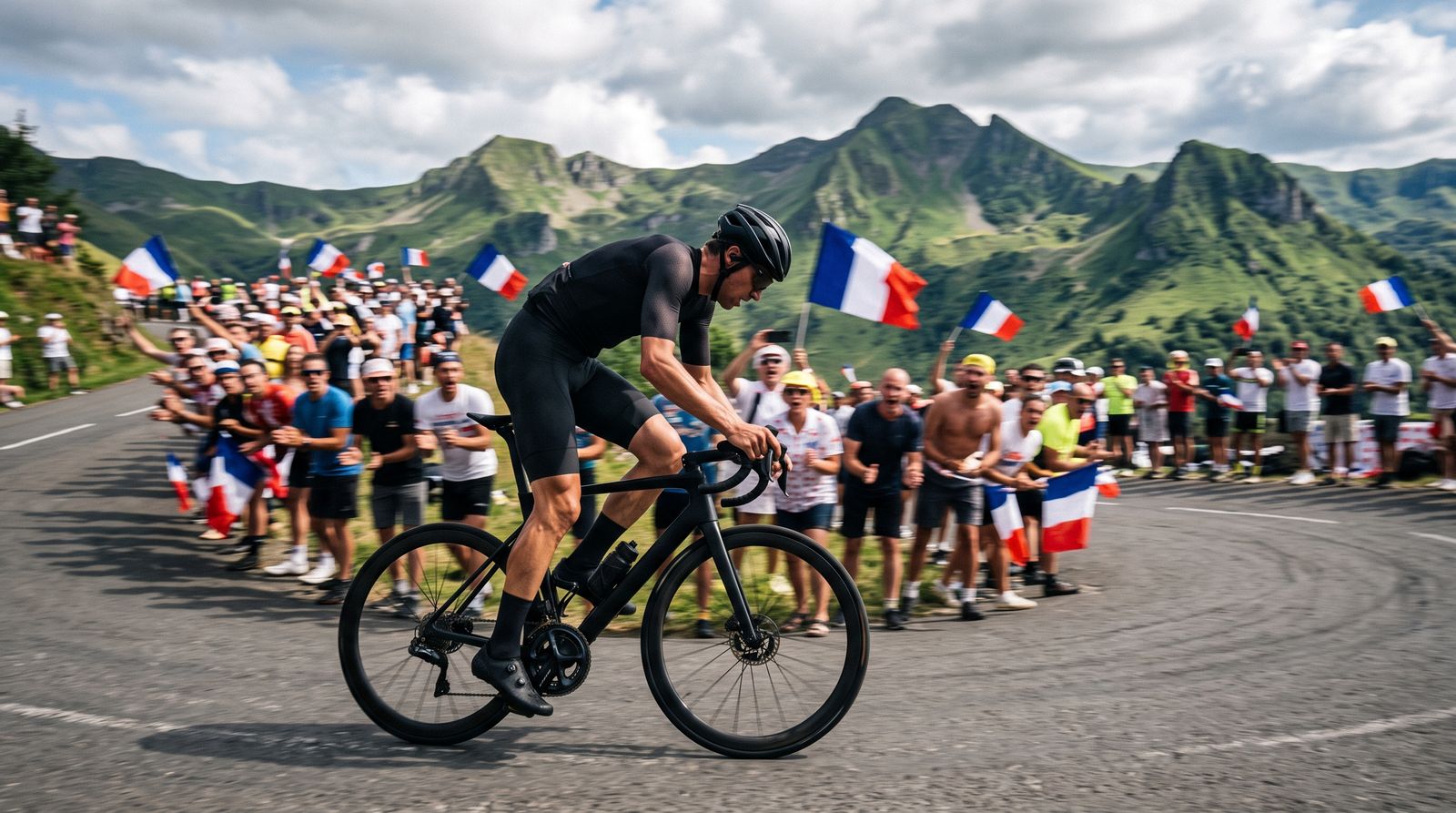
Bastille Day is the one stage the French circle in red every July. Instead, Tuesday’s 166.6km grind through the Cantal in the Massif Central ended the way Tour de France stages keep ending: Tadej Pogacar, alone, arms up at Le Lioran. The four-time champion attacked 15.5km from the finish — a little over a kilometre below the summit of the Col de Pertus — and no one even tried to follow. It was his 24th career Tour stage win, his third of this race, and it pushed his overall lead on Jonas Vingegaard to 3 minutes 36 seconds before the race has reached its hardest mountains.
The mechanics are worth slowing down for. Pogacar launched on the steepest part of the climb, swept past breakaway survivor Richard Carapaz 250 metres before the crest, and went over the top with a 20-second gap on a group that contained every man who matters in this race: Vingegaard, Remco Evenepoel, Paul Seixas, Florian Lipowitz, Juan Ayuso. From there the gap only grew. Evenepoel dug in for second at 32 seconds. Seixas, the 19-year-old French hope, took third two seconds later — the closest thing to a home result the day produced. Vingegaard, the only man to beat Pogacar at a Tour in the last five years, faded on the final drag and rolled in seventh, 44 seconds down.
Strip the bike out and there’s a performance lesson underneath. Pogacar’s signature move is the least mysterious in sport — attack on the steepest slope, late, alone. Rivals have watched it 24 times now, and knowing hasn’t helped, because the move exploits arithmetic rather than surprise: he accelerates at the exact point where everyone is already at threshold. The surge costs him dearly too — but he has budgeted for it, and they haven’t. That’s the same asymmetry behind clutch performance anywhere: the winner isn’t the one who hurts less, it’s the one who planned to spend at the moment everyone else is protecting themselves.
Our take: Dominance looks boring up close — it’s one rehearsed play, executed at the point of maximum mutual pain, over and over. The transferable version: make your move when the whole field is tired — the late-August lull, the ugly market, the end of a quarter — because effort is cheapest, relatively, exactly when everyone else is rationing theirs. And note the other half of the scoreboard: Vingegaard didn’t crack once. He lost 44 seconds here, a handful there. Losing slowly still compounds — 3:36 is what “just hanging on” adds up to.
There’s also a youth story hiding in the result. Seixas beating Lipowitz to third on the sport’s biggest day, at 19, in front of a home crowd, is the kind of pressure exposure that builds champions — the same trajectory we flagged when Wimbledon’s young outsiders ran out of road. And it all happened in a Tour that has already been forced to rewrite its rules around extreme heat — conditions that punish exactly the kind of all-in effort Pogacar keeps producing.
What to watch
- The high mountains. The Tour’s hardest climbing traditionally stacks the final week. A 3:36 cushion before it starts means rivals must gamble early — expect long-range attacks and blown-up GC days.
- The record books. A fifth yellow jersey would tie the all-time mark shared by Anquetil, Merckx, Hinault and Indurain. Every stage win also moves him up the all-time stage list.
- Vingegaard’s response. Forty-four seconds on a medium mountain day is a warning shot. If his team keeps riding defensively, the race for first is functionally over.
- Seixas. France hasn’t won its home Tour since 1985. A teenager trading blows with the podium group is the most interesting French storyline in years.