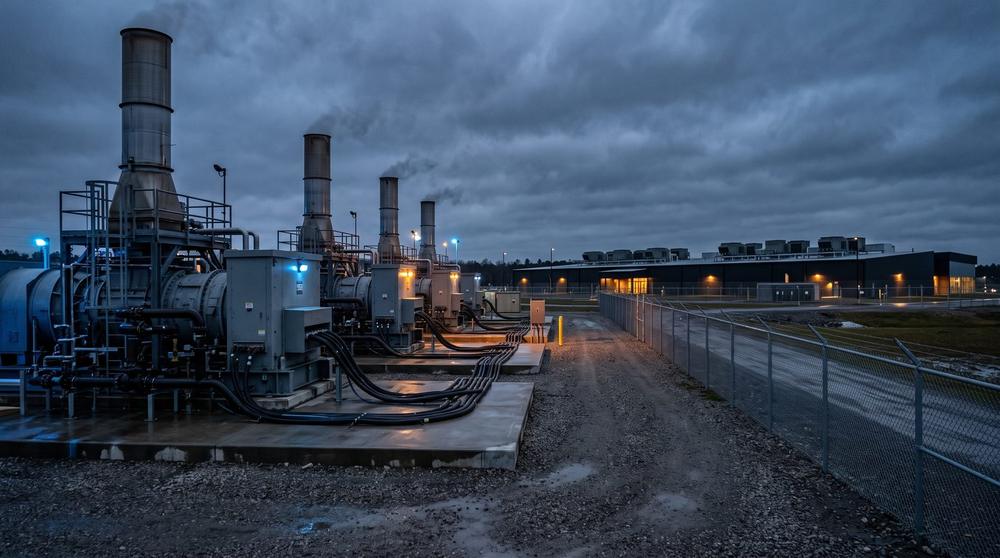
In September 2024, Energy Capital Partners bought a roughly 60% stake in ProEnergy, a Missouri company that overhauls aeroderivative gas turbines and packages them into dispatchable power plants. The price, as later reported, was about $275 million — implying a whole-company value somewhere around $460 million.
Bloomberg reported on September 18 that ECP is now weighing a US listing at a valuation of $40 billion to $50 billion, with Morgan Stanley and JPMorgan working the process. A sale is reportedly also on the table.
Run the arithmetic and the target implies something close to 90 to 110 times the 2024 mark. Two years. Same turbines.
What actually changed
ProEnergy’s core product, the PE6000, is an aeroderivative unit — a jet engine repurposed as a generator — rated at roughly 50MW, enough for about 40,000 homes. Aeroderivatives are not the most efficient way to make electricity. They are the fastest. They ship on trailers, install in months rather than years, and start on demand.
That was an unglamorous niche until the AI build-out ran into two hard walls at once: a multi-year order backlog at the heavy-frame turbine makers, and interconnection queues that make grid power a 2029 problem. In April, ProEnergy agreed to supply Crusoe with 13 PE6000 units for AI data centre projects — roughly 650MW of behind-the-meter capacity that does not wait on a utility.
So the asset was revalued not on what it produces but on when it can produce it. Speed became the scarce input, and ProEnergy happened to own a lot of it.
Our take: A 90x-plus markup in two years is not a story about ProEnergy. It is a price being put on the delivery date. The market has decided that a megawatt available in 2027 is worth a large multiple of the same megawatt available in 2030 — and that spread is now showing up as equity value in anyone holding fast iron. The risk is symmetrical: the premium is entirely a function of the backlog at the people who build the slow kind. Backlogs clear.
The pattern this belongs to
This is the third route the same trade has taken to public markets in two months. Aggreko took the rental path onto the NYSE. Bloom Energy took the fuel-cell path, with a backlog number that its own filings struggled to support. ProEnergy is the refurbishment path. Different machines, identical pitch: we can energise a data hall before the grid can.
What separates them is contract quality. Nscale’s S-1 this week showed how wide the gap can be between a headline backlog and booked revenue. Any ProEnergy filing will get read the same way — and it should be, because a valuation set at 90 times a 2024 control price needs the contracts to be signed, funded and long-dated, not indicative.
What to watch
- The S-1, if it comes. Revenue, backlog, and the split between refurbishment services and whole-plant sales. Those are very different multiples.
- Whether ECP sells instead. A trade sale at $40bn tells you strategics believe the scarcity lasts. A listing tells you the sponsor wants public money to carry that bet.
- Heavy-frame lead times. The entire premium sits on them. Any sign that GE Vernova, Siemens Energy or Mitsubishi are pulling delivery dates forward compresses it.
- Customer concentration. If the order book is mostly two or three AI infrastructure buyers, this is a credit story wearing an equity story’s clothes.
The AI capex cycle keeps producing the same discovery: the bottleneck is never the chips for long. Right now it is a 1960s engine design on a trailer, and someone wants $50 billion for the company that refurbishes them.