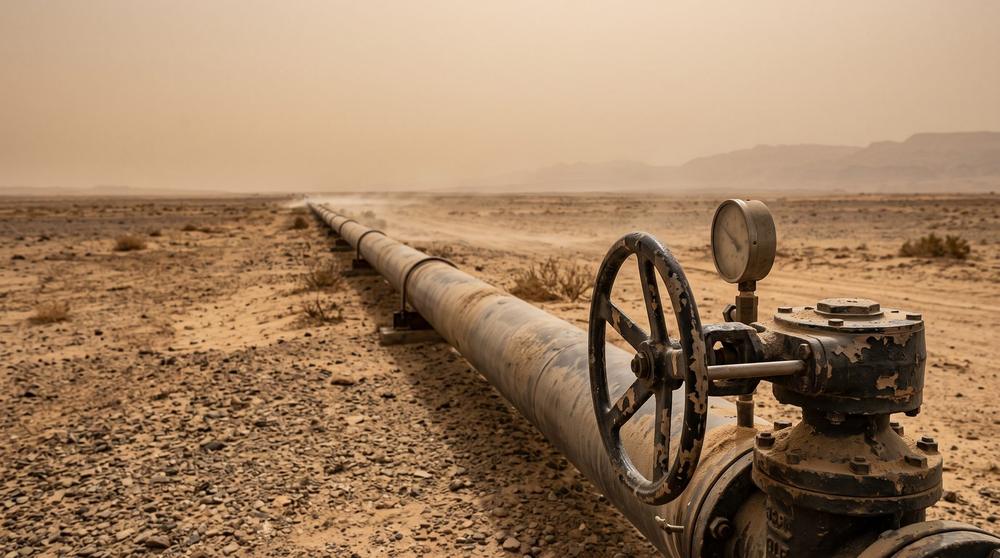
Saudi Arabia suspended its East-West crude pipeline after drone strikes on Thursday, and the market spent the weekend working out what that means. Brent for October and November delivery gained more than 3% to trade above $108 a barrel. WTI for October rose roughly 2.3% to around $102, a four-month high, after a gain of more than 9% last week.
The pipeline matters more than its name suggests. It runs the width of the kingdom, connecting Gulf-side production to Red Sea export terminals, with capacity of up to 7 million barrels a day. For months it has been the mechanism by which Saudi barrels reached buyers without transiting the Strait of Hormuz. It was the workaround. Riyadh has not said how badly it was damaged by the drones — launched, per the reporting, from Iraq — or when it restarts.
So the escape hatch and the front door are now constrained at the same time. Hormuz traffic is already down. The Red Sea alternative is offline for an unspecified period. And Houthi forces have taken positions that bring them close to controlling Bab al-Mandeb, the other end of that same Red Sea route.
Our take: Last week's oil rally was a risk premium on a route that might close. This is a route that has closed. The difference shows up in the shape of the curve, not just the level — when the substitute for the chokepoint is also unavailable, the market stops pricing a disruption scenario and starts pricing an actual barrel shortfall. That is a harder thing for a central bank to look through.
Diplomacy went the wrong way too
The GCC-Iran talks scheduled for Oman, aimed at getting regional supply moving again, were postponed by Tehran. We wrote yesterday that the meeting was the week's real hinge because it was the only forum where the flow could be restored rather than merely re-routed. It has not happened, and no new date has been published. Meanwhile Saudi energy and civilian facilities have absorbed a run of strikes from Iran-aligned groups, with more than 70 people injured in attacks early last week.
Wednesday is the collision
The FOMC announces on 16 September into this. August CPI came in at 3.4% year over year with core at 0.3% month over month, hotter than the 0.2% consensus, and CME FedWatch odds of a 25bp hike ran near 86% after the print. Diesel has since pushed to a fresh all-time high on the crude move — and diesel is the barrel that shows up in freight rates, food prices and every goods-sector input line with a two-month lag.
An energy shock is a supply shock, which is the one kind of inflation a rate rise handles badly: it raises prices and lowers activity at once. The Fed's problem on Wednesday is not whether to hike. It is what to say about a price level being set in the Gulf rather than in the labour market.
What to watch
- Any Saudi statement on repair timelines. Silence on damage is itself information; a stated restart date would take several dollars out of Brent.
- The Brent-WTI spread. It has been widening as the disruption concentrates on waterborne Gulf barrels. Watch whether it keeps going.
- Diesel cracks. The all-time high is the transmission channel into core goods.
- A rescheduled Oman date. Postponed is not cancelled, and Tehran has an interest in the revenue.
- The FOMC statement language on energy. Whether "transitory" makes a return appearance in any form.