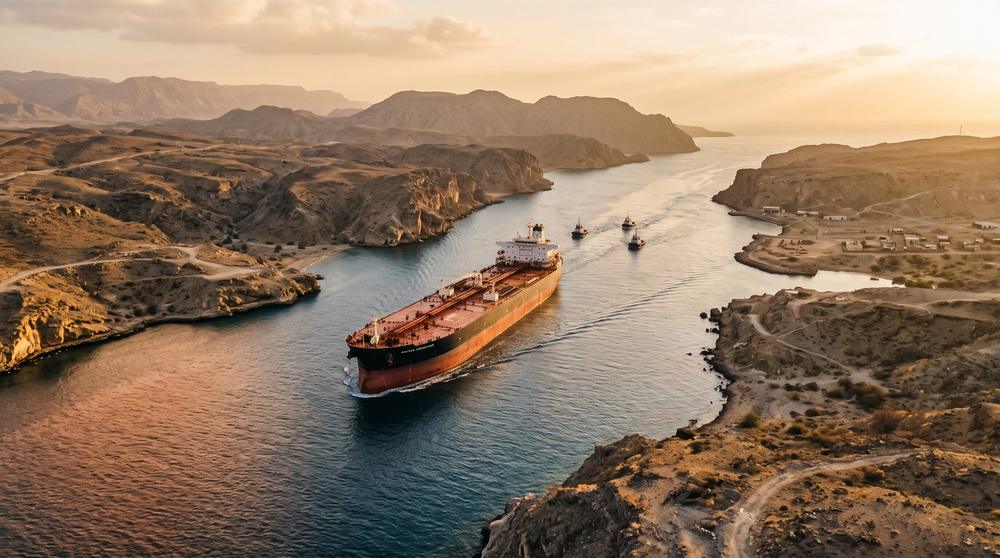
On Monday, Iranian officials meet foreign ministers from the Gulf states and representatives from Iraq in Oman to discuss security and shipping through the Strait of Hormuz. One stated goal is narrow and physical: agree the maps — the actual routes tankers would use. Mine clearance and short-term management of the waterway are also on the agenda. An Iranian official has already said no signed agreement is expected.
The United States will not be at the table. The plan on offer is Omani, negotiated between Tehran and Muscat over several weeks, and the absence of Washington is the feature that makes it plausible to Iran and fragile to everyone else. Shipping through the strait has been disrupted since US–Israeli strikes on Iran began in late February and Tehran retaliated by restricting maritime traffic. Roughly a fifth of the world’s oil supply normally passes through it.
The talks are not happening in calm conditions. A vessel was struck in the strait on Sunday, according to the UK Maritime Trade Operations. Brent rose for a second week, slipping below $105 on Friday but finishing almost 9% higher on the week, with WTI around the $96–100 range. Then, on Wednesday, the Federal Reserve announces its decision.
Our take: This is the most consequential meeting of the week and it will produce no document. Markets are positioned for a route map, not a peace deal — which means the downside surprise is not “talks fail” but “talks succeed and nothing moves.” A corridor agreed on paper still needs mine clearance, war-risk cover and a hull owner willing to test it. Insurers, not diplomats, decide when the strait actually reopens.
Why the Fed is downstream of Oman
The sequencing this week is unusually tight. Monday’s meeting sets the direction of the oil price; the Fed meets Tuesday and Wednesday and announces at 2pm ET on September 16. Market-implied odds of a 25 basis-point hike have run around 85%, having climbed from roughly a third before Chair Warsh said inflation had not meaningfully improved. The September 11 CPI print, which showed inflation stuck rather than falling, did the rest.
That leaves the Fed tightening into a supply shock it cannot influence. A credible Hormuz corridor would pull energy prices down and make the hike look like insurance. A failed meeting, or another struck vessel, pushes crude back toward the highs and makes it look like tightening into a recession. Neither outcome changes Wednesday’s decision at this point — it is effectively priced — but both change the language, and the language is what the bond market trades.
The demand side is already cracking
The supply story has obscured how much damage has been done to consumption. OPEC has cut its 2026 demand-growth forecast for a fifth consecutive time. The International Energy Agency now forecasts a contraction of 2.5 million barrels a day in 2026 — the largest annual decline since the pandemic — attributing it to higher fuel prices and tighter supply.
That combination is the awkward part. Prices above $100 are not signalling a strong economy; they are signalling a blocked chokepoint against demand that is actively shrinking. If the corridor opens, the demand destruction does not reverse on the same schedule as the supply relief. The downside in crude is larger than the headline risk premium suggests.
What to watch
- Whether maps are published. A named, charted route is a real deliverable even without a signature. Vague language about “continued cooperation” is not.
- War-risk premiums. Cover has run as high as a double-digit percentage of hull value, and several P&I clubs have withdrawn. Premiums falling is the only hard evidence that risk has actually dropped.
- Tanker traffic counts, not prices. Transits per day is the clean measure. Crude can fall on sentiment; ships only move when owners are covered.
- The Fed statement’s treatment of energy. Whether the committee frames oil as a transitory supply shock or as an inflation input it must respond to sets the path for the rest of the year.
For anyone with fuel, freight or input-cost exposure, Monday is the date to watch and Wednesday is the date that gets the coverage. Nothing about a route map removes the need to hedge; it only changes the price at which hedging is available. The gap between those two things is where the week’s risk sits.
The Sharp Brief reports on markets and does not provide investment advice. Nothing here is a recommendation to buy or sell any security or commodity.