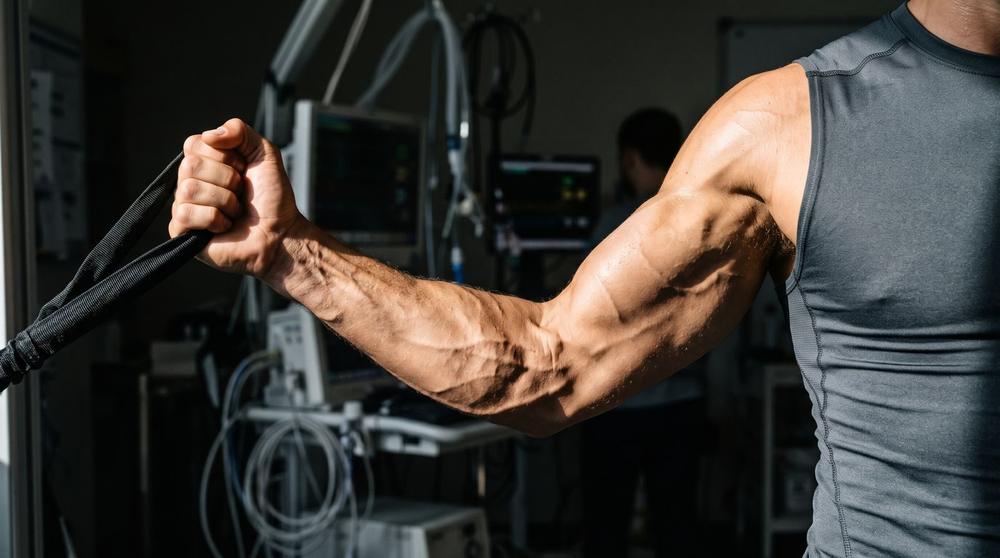
The protocol is simple enough to picture. Thirty-five healthy male college students who train with weights regularly came in twice, at least three days apart. Once after a normal night — more than seven hours, confirmed with a sleep monitor. Once after being kept awake until 3am and woken at 7am, leaving them under four hours.
Each time they sat against a wall with the right elbow at 90 degrees, an elastic band at the wrist loaded to 30% of their maximum bicep strength, and held the position until they could not hold it any longer. Resting EEG was recorded beforehand. EMG tracked the muscle throughout.
Short sleep made them fail sooner. The EMG said the muscle was not the reason: the rate of peripheral fatigue showed no statistically significant difference between the two conditions. Whatever ended the hold was upstream of the bicep.
Our take: This is the useful kind of small study. It does not tell you sleep matters — you knew that. It tells you where the loss lands. Peripheral capacity was intact and the hold still ended early, which means what a short night takes from a session is tolerance rather than strength. Practically: after a bad night, expect your working sets to feel roughly normal and your last reps to arrive sooner, and treat time-to-failure that day as a corrupted measurement rather than a verdict on your training. Thirty-five young men on one static contraction is a narrow base. Read it as a mechanism, not a prescription.
What the EEG showed
At rest after sleep restriction, connectivity went up rather than down: stronger links across several regions in the theta, beta and gamma bands, with the central executive network reaching out to the rest of the brain. The researchers read that as compensation — a tired brain spending more to stay alert.
During the contraction, the picture inverted. Connectivity was weaker than in the rested condition across theta, alpha and beta, and the links between the sensorimotor network and the default mode and salience networks fell away.
The oddest finding is a reversal. Rested, a weaker sensorimotor-to-default-mode connection went with longer holds. Sleep-restricted, the relationship flipped, and stronger connectivity went with longer holds. The authors’ reading is that a sleep-deprived brain loses the top-down control that normally suppresses the default mode network during effort, and recruits it instead.
Why this is a brain result and not a muscle result
An isometric hold to failure is a tolerance task. The load never changes, the joint angle never changes, and the only variable is how long the nervous system keeps issuing the command. That design is why the EMG null matters: if peripheral fatigue accumulated at the same rate in both conditions and the holds still differed, the decision to stop moved.
It also explains why the effect is easy to misread in a gym. Nothing about a short night announces itself in the first few reps of a set. It shows up at the end, as an earlier arrival of the point where continuing stops feeling possible — which is precisely the signal most lifters use to judge whether a session went well.
The limits, stated plainly
- Thirty-five young, healthy, trained men. Nothing here transfers automatically to women, older adults or clinical populations.
- One acute night of restriction, not chronic short sleep. They are not the same exposure.
- One static contraction at one intensity. No running, no dynamic lifting, no repeated sets.
- Motivation and mood were not measured — a real gap in a task that ends when a person decides they are done.
The paper, “Changes in athletes’ brain network connections during isometric muscle contractions after sleep restriction,” is published in the International Journal of Psychophysiology by Chengcheng Zhu, Ting Peng, Jing Song, Aiping Chi, Xin Wei and Puyan Chi.