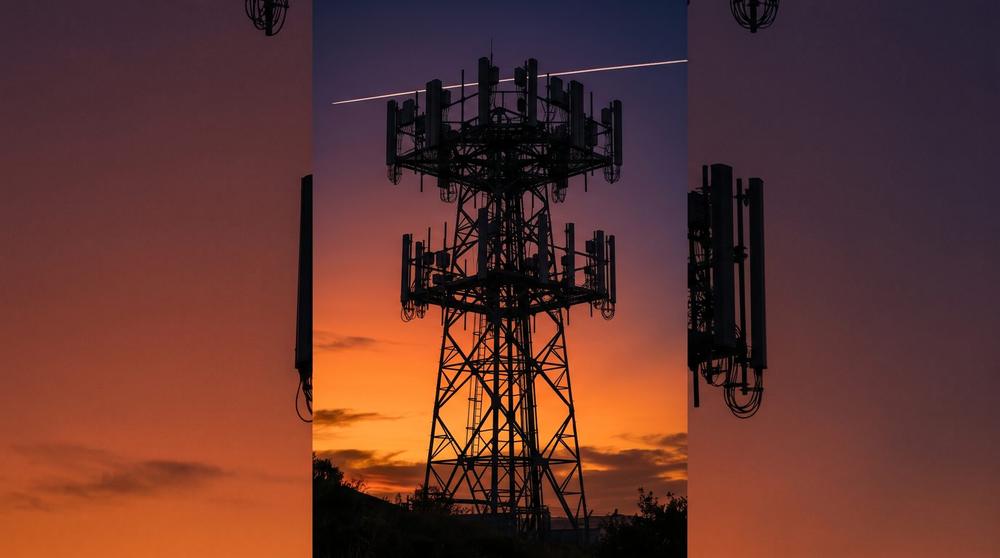
Bloomberg reported on Thursday that SpaceX is in talks to secure access to at least 80,000 cell sites across the United States, with Crown Castle among the companies in discussions, and that the deals could be worth billions of dollars.
The market read it instantly. Crown Castle rose 9.46% in Thursday after-hours trading to $86.29, having closed the regular session at $78.83. Verizon fell 3.74% after hours. AT&T and T-Mobile also fell in late trading. By Friday morning Crown Castle was still up around 9.8%.
Asked on Wednesday’s third-quarter earnings call about talks with both SpaceX and Amazon, Crown Castle’s chief executive said, “You can assume that we’re talking to all parties,” and declined to discuss customers.
The arithmetic is the story
Crown Castle owns roughly 40,000 towers. SpaceX reportedly wants access to at least 80,000 sites. One of those numbers is half the other, which means this is not a deal with a landlord — it is a build-out that needs most of the American tower industry to say yes, Crown Castle plus American Tower plus the rooftop and small-cell operators underneath them.
It also tells you what kind of company SpaceX is trying to become. Satellite direct-to-cell is a coverage product: it fills gaps where terrestrial networks do not reach, and it is sold through partnerships with the carriers who do. Leasing 80,000 macro sites is the opposite posture. That is the capital structure of a fourth national carrier, competing in cities where satellite physics does not help you, against three incumbents with decades of spectrum depth.
Which is where the plan gets harder. Most of SpaceX’s current terrestrial spectrum traces back to Dish’s holdings, topped up recently via a low-band arrangement with T-Mobile. That is enough for a coverage layer. It is not enough for dense urban capacity, and the realistic route to more — higher-frequency auctions — needs far more cell sites again, not fewer. The 80,000 figure may be the floor rather than the ask.
For the tower companies this is the best news in years. Their business model is one steel structure with multiple tenants, and tenant number four has not existed in the US since Dish’s network stalled — a failure that hurt Crown Castle directly. A well-funded new tenant signing long leases across an existing footprint is almost pure incremental margin. That is why the tower stock went up roughly as much as the carriers went down.
Our take: Treat the share moves as a verdict on credibility, not on the deal. Nothing has been signed and the only on-record comment is a chief executive saying he talks to everybody. What moved Verizon 3.7% is that the market now believes SpaceX could actually fund this — and it has reason to. SpaceX reported a $4.4bn third-quarter profit and guided fourth-quarter capital expenditure to $35–40bn, against $19.6bn a quarter earlier. A company spending at that rate can lease 80,000 sites without blinking. The question for the incumbents is not whether a fourth carrier is technically possible. It is what happens to postpaid pricing when the new entrant treats connectivity as a distribution channel for something else rather than as the profit centre.
What to watch
- A signed master lease agreement. Tower deals are disclosed in site counts and escalators. The first real one sets the price for everyone behind it.
- American Tower’s commentary. Crown Castle’s 40,000 towers cannot reach 80,000 sites alone. The second landlord confirming talks turns a report into an industry event.
- The T-Mobile satellite partnership. SpaceX supplying direct-to-cell to a carrier it intends to compete with is not a stable arrangement for long.
- Spectrum. Watch for SpaceX positioning ahead of higher-frequency auctions. Urban capacity is the part of this plan that money alone does not solve.
One detail for the operators: 80,000 sites is roughly the scale of a national network, not a supplementary layer. If SpaceX gets even half of them under lease, the incumbents’ cost advantage in tower economics — built over twenty years of consolidation — stops being a moat.