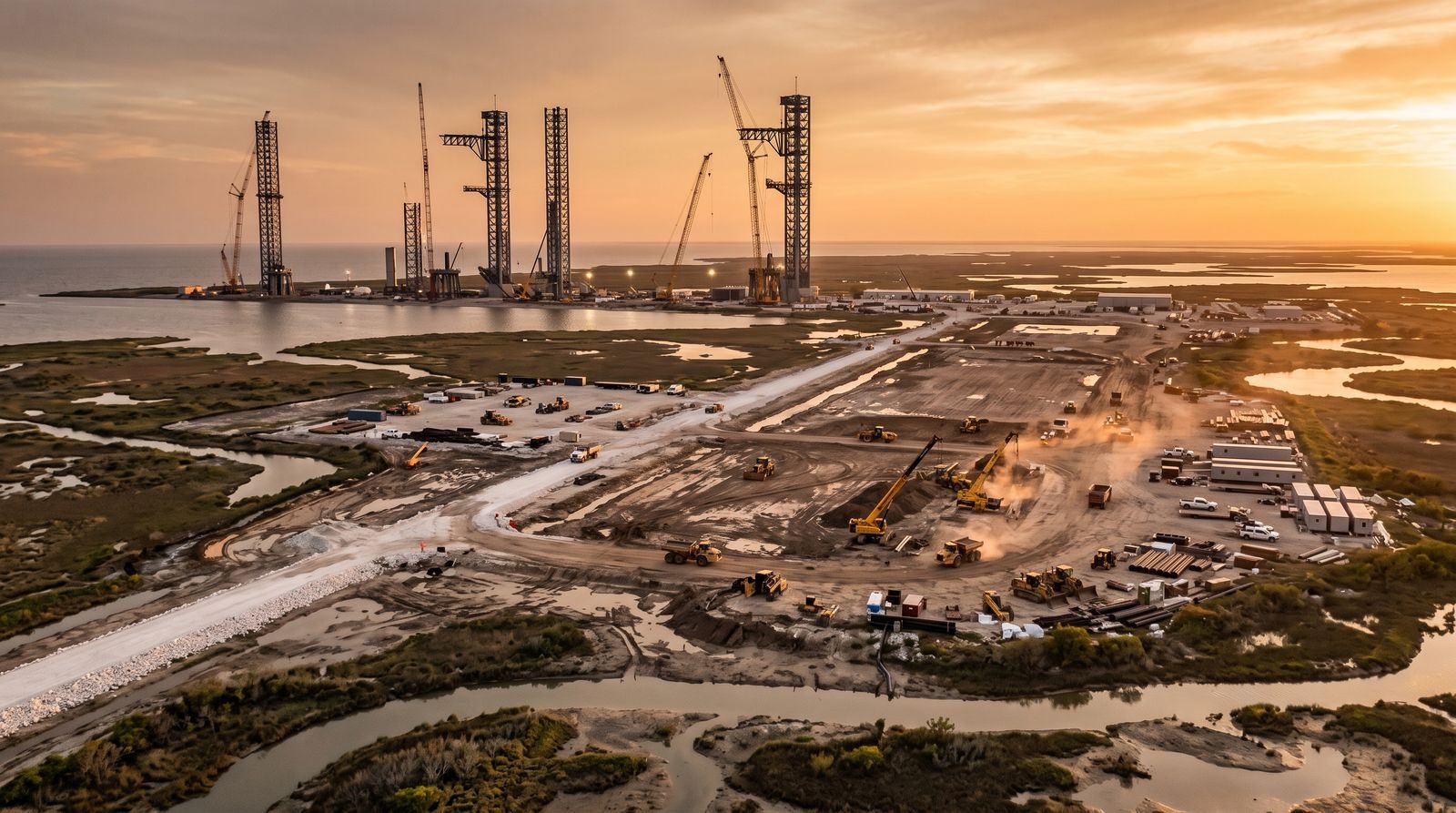
SpaceX announced Tuesday it will spend $100 billion building “Starbase, Louisiana” — a launch campus in coastal Vermilion Parish that the company is billing as the biggest launch site on Earth. Governor Jeff Landry made the announcement alongside the company, and Louisiana’s economic development agency published the fine print within hours.
The full buildout calls for five launch complexes, each with two pads and its own propellant farm, plus on-site propellant production, power generation, vehicle processing, and housing for employees and their families. Construction is slated to begin in 2027, with a first launch targeted for as early as 2029. Elon Musk went further: the site will “ultimately have over a dozen launch towers, enabling more than 30 Starship flights per day.” The stock liked it — SpaceX shares rose about 2.5% on the news, a familiar pattern since the company’s first earnings report showed $18.4 billion in annual capex and the market decided to price ambition as an asset.
The location is the tell. SpaceX’s Texas Starbase is boxed in by beach-closure limits, lawsuits, and geography. A second Gulf site — with water access for barging boosters and a state government actively courting the company — is how you get from a test program to something resembling an airline schedule. Flight 13 showed the hardware maturing; the pads are now the bottleneck.
The job math
Louisiana Economic Development’s own release says the project will create 3,000 direct jobs over ten years at an average salary of $92,600 — 192% above the Vermilion Parish average wage — plus an estimated 8,100 indirect jobs, for roughly 11,100 total. Musk, in the announcement video, said the spaceport would bring “probably 10,000 really exciting jobs.” Those two numbers aren’t the same claim: one is what the state will hold the company to in an incentive agreement; the other is a founder rounding up. When the incentive package reaches the legislature, the 3,000 figure is the one with teeth.
Our take: The $100 billion is the story, not the towers. Starship’s economics only close at airline-like cadence — and cadence is a real-estate problem, not a rocket problem. SpaceX is now applying hyperscaler-style capex to launch infrastructure, which no competitor — national or private — can match without a decade of lead time. The caveat: announcements aren’t appropriations. This site sits on wetlands, and the environmental permitting fight will start long before the first piling does. 2029 is the optimistic case.
What to watch
- The incentive package details — what Louisiana gives, and what claws back if the 3,000-job target slips.
- Environmental permitting on coastal wetlands, the likeliest source of schedule risk.
- Whether Texas Starbase hits its launch-cadence ceiling before Louisiana comes online.
- SpaceX’s next earnings: how $100 billion phases into capex guidance that was already the biggest line on the sheet.