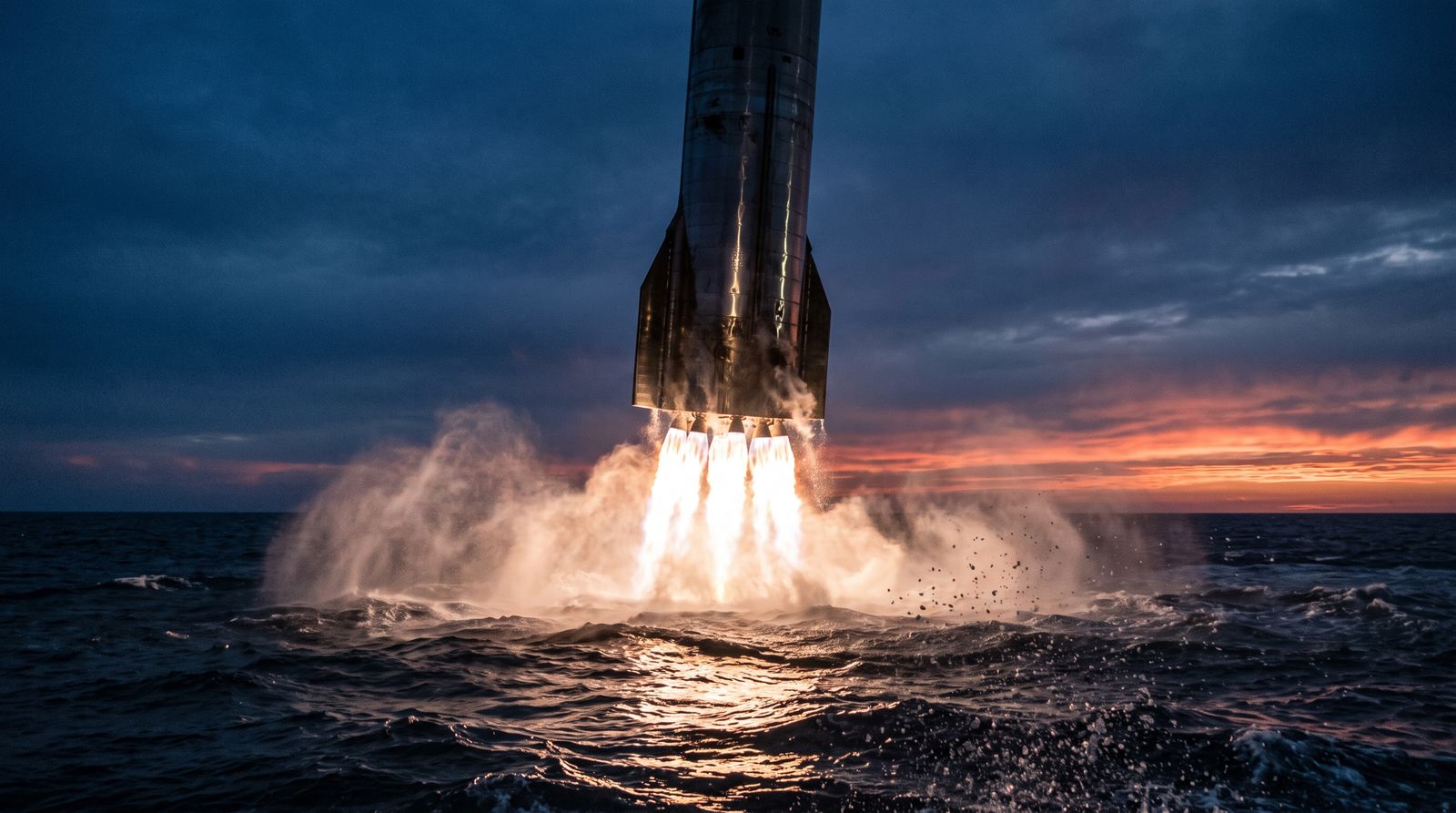
Starship Flight 13 finally flew Friday evening, eight days after four Raptor engines refused to light and the computer aborted the launch on the pad. This time all 33 lit. The stack cleared Starbase at 5:51 p.m. Central, completed its full ascent burn, and released all 20 Starlink V3 satellites roughly 124 miles up — the first flight-hardware payload Starship has ever carried, and the first orbit-bound version of the antenna that generates most of SpaceX’s money. Engineers reached every one of the 20 by radio and laser link before the batch reentered as planned. Six carried cameras pointed at the ship’s heat shield.
Then the ship came home better than it ever has. It reentered, flipped, lit its landing burn and settled into the Indian Ocean without exploding — the softest Starship splashdown on record, intact enough to float and keep transmitting telemetry after it was down. Elon Musk said on X that unless the data review turns up problems, SpaceX will try to catch the ship with the launch tower on Flight 14. No one has ever recovered an orbital-class upper stage that way.
The Super Heavy booster is the part that didn’t work. All 33 engines performed on ascent, but too few relit for the landing burn and the booster hit the Gulf at speed. That is two consecutive flights where the booster failed to complete its return — the May mission ended the same way. Neither loss touched the mission objectives. Both hit the thesis, because a booster that can’t be caught is a booster that has to be rebuilt.
Our take: Friday split Starship cleanly into its two business cases and graded them differently. The revenue case — get V3 satellites up cheaply, in bulk, to keep the segment that was about 61% of 2025 revenue and $11.4 billion compounding — got its best proof yet. The cost case, which is the entire reason Starship exists rather than a bigger Falcon, is now 0-for-2 on booster recovery, and a $114 stock is not paying for expendable heavy lift. Note the timing: the launch happened roughly three hours after the closing bell on a day SPCX finished at $114.25, about 15% under its $135 IPO price and roughly half the $225.64 it printed on June 16. Nothing about this flight has been priced. Monday morning is the first real read on whether public shareholders grade SpaceX on satellites delivered or on hardware recovered.
What to watch
- Monday’s open. The first tradeable reaction to a mostly successful flight, from a stock coming off a break of its IPO price and a run of red sessions. A muted pop would say the market has already moved on to the booster.
- The Flight 14 catch attempt. Musk conditioned it on the data review. Land it and the reusability story restarts; slip it and the gap between test cadence and revenue cadence widens again.
- Booster root cause. Two failed return burns in a row is a pattern, not a data point. Watch whether SpaceX names a cause or just flies the next one.
- V3 in service. Deployment is not deployment revenue. The number that matters is when V3 capacity reaches the 10.3 million active Starlink customers — and what that does to the incumbents already bleeding broadband subscribers to it.
- $135. Still overhead. Until SPCX takes it back, every rally is somebody’s exit.