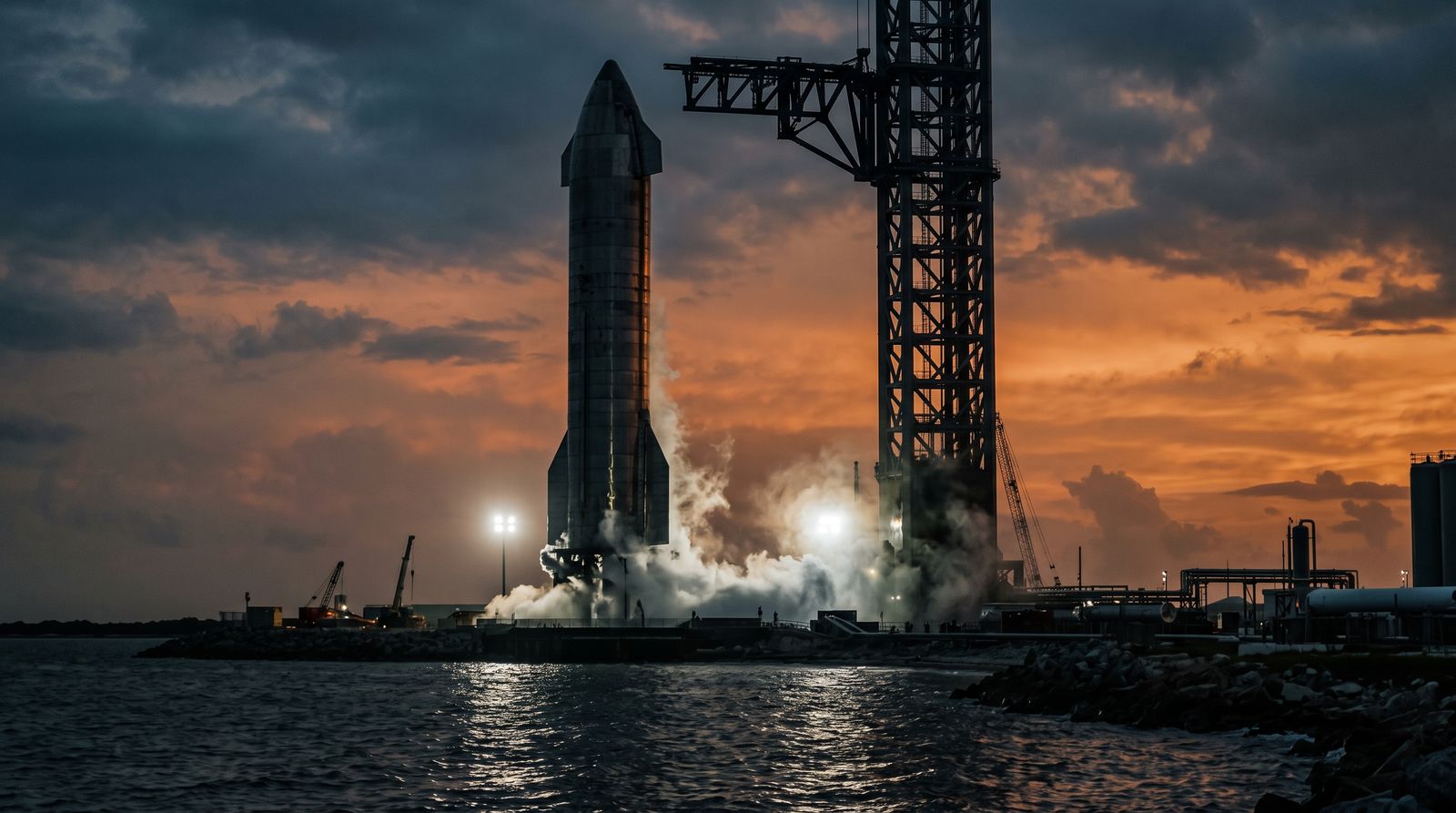
The countdown reached ignition at Starbase on Thursday evening — and then nothing left the ground. Four of the Super Heavy booster’s 33 Raptor engines failed to start, telemetry showed, and the automated system killed the launch moments before liftoff. The rest of the engines shut down, the vehicle stayed clamped to the pad, and Starship Flight 13 became a scrub instead of a spectacle.
Elon Musk confirmed the sequence on X: “Some of the engines didn’t start, triggering an automatic launch abort.” Two Raptors will be pulled and replaced, he said, with the next attempt likely early next week — SpaceX is targeting a window around July 20. The stakes are bigger than a routine test: Flight 13 is slated to carry the first batch of Starlink V3 satellites, the higher-bandwidth hardware that underpins the constellation’s next revenue leg.
Markets did not treat it as routine. SpaceX shares slid more than 3% Thursday to close at $131.11, then fell roughly 4% further on Friday — dropping below $130 to fresh post-IPO lows and pacing a sixth consecutive losing session. The stock broke its $135 IPO price on Wednesday, and it now sits roughly 45% below the $225 peak it touched just over a month ago. The tape offered no shelter either: the abort landed in the middle of the worst week for chip and AI stocks since the April 2025 tariff meltdown, with Netflix down 9% on soft guidance the same day.
Our take: the abort was the system working. Four engines refused to light, the computer caught it, and SpaceX kept a full stack it would otherwise have lost — as an engineering outcome, that beats a fireball every time. The problem is that SPCX shareholders aren’t grading engineering; they’re grading cadence. As a private company, a scrub cost SpaceX a news cycle. As a public one, it costs a ticker print, and six straight red days say the market is repricing how long the Starship-to-revenue story takes. The number that actually matters isn’t Friday’s close — it’s when Starlink V3 hardware reaches orbit, because that’s the product the valuation is borrowing against.
What to watch
- The retry window around July 20. A clean flight next week turns this into a footnote. Another engine-related scrub makes Raptor reliability the story of the summer.
- The Raptor swap. Two engines out, two in, on a booster that needs 33 to cooperate. Watch whether SpaceX discloses a root cause or just flies.
- $135. The IPO price is now overhead resistance. The longer SPCX trades below it, the more trapped buyers become sellers into every bounce.
- Starlink V3 deployment. First new-generation satellites on orbit would hand the bulls their proof point — and Big Telecom another headache.