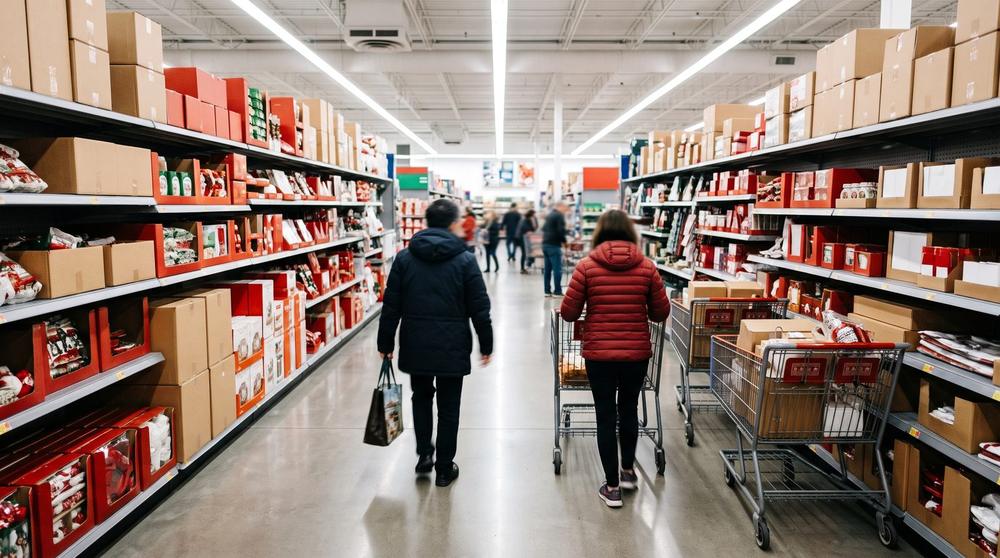
Target reported its strongest sales growth in five years on Wednesday morning: net sales of $27.07 billion against $25.27 billion a year ago, up 7.1%. Comparable sales rose 5.6% after falling 2.7% in the same quarter last year. Comparable traffic — the number that is hardest to manufacture — rose 5.0%. Digital comps rose 9.8%, store comps 4.6%.
Earnings came in at $2.65 a share on both a GAAP and an adjusted basis, against a consensus near $2.07 to $2.08. The company raised its full-year outlook. The stock did not cooperate.
The reason is on the second page of the release. Of that $2.65, fifty cents is a one-time tariff refund: $301 million pretax, recorded as a reduction of cost of sales, $228 million after tax. Strip it out and the quarter earned about $2.15 — still up roughly 21% on an adjusted basis, still a beat, but a beat of about 4% rather than 28%.
The guidance raise is roughly the size of the refunds
Target lifted full-year EPS guidance to $10.65–$11.40 from $9.90–$10.90, and nudged its sales-growth plan up a point to around 6%. The new EPS range includes about $2.14 of tariff refunds recognised so far this year, and explicitly excludes any future refunds.
That is the arithmetic worth holding onto. Roughly a fifth of the guided full-year earnings number is a customs reimbursement, not retail. It is real cash and it is Target’s money, but it does not recur on a schedule anyone can plan against, and the company has pointedly declined to estimate what else might come back.
The margin line carries the same fingerprint. Gross margin reached 30.5% from 28.2%, but roughly 1.1 points of the improvement is the refund. Operating margin of 6.2% against 3.8% looks like a transformation; the underlying move is smaller and slower.
What is genuinely working
Traffic. CEO Michael Fiddelke said the growth came from footfall rather than one hot category, and the mix supports him: average transaction amount rose only 0.6%, so this is more visits, not bigger baskets or higher prices. Target has cut prices on nearly 2,000 more items. Non-merchandise revenue, which includes its advertising business, grew nearly 20%. November sales to date are in line with guidance and have accelerated from October.
Two soft spots are on the record from the company: apparel and home goods. And inventory finished the quarter at $16.1 billion against $14.9 billion a year ago, up 8% on sales growth of 7.1% — close enough to call matched, but a figure to re-read in January.
Our take: This is a genuine operating recovery wearing a one-time windfall as a jacket. Traffic up 5.0% with flat ticket after a year of declines is the real signal, and it is the hardest kind of retail improvement to fake. But the headline EPS beat is mostly refund, the headline guidance raise is mostly refund, and a stock up more than 80% over twelve months had already been paid for the recovery. The market subtracted the fifty cents and found a quarter that was good rather than spectacular. That is the correct subtraction.
What to watch
- Q4 EPS excluding refunds. The guide bundles them in. The clean number is the one that tells you whether price cuts are buying traffic profitably.
- Whether the price investment holds margin. Nearly 2,000 more items cut is a durable cost; refunds are not.
- Apparel and home. Management named them. Discretionary categories are where a traffic recovery either converts or stalls.
- 2027 capex of $5–$6 billion, up from about $5 billion this year — and January inventory against January sales.