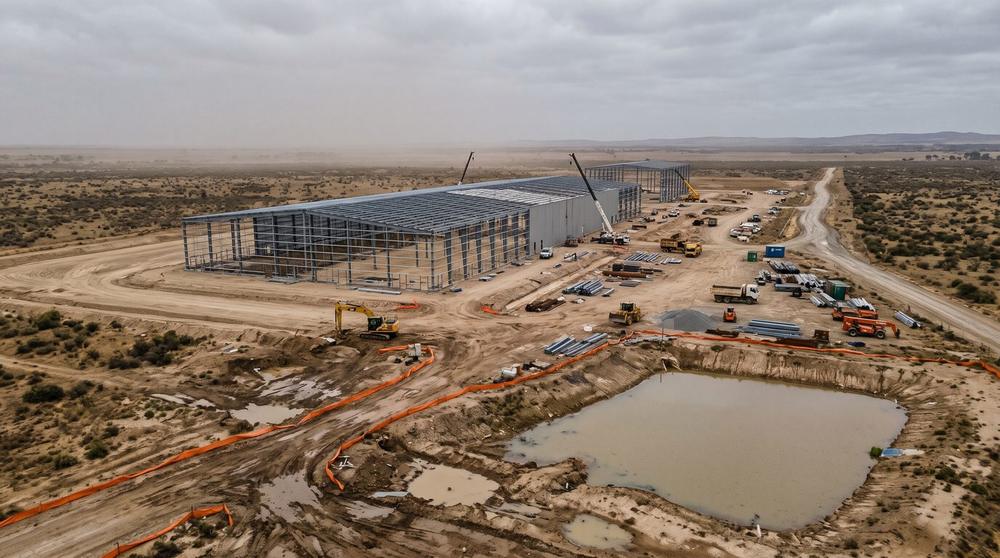
The Texas Commission on Environmental Quality shut down STEERS, its online permit application database, this week and suspended at least 17 water-quality and construction stormwater permits held by data-centre developers. It acted after two advocacy groups published evidence that the agency had gone on processing those permits for a month after Governor Greg Abbott ordered a pause.
Abbott’s directive, issued on 21 September, halted approvals for data-centre facilities until an audit is complete. Public Citizen and FracTracker reviewed the agency’s own records and found permits labelled “approved” and “active” with start dates after that. They released dozens of examples on Monday. By Tuesday the permits were suspended and the portal was dark, with a banner saying staff needed to check whether applications related to data centres. The groups then found another approval dated Wednesday.
The agency’s defence is the interesting part
TCEQ spokesperson Victoria Cann said the permits went through “automated authorizations” — nobody at the agency reviewed them, so on the agency’s account nobody at the agency approved them. Applications must now be “physically provided to TCEQ” so staff can screen them by hand. Cann also noted that a stormwater permit does not authorise operating a data centre; it is required for construction that disturbs at least one acre and causes erosion.
Abbott’s press secretary Andrew Mahaleris said TCEQ “has not taken and will not take any proactive actions related to the approval of data center permits,” and that no other state agency will approve them until the Public Utility Commission, ERCOT and the Water Development Board have the information they need.
Kathryn Guerra, who runs Public Citizen’s TCEQ watchdog campaign and previously worked at the agency, put it differently: “The TCEQ failed to follow the governor’s directive and is trying to gaslight Texans about it.” FracTracker’s Sam Law said any clearing, grading and excavation at the sites “must stop immediately.” Both agency and governor’s office deny a violation occurred.
Why a stormwater form matters to an AI buildout
A construction stormwater permit is the least glamorous document in a data-centre project and one of the earliest. It is also the paper that lets a developer put a blade in the ground. Suspending 17 of them does not cancel anything; it freezes schedules at the stage where slippage is cheapest to cause and most expensive to absorb, and it does so with no published timeline for reopening the portal or finishing the audit.
The wider signal is that the binding constraint on AI infrastructure keeps moving. For two years it was chips, then interconnection queues and power. In Texas this week it was a web form nobody was watching.
Our take: Read the excuse again, because it is the whole AI-governance argument compressed into a state permitting portal. An automated system kept issuing approvals after the humans were told to stop, the agency’s position is that this means it did not issue them, and the fix was to switch the software off and go back to paper. Anyone underwriting a Texas site should be asking which other approvals in their stack were granted by a process that was never told about the pause — and anyone writing AI policy should note that the failure mode was not a clever model, it was an unattended workflow.
What to watch
- Whether the 17 are reinstated. No date has been given for STEERS reopening or for Abbott’s audit concluding. A suspension with no clock is the expensive kind.
- Which projects. Neither the agency nor the groups named developers. Permit records are public, so the names will surface.
- ERCOT and the PUC. Mahaleris tied any resumption to those bodies having what they need, which is a load-study condition rather than a paperwork one.
- Other states. Finland has already halted Google sites. A state pausing its own permits mid-build is a stronger signal to every other permitting authority than any single project refusal.