Seagate and Western Digital were two of the worst performers in the S&P 500 on Friday. Seagate closed down about 10%, with intraday reads as deep as 14%; Western Digital closed down about 10% on a similar spread. Between them they shed tens of billions of dollars of market value.
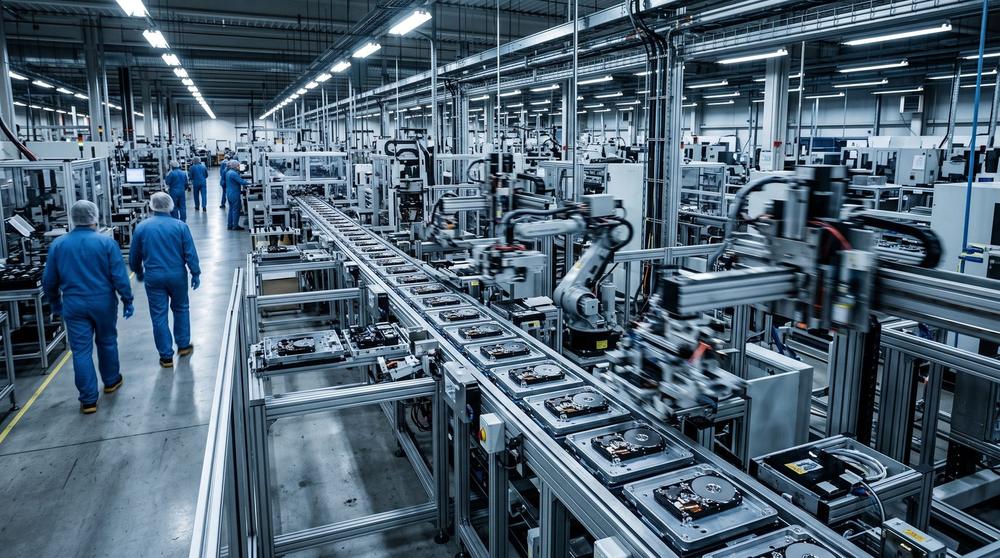
Nothing happened to either company. The catalyst was a Nikkei report that Toshiba intends to roughly double its hard-disk-drive output for AI data centres, backed by about 60 billion yen — roughly $380 million — of expansion at its facility in the Philippines, targeted for completion by fiscal 2027. Toshiba has not publicly confirmed the plan.
The ambition inside the report is what did the damage. Toshiba currently holds a little over 10% of the market measured by storage capacity shipped. The reported target is 30%. Alongside the volume, the plan points at drives with up to 40% more capacity per unit, with 65-terabyte and eventually 100-terabyte products in view.
Why a third-place supplier moves the first two this much
Because the trade was never about demand. Seagate is up more than 228% year to date and Western Digital close to 150%, and that re-rating did not come from a forecast that AI would need storage — everyone agreed on that in January. It came from the belief that nearline HDD supply would stay structurally tight, letting a three-player oligopoly price capacity rather than compete for it. Seagate said in January that its 2026 nearline capacity was already sold out. Sold out is a pricing position.
A supply-discipline thesis has exactly one failure mode, and it is a competitor who decides to break discipline. Toshiba is the smallest of the three and therefore the one with the most to gain and least to lose from expanding. A credible report that it intends to triple its share is a direct attack on the premise the other two are valued on.
The counterargument is the arithmetic. $380 million is modest against the capital intensity of this industry, fiscal 2027 is a long way from today’s sold-out order books, and capacity announced is not capacity qualified — hyperscalers run long validation cycles before a new drive enters a fleet. Several analysts called Friday’s move overdone. S&P Global raised Western Digital’s outlook to positive on 25 September, projecting fiscal 2027 revenue growth near 44%, while flagging exactly this risk: it would revisit the call if weaker AI or IT spending combined with new supply to produce an HDD glut.
Our take: Friday was a stress test of a thesis, not a change in a business, and it revealed how thin the thesis is. If a 10%-share supplier’s unconfirmed plan for a $380m plant expansion three years out can take 10% off your stock in a session, you do not own a company with pricing power — you own a bet that nobody defects. That bet can be right for several more quarters and still be a bet. The interesting question is not whether the selloff was overdone. It is why a sector trading at these multiples had so little margin for a single wire report.
What to watch
- Confirmation from Toshiba. Until the company speaks, this is a Nikkei report, and the market has already priced it as fact.
- Nearline contract pricing into 2027. Long-term agreements signed in the next two quarters will show whether buyers believe new supply is coming.
- Qualification timelines, not plant timelines. The date that matters is when a Toshiba drive is approved into a hyperscaler fleet, not when the Philippine line finishes.
- Whether Seagate or Western Digital respond with capacity of their own. That would confirm the discipline is over, and it is the single worst outcome for both.