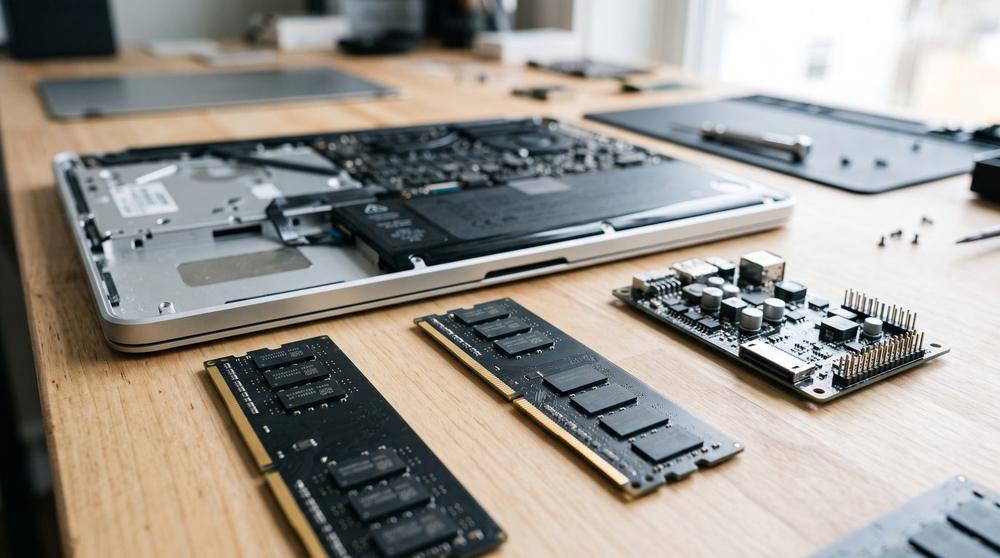
HP told investors on Monday that it expects global PC unit volumes to shrink by mid-single digits in calendar 2027 against 2026, and gave a number for why: memory now accounts for about 35% of the bill of materials for building a PC, up from somewhere between 15% and 18% a quarter earlier. The shares fell 4.75% in premarket trade.
The company was careful about what it was and was not saying. It is still inside its fiscal 2027 planning period and declined to give financial guidance for the year, saying it would detail cost-mitigation work alongside fiscal Q4 earnings. What it did commit to was the direction: component shortages and memory pricing are squeezing volumes, pricing and Personal Systems profitability at the same time.
A cost line that doubled in ninety days
Take the 35% figure seriously for a moment, because it is unusual. Bill-of-materials shares move slowly. A single component category going from roughly a sixth of build cost to more than a third in one quarter is not a supply wobble; it is a repricing of the input. And it is happening to a component that a consumer PC cannot substitute away from, cannot redesign around inside a product cycle, and cannot buy less of — because every AI feature shipped into the operating system in the last eighteen months raised the minimum memory configuration rather than lowering it.
The cause is not mysterious. HBM and server DRAM for AI infrastructure are consuming fab capacity and output that previously served consumer devices, and the capacity is being allocated to whoever pays most. That is hyperscalers. A PC maker competing for wafers against an AI datacentre operator loses that auction every time.
Our take: This is the first genuinely clean read-through of AI capex into ordinary household costs, and it should reframe how the buildout gets discussed. Every argument about whether AI spending is a bubble has been conducted in the language of depreciation schedules and datacentre contracts — abstract, distant, argued between analysts. HP just put it in a form anyone can check: the laptop costs more, or it gets worse, or both, and it happens next year. Apple reached the same place two weeks ago with the iPhone 18 Pro’s $1,199 starting price. Two of the largest consumer hardware franchises on earth have now independently pointed at the same input cost. That is no longer a company-specific supply issue. It is a transfer of the AI buildout’s cost onto the consumer device market, and it is showing up in guidance rather than in speculation.
The three levers, and why none of them is good
A hardware business facing a doubled input cost has three moves, and HP will need some blend of all of them.
- Raise prices. Clean for margin, brutal for volume — and mid-single-digit volume decline is already the base case before any price action.
- Cut configurations. Ship less memory at the same price. Protects the P&L, degrades the product, and runs directly against every AI feature the same machines are being marketed on.
- Absorb it. Protects share and the roadmap, and comes straight out of Personal Systems operating margin — which is the segment investors already watch most closely.
There is a fourth option that only exists on a multi-year horizon: more memory capacity comes online and the auction stops being lost. That is real — Chinese and Korean capacity is expanding and new US fab discussions are live — but none of it helps a 2027 build plan being locked now.
What to watch
- HP’s fiscal Q4 report, where management has promised cost-mitigation detail and will have to pick between the three levers in public.
- Dell and Lenovo. If both confirm a similar bill-of-materials shift, it is an industry input cost; if they do not, HP has a procurement problem.
- Whether retail PC prices move before Christmas or the industry eats the quarter and reprices in the spring.
- Contract DRAM pricing into Q1. The leading indicator for whether 35% is a peak or a waypoint.