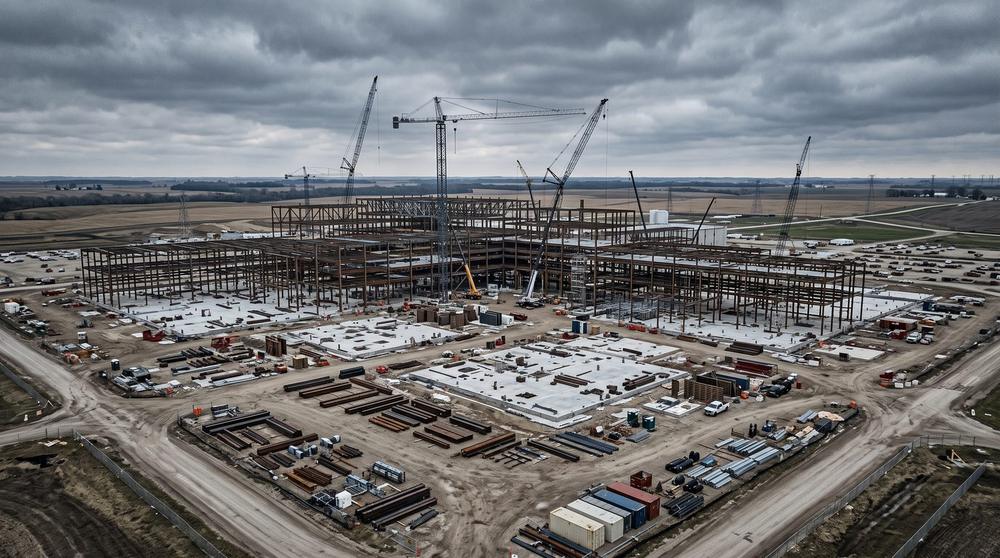
Reuters reported Wednesday that SK Hynix is in early talks with Intel about manufacturing memory chips in the United States for the first time, with Intel’s stalled Ohio One campus among the sites on the table. Intel closed up 4.3%, the most actively traded name in the premarket. SK Hynix rose about 1.3%.
Both companies are being careful. SK Hynix said it is “reviewing various measures, including establishing additional production bases,” and that “no matters have been determined at this stage.” The reported options range from simply leasing space at the unfinished Ohio site to a joint venture that would also pull in AI hyperscalers who cannot get enough high-bandwidth memory. The product mix — HBM, DRAM or NAND — is reportedly undecided.
Read that list again, because the range is the news. Leasing a building and co-founding a memory venture with the buyers of the output are not variations on one deal. They are two completely different companies at the other end.
Why Intel is the one with the empty building
Ohio One was announced as the anchor of American advanced-chip manufacturing and has slipped repeatedly. It is capital already sunk into concrete that currently produces nothing. A tenant — any tenant — converts a stranded asset into a cash-generating one without Intel having to win the logic-foundry argument first.
SK Hynix has the opposite problem: demand it cannot serve fast enough, and political pressure to serve it on US soil. It already broke ground on a $4bn HBM packaging facility in Indiana. What it does not have is American wafer capacity, and building that from scratch is a multi-year exercise in permits and pours. Intel has the pours.
Our take: The obstacle here is not commercial, it is Seoul. Advanced memory process technology is treated as strategically sensitive by the South Korean government, and a joint venture that puts HBM know-how inside an American fab is the kind of thing that gets reviewed rather than waved through. That is why the leasing option exists in the reporting at all — it is the version of this deal that transfers square footage instead of knowledge. Watch which option survives contact with Seoul, because it determines whether this is a real restructuring of the memory supply chain or an unusually large commercial-property transaction.
The hyperscaler angle is the one to take seriously
The most interesting option in the reporting is the one that adds AI buyers to the cap table. HBM is the acknowledged bottleneck in AI accelerator supply, and the companies buying those accelerators have shown a willingness to finance capacity directly rather than wait in line. A venture in which the customers fund the fab is how memory stops behaving like a commodity cycle and starts behaving like contracted infrastructure.
It also fits a pattern we keep covering: capital moving upstream to buy certainty. See Ayar Labs raising $650m against the copper limit and Positron’s $875m memory-first inference bet. Everybody is trying to solve the same constraint from a different side of it.
What to watch
- Any signal from Seoul. A statement from South Korea’s trade ministry would tell you more about the odds than anything either company says.
- Which product line is named. NAND or commodity DRAM is a capacity deal. HBM is a technology-transfer deal, and a far harder one to approve.
- Whether a hyperscaler is named. The moment a buyer appears on the structure, this stops being about Intel’s real estate.
- Ohio One’s schedule. Intel has revised it before. A firm date attached to a tenant would be the first credible one in a while.