Ayar Labs raised another $150 million this week, taking its primary capital raised in 2026 to roughly $650 million. A separate $225 million secondary share sale valued the company above $5 billion, up from $3.75 billion when its Series E closed in March.
The investor list is the story as much as the number. Wiwynn, AMD, Intel, MediaTek and Nvidia are all on the cap table. Those are not five firms that agree about much. They agree about this.
Chief executive and co-founder Mark Wade put the thesis in one sentence: copper interconnect is becoming the limiting factor for AI scale-up. Not compute. Not memory. The wire.
The constraint nobody budgeted for
Every AI cluster is a negotiation between how much silicon you can put in a rack and how fast you can move data between racks. Copper handles the first job beautifully — short runs, inside the box, cheap. It falls apart on the second. Push a copper link past a couple of metres at the bandwidth a modern accelerator wants and you pay in three currencies at once: distance you cannot have, power you cannot spare, and heat you then have to remove.
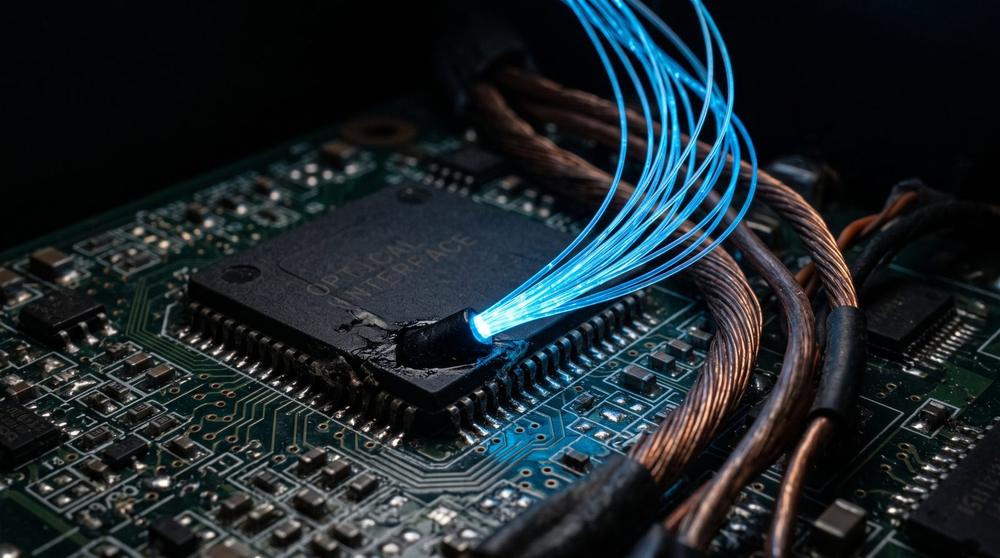
Co-packaged optics moves the optical engine onto the chip package itself, so light rather than electricity carries the signal from the moment it leaves the die. Ayar’s TeraPHY optical engine is the product. The pitch is that it lets a scale-up domain — the set of accelerators that can talk to each other as if they were one machine — extend beyond a single rack without the interconnect becoming the bottleneck.
This is not a new idea. It has been a conference-slide idea for roughly a decade. What changed is that the constraint stopped being theoretical.
Our take: The money here is not buying research, it is buying a factory. Ayar says the capital goes to high-volume manufacturing — product validation, scaling the manufacturing ecosystem, a new design centre in Bengaluru. That is the language of a company that has solved the physics and is now fighting yield. Which means the interesting risk has moved: it is no longer “does co-packaged optics work,” it is “can anyone make enough of it.” A 2026 raise of $650 million for a components company is a bet that the answer arrives before the hyperscalers’ build cycles do.
Why the strategic investors matter more than the valuation
AMD, Intel, Nvidia and MediaTek design the packages Ayar’s engine has to sit inside. Wiwynn builds the systems. Strategic money in a components business is usually a signal of one of two things: an option on supply, or a hedge against a competitor locking it up. With all four major silicon players in at once, it reads as the second.
That is unusually good news for Ayar and unusually awkward for everyone else. A component that four rival designers all want access to tends to get standardised or second-sourced quickly, because none of them will accept a single-vendor dependency on the thing that determines how big their clusters can get. Expect pressure toward an open interface long before the manufacturing question is settled.
What to watch
- A named design win in a shipping product. Funding rounds are cheap signals. A publicly disclosed accelerator that ships with co-packaged optics in the package is the expensive one.
- Yield disclosure. Nobody in optics volunteers yield numbers unless they are good. Silence is the default; a number is news.
- The Bengaluru design centre’s scope. A validation and test centre is a manufacturing story. A full design centre is a second product line.
- Whether the scale-up domain actually grows. The whole case rests on clusters spanning multiple racks as one coherent machine. If 2027 architectures still stop at the rack boundary, the urgency drops.
For two years the AI infrastructure trade has been about power and about chips. The quieter version — that the copper between them runs out first — just attracted $650 million and every major silicon vendor at once. That is not a consensus you get for a nice-to-have.