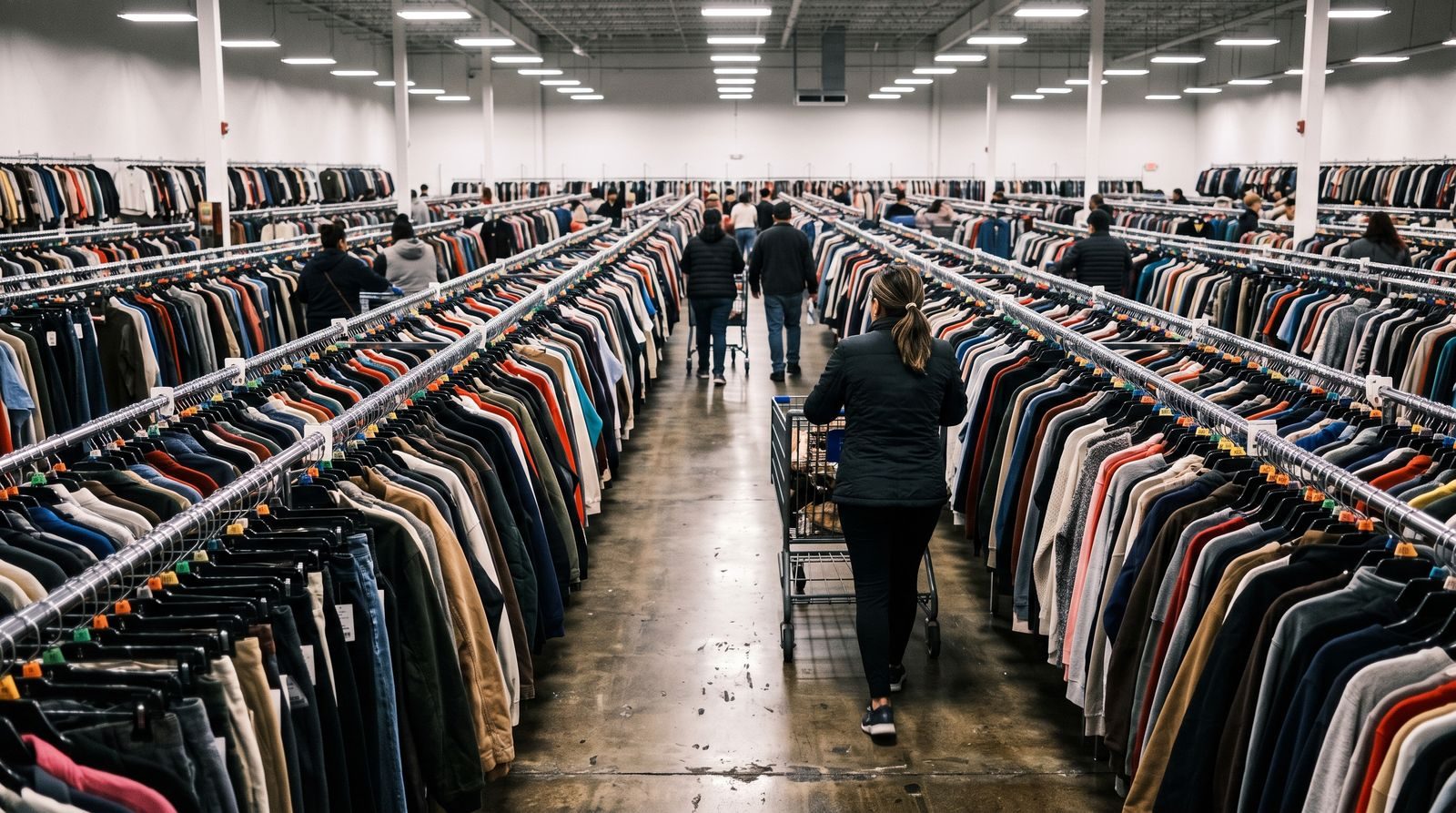
Ross Stores closed its second quarter on August 1 with comparable-store sales up 10%, and management was unusually specific about where that came from: customer traffic, not fatter baskets. More new customers, and more trips from the ones it already had. Total sales rose 13% to $6.26 billion. Diluted earnings were $2.66 a share against the company’s own guidance of $1.85 to $1.93.
About $0.60 of that came from IEEPA tariff refunds — $253 million booked in the quarter. Strip the refund out and operating margin still expanded 205 basis points against a plan of 130 to 150. The beat was already there before the cheque arrived. Ross raised full-year earnings guidance to $8.61–$8.77 and lifted its 2026 store-opening plan to 115 locations. Shares were up about 8% before Friday’s open.
Fourteen hours later, BJ’s Wholesale reported comparable club sales up 11.9%. That headline is carrying gasoline, and crude is above $86 with Brent near $93 — ex-fuel comps were 3.1%. The cleaner signal sits one line down: membership fee income rose 9.9% to $135.6 million on a record 8.5 million members. People are now paying an annual fee for the privilege of a lower price.
Set both against Walmart, which on Thursday posted US comparable sales of 2.6% against a consensus near 3.5% — and shed roughly 9% of its market value in a single session despite beating on revenue, beating on adjusted EPS and raising its full-year outlook.
The consumer isn’t weakening. They’re re-sorting.
Three retailers, three quarters, one shopper. The money did not leave the system — July retail sales fell 0.6%, but that is a rounding error next to a 10% comp. It moved. Off-price and warehouse-club formats are absorbing trips that used to belong to the mass merchants, and they are doing it on traffic rather than price increases, which is the harder and more durable version of growth.
Our take: The tell is traffic, not spend. Ross said its comp was “primarily driven by customer traffic”; BJ’s is converting that traffic into paid memberships. Trips are up and wallet share is migrating to whoever prices the trip lowest. That is a market-share story wearing a consumer-health costume — which means reading the American consumer off any single retail bellwether is now close to useless. Walmart’s 2.6% and Ross’s 10% are the same economy.
What to watch
- Ross’s November print. The company guided to 6–7% comps in Q3 and 4–5% in Q4 against far harder year-ago comparisons. Deceleration is planned, not a warning — but Q3 is the honesty check on whether the traffic is sticky.
- The tariff-refund cliff. Ross, Walmart, Target and Home Depot have all now booked IEEPA refunds. These are one-time credits sitting inside operating income. Fiscal 2027 comparisons will look ugly by construction, and the market has not obviously priced that.
- Fuel in the headline number. BJ’s 11.9% versus 3.1% ex-gas is a 880-basis-point wedge created by oil. With crude elevated on the Iran standoff, expect that gap to widen and expect headline club comps to flatter.
- Square footage. Off-price is adding 115 stores this year while mass merchants defend existing traffic. That is a share grab with a two-to-three-year fuse.
The retailers that beat this season did it by being the cheapest credible option in their category. The one that missed was the incumbent everyone assumed already held that position. Worth remembering when the next “consumer is fine / consumer is cracking” headline crosses.