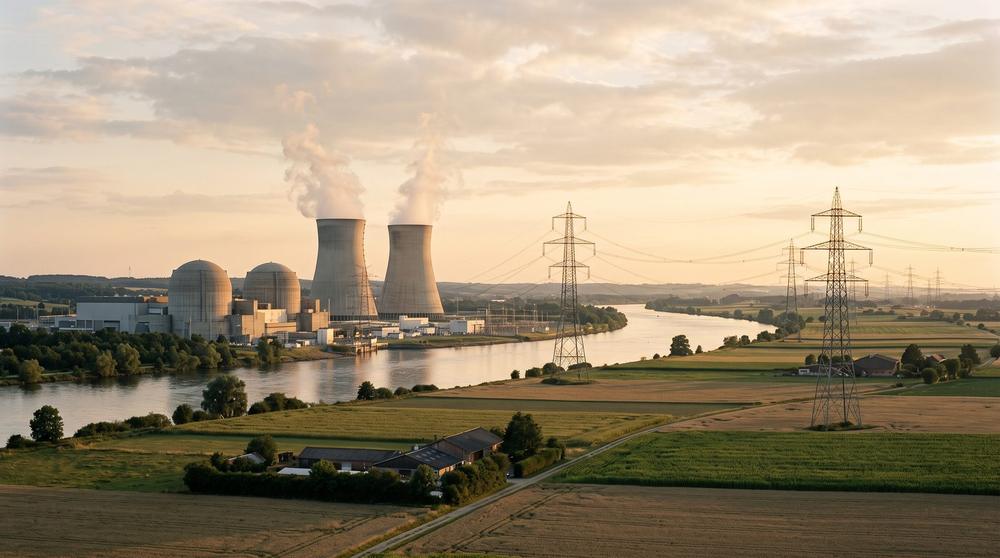
The Department of Energy has offered Vistra a conditional loan commitment of up to $4.2 billion to fund uprates and modernisation across three nuclear plants: Beaver Valley in Shippingport, Pennsylvania (two pressurised water reactors, 1,872 MWe), Davis-Besse in Oak Harbor, Ohio (908 MWe) and Perry in Perry, Ohio (1,268 MWe). The money comes from the DOE’s Office of Energy Dominance Financing, the renamed Loan Programs Office.
The headline figure buys two different things, and they are worth separating. The work adds 433 MW of genuinely new nuclear capacity — squeezed out of existing reactors, with no new transmission corridors required. It also preserves roughly 4 GW of existing baseload and supports operation for 20 years beyond current licences, which expire in 2036 and 2047 for the two Beaver Valley units, 2037 for Davis-Besse and 2046 for Perry. The DOE puts the labour at about 3,000 engineering, construction and outage jobs.
Markets read it as an AI-power trade. Vistra rose about 11% on Tuesday and added another 3.9% on Wednesday to close at $166.72 — roughly 15% across two sessions, in a week when the Dow fell 0.7% and the S&P 500 slipped 0.2%.
Our take: This is a licence-extension deal with an uprate attached, not a capacity deal. Split the number the honest way: $4.2bn against 433 MW of new output is about $9.7m per megawatt, which would be terrible if new megawatts were the point. They are not. The point is keeping 4 GW of already-built, already-interconnected baseload alive two decades past its current paperwork, inside the PJM footprint that is short of power right now. On that basis it is the cheapest firm capacity anyone is financing. The catch is the calendar, and it is brutal: per the NRC’s own list, the extended power uprate applications do not get filed until Q3 2029 for Perry, Q3 2030 for Beaver Valley-2, Q3 2031 for Beaver Valley-1 and Q3 2032 for Davis-Besse. Nothing in this announcement puts an electron on the grid this decade.
Conditional is doing real work in that sentence
No money has moved. Vistra must satisfy technical, legal, environmental and financial conditions before the DOE signs a definitive agreement and funds anything. Conditional commitments of this kind have historically converted at a decent but not guaranteed rate, and the four-to-six-year gap before the first regulatory filing is a long window for conditions to be renegotiated or for a subsequent administration to reprice the programme.
There is also an unexercised option tucked into the commitment: financing for possible future uprates at Comanche Peak in Glen Rose, Texas, two units totalling 2,400 MWe. That is the part a long-term holder should care about more than the three plants named today, because it is where the next tranche of capacity would come from.
One name is missing from the announcement. In January, Meta said it would back uprates at Perry, Davis-Besse and Beaver Valley, describing them as the largest uprates a corporate customer had ever supported. The DOE release does not mention Meta. Whether federal credit is layering on top of that commitment or quietly replacing it is the single most useful thing an investor could find out this quarter. It fits a pattern we have been tracking: Google did not buy a power plant, it bought permission to plug in, and bought 22 years of Finnish nuclear before pouring a foundation.
What to watch
- The definitive agreement. Until it is signed, this is a letter. Watch for the conditions list and any change to the $4.2bn ceiling.
- Meta’s role. Whether the January corporate commitment survives, stacks or is superseded changes who captures the economics of the added output.
- Q3 2029. Perry’s uprate application is the first hard date in the whole programme. Everything before it is financing and engineering.
- Subsequent licence renewals. Vistra told the NRC in January it intends to file for all three sites. Those filings, not the loan, are what actually buys the extra 20 years.
- Comanche Peak. If the option gets exercised, the thesis gets meaningfully larger.
The trade and the asset are on different clocks here, which is the thing to hold onto. A 15% two-session move prices a near-term benefit from a programme whose first regulatory milestone is three years out and whose last is six. That gap can be perfectly rational — markets discount future cash flows for a living — but it is the gap, not the $4.2bn, that will determine whether this looks well-priced in 2027.