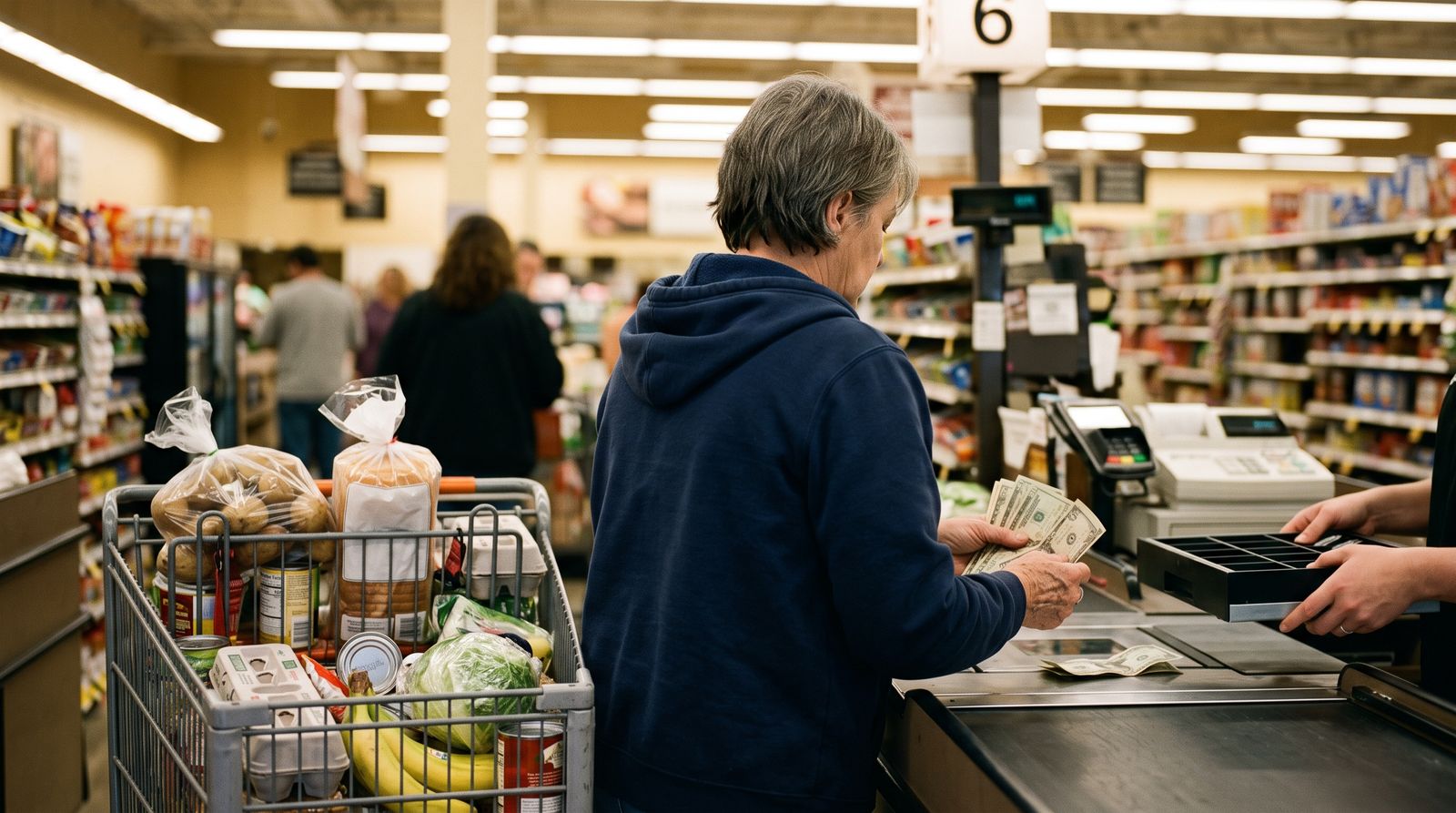
Friday’s jobs report was read as a labour-market story. The more consequential number was in the pay column.
Average hourly earnings rose 3.2% over the year to July, to $37.62, the Bureau of Labor Statistics reported — down from 3.4% in June and the slowest annual pace since May 2021. Consumer prices, in the most recent published reading, rose 3.5% over the year to June. Pay is no longer keeping up with prices.
That is a different economy from the one most households budgeted for. For roughly two years, wage growth ran ahead of inflation and workers slowly clawed back purchasing power lost in the 2022 spike. The arithmetic has flipped, and it flipped while the labour market was already thinning out.
The rest of the report backs it up
Payrolls fell 23,000 in July. The unemployment rate held at 4.1%, but only because the labour force shrank rather than because anyone found work — participation was 61.4% and the employment-population ratio 58.9%, both little changed. We covered that mechanic on Friday in the economy shed 23,000 jobs and the unemployment rate improved.
The revisions were uglier than the headline. May was cut by 66,000, from +129,000 to +63,000. June was cut by 37,000, from +57,000 to +20,000. Combined, spring hiring was 103,000 jobs weaker than previously reported. Losses concentrated in local government education and retail trade; health care kept adding. That squares with announced layoffs sitting at a two-year low — firms are not firing, they are simply not hiring.
A labour market that is not adding workers does not generate wage pressure. That is the mechanism, and it has now surfaced in the pay line.
Why the gap bites harder than it reads
June’s 3.5% headline was itself an improvement, down from 4.2% in May. But the composition is what lands in a household budget. Core CPI, stripping out food and energy, ran 2.6%. Energy ran 15.7%, with gasoline up 26.7% and electricity up 4.0%. Shelter rose 3.3%, food 3.0%.
The inflation currently outrunning pay is concentrated in the categories nobody can opt out of. A 3.2% raise against 26.7% gasoline is not a rounding error at the pump — and the energy line has not had time to absorb the latest disruption to Gulf shipping, which we tracked in Iran’s price for reopening Hormuz.
Our take: The number that matters is not the payroll print, it is the spread between pay and prices. When wage growth trails inflation, consumer spending stops being funded by income and starts being funded by savings and credit. That works for a quarter or two, and then it does not. Retail is where it shows up first, and this month the calendar is unusually tight — the inflation print and the biggest consumer-facing earnings reports land inside ten days of each other.
What to watch
- Wednesday 12 August — July CPI. Consensus is roughly 3.4% headline and 2.5% core. Anything above 3.2% keeps real pay negative for a third straight month.
- Thursday — July PPI. Producer costs feed consumer prices with a lag; a hot print argues the gap widens into autumn.
- Friday — July retail sales and the preliminary University of Michigan consumer sentiment reading. This is the first hard test of whether squeezed pay is changing behaviour.
- 18–20 August — the retail confessional. Home Depot reports on the 18th; Walmart is expected on the 20th. Between Walmart’s essentials mix and Home Depot’s exposure to a housing market frozen by high mortgage rates, the two of them describe most of the American consumer.
One month of negative real wages is noise. Three months is a trend, and it is the kind of trend that shows up in guidance before it shows up in the data.