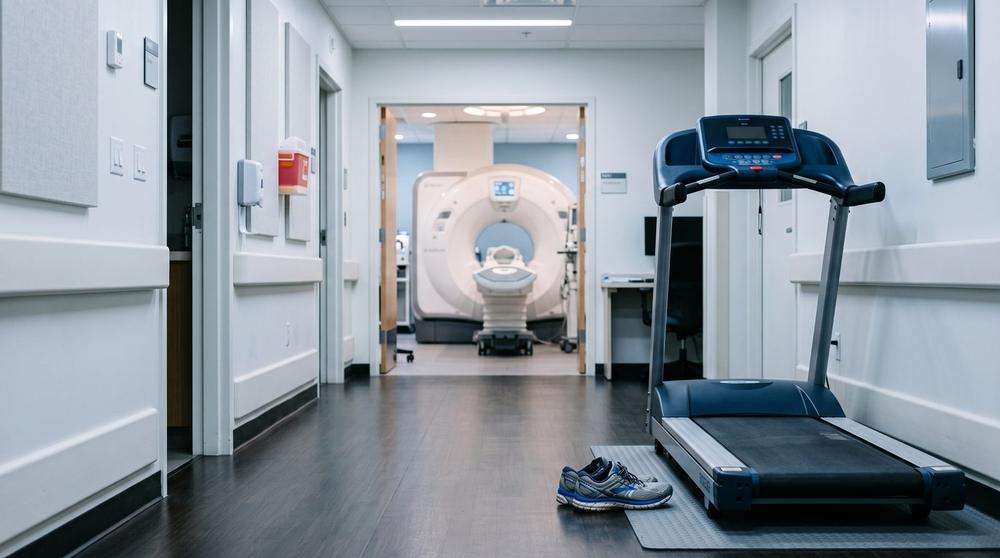
“Go for a walk before the hard thinking” is one of the most repeated pieces of performance advice in circulation. A new crossover fMRI study puts the claim in a scanner and comes back with a more precise answer than the advice deserves: the walk did something to the brain. It did not do anything to the score.
Researchers at Japan’s AIST, working with the University of Texas Southwestern Medical Center, ran healthy young and older adults through a task-switching test inside an MRI scanner, before and after either 30 minutes of moderate-intensity walking or 30 minutes of sitting. The results are published in the Journal of Magnetic Resonance Imaging (Asahara et al., 2026).
Walking helped maintain activity in the brain regions involved in switching between rules. Task performance did not improve. Repeating the task — simply doing it again — reduced brain activity and improved performance, and did so most clearly in the older adults.
The methodological point is the real story
Plenty of earlier work has reported that acute exercise sharpens executive function. The design problem in much of it is that measuring cognition before and after exercise means the participant has done the cognitive task twice. People get better at tasks by doing them. That improvement has nothing to do with the treadmill.
This study was built to pull those two effects apart, and when it did, they separated cleanly: practice carried the performance gain, exercise showed up in the imaging. That is not a null result — maintaining activation in task-switching regions is a real finding, and one with obvious relevance to ageing. It is simply a different finding from the one usually claimed.
Our take: Most performance advice is untested because testing it properly is expensive and the answers are unflattering. Here someone paid for the scanner and the control condition, and the effect people actually care about — do better on the thing — turned out to be the practice effect wearing exercise’s clothes. That does not make walking a waste of half an hour. It makes it a poor substitute for reps. If the goal is to perform better at a specific cognitive task on a specific day, the evidence here points at having done the task before, not at what you did in the hour beforehand.
What this does and does not license
It does not license skipping exercise. The cardiovascular and long-term cognitive case for regular aerobic activity is built on a completely different body of evidence, over years rather than 30 minutes, and nothing here touches it. The brain-activity result is, if anything, consistent with the idea that movement matters for maintaining the machinery over time.
What it does license is scepticism about the acute framing — the walk-before-the-meeting, the lunchtime run as a focus hack, the idea that you can buy sharpness in the next hour with cardio. On a same-day, same-task basis, this design found no performance edge. Anyone selling the acute version should be asked whether their evidence controlled for repetition, because the honest answer is usually no.
What to watch
- Whether the design gets copied. The separation of exercise from task repetition is the contribution. Studies published after this one without that control are easier to discount.
- The age split. Practice effects were strongest in older adults. That is a more interesting lead for training and rehabilitation than the exercise arm.
- Maintained activation over time. Holding activity steady in task-switching regions is a single-session imaging finding. Whether it compounds is the open question.
- Your own protocol. If you rehearse before high-stakes cognitive work, you are already using the effect this study found. If you only walk, you are using the one it did not.
This is one study, in healthy adults, on one class of task. It is not the last word. But it is a well-controlled word, and it points somewhere unglamorous: the thing that made people better at the test was the test.