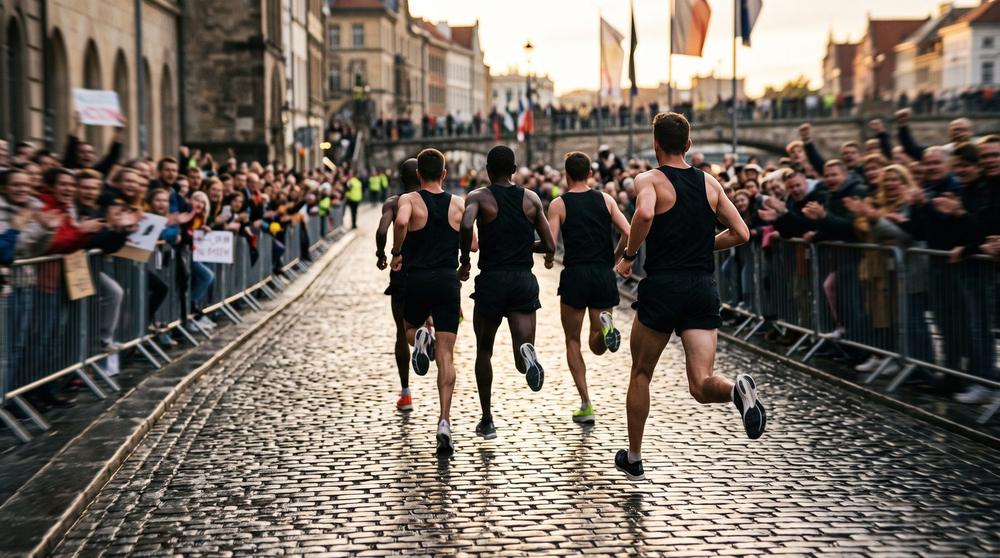
Jakob Ingebrigtsen ran a Norwegian record on Saturday and lost. Dawit Seare of Eritrea went past him in the closing metres of the world 5km road title in Copenhagen, crossing in a national record 12:56 to Ingebrigtsen's 12:59.
Seare's teammate Saymon Amanuel, still a teenager, took bronze in a personal best 13:00. Three men under or on 13 minutes for a road 5km, on a September course, in a championship race with no pacemakers.
The pattern repeated an hour earlier and later on the same streets. In the men's road mile, Germany's Robert Farken came past Yared Nuguse in the closing stages for a world-leading German record of 3:51.80, with Nuguse taking silver and Luxembourg's Ruben Querinjean bronze. Agathe Guillemot won the women's mile for France's first gold of the championships, ahead of Hailu in 4:24.35 and Mirriam Cherop in a season-best 4:25.71.
The closing-speed problem
Four medal races on day one, and in at least three of them the favourite was beaten in the final 200 metres by someone with more left. That is not a coincidence of scheduling. It is what championship road racing selects for.
A road 5km run in 12:56 averages roughly 62 seconds per kilometre. There is no meaningful tactical variance available at that speed — nobody surges early and survives. The race compresses into a single decision point in the last 30 seconds, and the winner is whoever arrives at that point with the largest remaining anaerobic reserve.
Ingebrigtsen is among the most physiologically complete distance runners alive and he ran a national record. He still lost, because the race did not reward the thing he is best at. Sustained honest pace flattens the field rather than breaking it, and a flat field is decided on kick.
Our take: The transferable lesson is not about running. It is that the quality that wins a contest is set by the structure of the contest, not by who is objectively strongest. Ingebrigtsen optimised for the metric that wins championship track finals — a long, grinding drive from 600 out. On a flat road course against a compressed field, that drive costs more than it buys. If you keep losing while performing at your best, check whether you are competing on the axis the format actually scores.
What the times mean
Road times are not directly comparable to track times — course profile, turns, surface and wind all move the number, and road courses are certified differently. What can be read is the finishing order and the margins, and those were tight: three seconds covering gold and silver in the 5km, four seconds covering the podium.
Farken's 3:51.80 is a German record and a world lead on the road. Nuguse, a superb closer on the track, was beaten by a closer who timed it better.
What to watch
- Sunday's half marathon. The distance where sustained honest pace does break the field, and where the day-one pattern should reverse.
- Seare's next move. A national-record 12:56 to beat Ingebrigtsen is a result that changes a season, and Amanuel's 13:00 at his age is arguably the more remarkable line on the results sheet.
- Whether Ingebrigtsen adjusts. He has now been beaten on a kick in a format that rewards kicks. The fix is tactical, not physiological.
Championship racing is a different sport to time-trialling, run by the same people over the same distances. Saturday in Copenhagen was a clean demonstration of the gap.