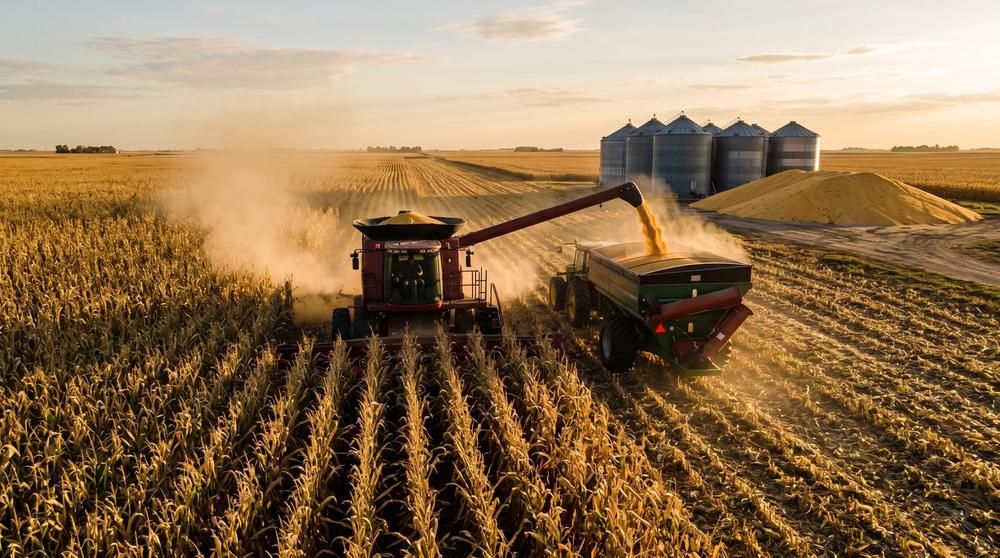
The October World Agricultural Supply and Demand Estimates landed Friday morning and did the one thing the trade had positioned against. USDA raised the 2026-27 corn yield to 181.2 bushels an acre, up 2.7 from September's 178.5 and well above the 177.6 average of analyst estimates. The range of pre-report guesses ran 173.2 to 182.1, so the print came in near the top of it.
Everything downstream followed. Production was put at 16.034 billion bushels, against 15.800 billion in September and a 15.716 billion trade average. Ending stocks went to 1.849 billion bushels from 1.567 billion — the expectation was 1.677 billion, and the top of the estimate range was 1.895 billion. USDA cut the season-average corn farm price by a dime to $4.70 a bushel. Total use was pegged at 16.305 billion bushels with exports at 3.3 billion.
December corn traded limit down on the release and then clawed part of it back, settling 20½ cents lower at $4.79¾. That is a notable round number: corn had been trading either side of $5.00 all week, touching a six-week low below $5.00 on 5 October after a larger-than-expected stocks figure, then recovering toward $5.10 on 7 October. One report took out the whole range.
Soybeans refused to follow
The soybean numbers were close to neutral — yield 53.1 bushels against 52.8 in September and a 52.9 trade average, production 4.562 billion bushels, ending stocks 315 million against an expected 311 million. November beans opened under pressure and then reversed, closing up 4½ cents at $12.94 after rallying more than 22 cents off the morning low. The season-average soybean price was held at $12.00.
Wheat went with corn rather than beans. Production was 1.534 billion bushels and ending stocks rose to 740 million from 717 million, with exports cut to 750 million bushels from 775 million. December Kansas City wheat finished 17 cents lower at $7.19¼; Chicago spot was off 12 cents. The season-average wheat price came down a dime to $6.30.
DTN's analysts graded US corn ending stocks bearish, soybean stocks neutral and wheat stocks slightly bearish. A large fund net long in corn added to the downside, which is the usual mechanic: a surprise supply number does not just reset fair value, it forces liquidation from the side of the market that was leaning the wrong way.
Our take: The divergence is the signal, not the limit-down move. Corn and soybeans trade the same weather, the same freight, the same dollar and broadly the same Chinese demand picture. When one goes limit down on a USDA print and the other closes up, the news is specific to one balance sheet — and here that balance sheet is US corn supply, not global ag demand. Carryout near 1.85 billion bushels is the kind of number that caps rallies for months rather than days, because it means a weather scare in 2027 has a cushion to eat through before it becomes a price event. Note also what USDA did to the farm price: $4.70. That is the figure that shows up in crop insurance maths and in farmers' decisions about whether to sell out of the field or put corn in the bin and pay for storage, and it just got cut while the harvest was still running late.
What to watch
- Export sales pace against the 3.3 billion bushel forecast. With stocks this heavy, demand is the only variable that can tighten the balance sheet before next spring.
- The November WASDE. Harvest was running late into October, so the 181.2 figure rests on fewer combines than usual. A revision either way moves the whole curve.
- Whether the fund net long rebuilds. Positioning got flushed on Friday. Whether money comes back in determines if $4.79 was the low or the start of a lower range.
- Basis and storage economics. Full bins plus a cut farm price is how you get wide basis and heavy on-farm storage, which in turn hangs over the spring market.
- Soybean follow-through. If beans hold the reversal into next week, Friday was a corn-specific event. If they roll over, it was an ag-complex event with a one-day lag.
USDA found 318 million more bushels than the trade expected. That number does not get traded away in a session.