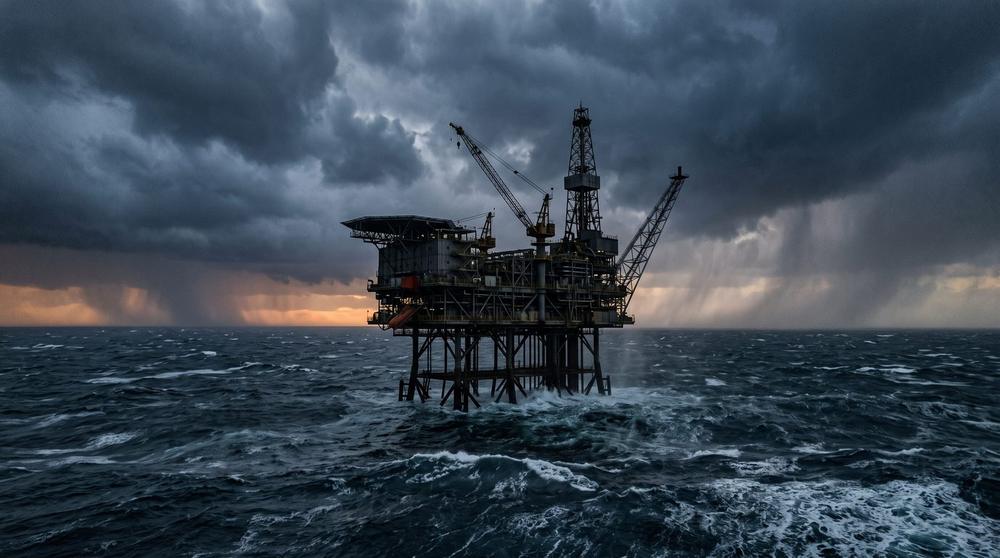
More than 70% of crude production in US Gulf waters was shut in on Friday as Hurricane Isaias, a Category 3 storm, tracked toward the northern Gulf Coast. WTI settled at $91.85, up 36 cents. Brent settled at $104.72, up 44 cents.
That is a 0.4% move on an outage of roughly 1.3 million barrels a day. The federal offshore regulator put shut-ins at 62.9% of current Gulf oil production as of Thursday; by Friday the figure reported across the wires had climbed past 70%. Chevron’s Pascagoula refinery and a Vertex Energy facility in Alabama sat under hurricane warnings.
An outage that size would normally be the whole story. It was not, because something pushed the other way on the same day: President Trump said the US would not strike Iran before the 3 November midterms and described talks with Tehran as productive. Crude had been carrying a large Strait of Hormuz risk premium. Friday took a slice of that premium out and put a hurricane in, and the two roughly cancelled.
Why the market shrugged at 1.3 million barrels
Offshore shut-ins are the most reversible supply loss in energy. Operators evacuate platforms ahead of a storm, the wells sit idle, and — absent structural damage — production is back within days. Traders have run this exercise every hurricane season for decades and price it as a timing problem, not a supply problem. Inventories absorb it.
Refining is the part that does not reverse on a schedule. A flooded or power-starved refinery can be down for weeks, and when it is, the barrels keep flowing but the gasoline and diesel do not. That is why the gap worth watching this week is between crude and product cracks rather than in the crude print itself. The same asymmetry is already visible downstream in Delta’s fuel bill, which took a quarter of its full-year profit — airlines buy refined jet fuel, not crude.
Our take: A 0.4% settle on a 70% regional outage is not complacency, it is a market that has already repriced to a bigger risk. When Hormuz is the marginal worry, a Gulf hurricane is noise. The practical read for anyone with fuel exposure: the crude headline understates what is coming, because the damage function here runs through refineries and pipelines, and that shows up with a lag in product prices rather than today in the front-month contract.
What to watch
- The regulator’s shut-in series next week. A fast return toward normal confirms the timing-problem read. A slow one means platform or pipeline damage, which is a different trade.
- Gulf Coast refinery restart notices. Pascagoula and the Alabama facilities are the names to track. Product cracks, not crude, carry that news.
- Whether the Iran de-escalation holds. Friday’s statement was political, not structural; the Hormuz premium can come back as fast as it left. OPEC+ already froze November output, so there is no spare-capacity cushion arriving on a quota decision.
- Retail fuel prices into late October. That is where a refining outage lands, and where it becomes a politics story rather than a markets one.
Two supply shocks on one day, pointing in opposite directions, netted to 36 cents. The one that reverses in days got priced. The one that reverses in weeks has not been yet.