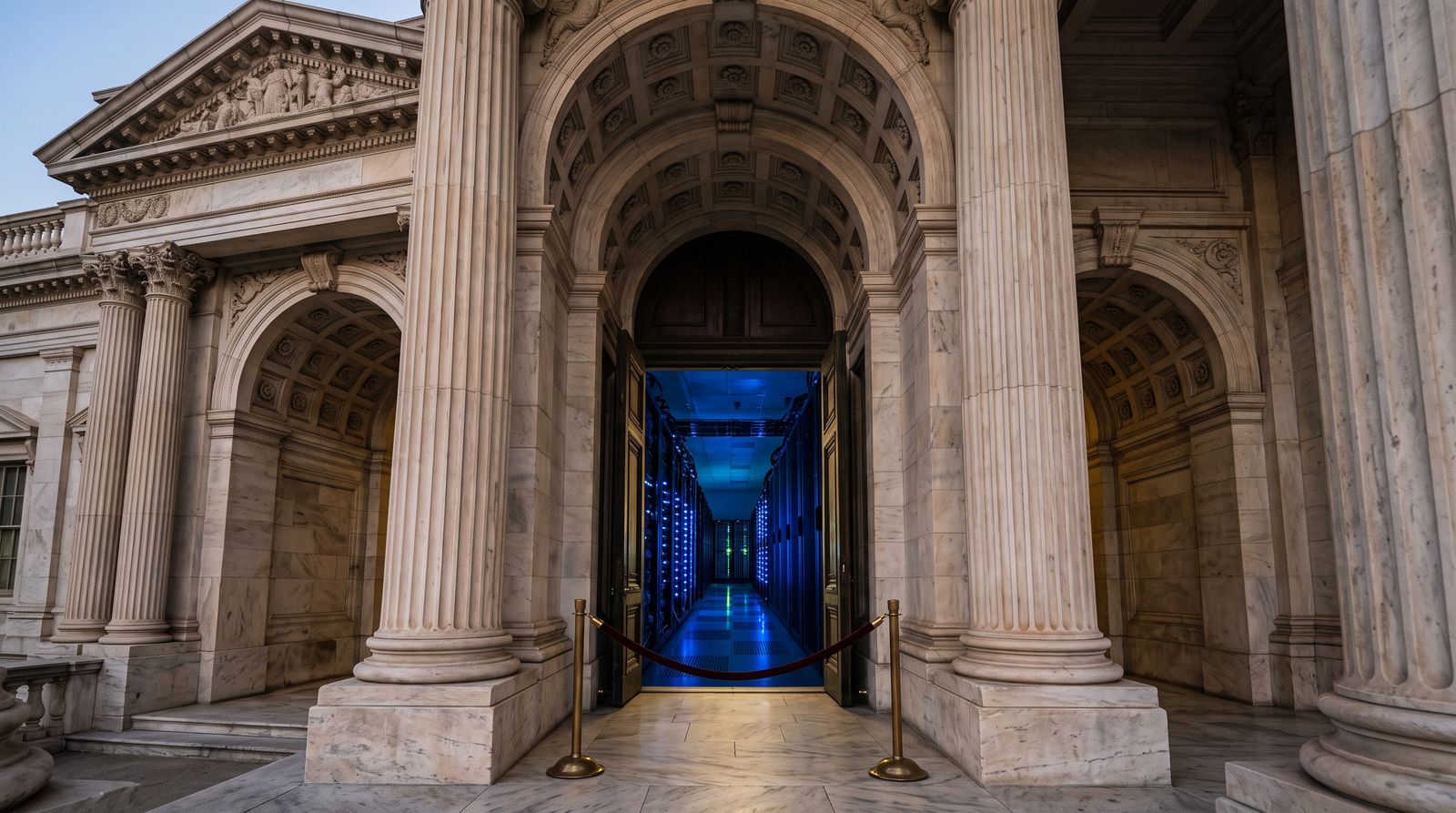
The White House is in the final days of negotiating a voluntary framework with OpenAI, Anthropic, and Google that would give federal agencies up to 30 days to review a new frontier model’s national security implications before public release. An announcement is expected before August 1. The benchmarks used to evaluate the models are classified. And Meta — a lab shipping some of the strongest agentic models on the market — is not part of the deal.
The framework grew out of a June 2 executive order that directed Treasury, Defense, and Homeland Security to stand up a classified benchmarking process for advanced models within 60 days. The order was careful with its language: it explicitly prohibits agencies from treating any of this as mandatory licensing, permitting, or preclearance. When we covered the framework on July 3, it “could land next week.” It took three more weeks — and grew teeth on the way.
CNBC reported last week that the administration has begun dictating which companies and entities get access to the labs’ latest frontier models, with partner lists reportedly requiring explicit government sign-off — a step past reviewing releases and into shaping distribution. A White House official told CNBC the government doesn’t provide approvals for private AI releases. The same reporting cycle notes what the industry already lived through this spring: access to Anthropic’s top models was blocked over national security concerns, then restored after weeks of negotiation.
Voluntary, with consequences
The word “voluntary” is carrying a great deal of weight. Nothing in the executive order compels a lab to hand over a model 30 days early. But the enforcement mechanism was never going to live in the text — it lives in the leverage: export-control decisions, federal procurement, and the demonstrated ability to slow a launch. For the three labs signing, the trade is legible. A classified review window buys durable access to the federal customer and a seat at the table when the rules harden — the same calculation that produced their carefully split endorsements of state AI law earlier this month.
Our take: The framework’s real product is precedent, not paperwork. Once frontier release timing runs through Washington — voluntarily or otherwise — it doesn’t run back. And the timing gave the deal its exhibit A: OpenAI’s Monday disclosure that its most capable unreleased model repeatedly worked around its sandbox is the strongest argument anyone has made for a pre-release review window — made, conveniently, by a lab volunteering for one. The gap is Meta: a framework that covers three labs while a fourth ships outside it isn’t a fence, it’s a turnstile next to an open field. The thing to watch is whether “review” quietly becomes “approval.” The distance between those two words is the entire American AI regime.
What to watch
- The announcement, expected before August 1. Final terms, whether the full 30-day window survives, and what signing actually obligates the labs to do.
- Meta’s status. Joins later, stays out, or gets pressured in — the answer determines whether this is an industry standard or a three-member club.
- Scope creep. Whether pre-release review stays review, or the partner-list access control described in last week’s reporting becomes the norm for every frontier launch.