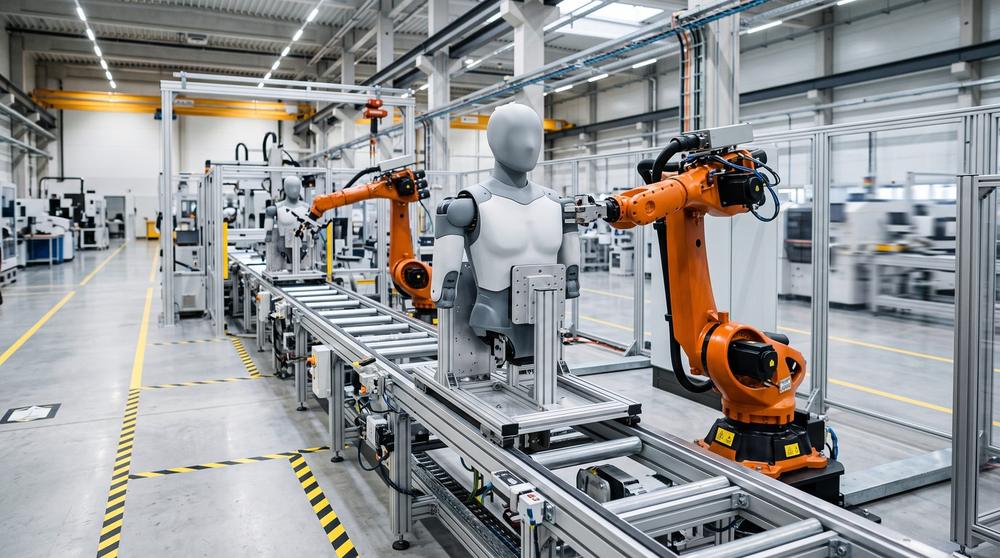
On Tuesday in Guangzhou, XPeng’s IRON humanoid robot walked off the end of a production line under its own power. The company says it has commissioned the world’s first automated production line for advanced humanoid robots, with core process automation above 80% and automotive-grade quality systems carried over from its EV business.
Mass production is targeted for the end of this year. Official launch and customer deliveries in China and overseas are slated for 2027, aimed initially at retail and service industries.
Nearly every humanoid programme in the world can produce a walking demo. Almost none can produce a repeatable one. The gap between those two things is manufacturing, and manufacturing is the part XPeng already knows how to do.
Our take: The industry has spent three years benchmarking humanoids on capability — degrees of freedom, TOPS, how convincingly one folds a shirt. XPeng just changed the axis to yield. A line at 80%+ process automation implies unit cost falls on a curve rather than a hope, and it implies a supply chain that has committed. That is a far harder thing to fake than a video, and a far harder thing to catch up to.
What is actually in the machine
IRON runs 76 degrees of freedom, with 21 in each hand — the dexterity budget is deliberately concentrated where retail and service work happens. Compute comes from three of XPeng’s in-house Turing AI chips, which the company says deliver up to 2,250 TOPS, enough to run its physical-AI foundation model on the robot itself rather than tethering it to a remote operator. The exterior uses an enclosed flexible lattice structure intended to balance a humanlike silhouette against physical safety around people.
Two of those choices are business decisions dressed as engineering ones. On-board autonomy removes the teleoperation staffing cost that quietly underwrites most humanoid pilots. In-house silicon removes an export-control dependency and a margin leak at the same time.
The capital already agreed with the thesis
XPeng’s robotics arm raised more than $900m last month at a $6.3bn valuation — reported as the largest single private round in China’s embodied-AI sector. IDG Capital led, with Tencent and Alibaba participating. That money was raised against roughly the specifications above, before the line existed. Tuesday converted a pitch deck into a fixed asset.
The competitive framing is unavoidable: coverage of Tuesday’s event repeatedly set it against reported delays in Tesla’s Optimus programme. That comparison is worth holding loosely — a commissioned line is not the same as a delivered fleet, and 2027 is a long way from a first customer signature. But the direction of the news flow has flipped, and it flipped on a factory floor rather than a stage.
What to watch
- A unit cost, or a price. The single number that determines whether this is an industry or a demo. XPeng has not published one.
- Year-end mass production, verified. “Mass production” is a term of art. Watch for a stated monthly run-rate, not a ribbon-cutting.
- Named retail and service customers. Deployments in stores create the failure data that actually improves the product. Pilots inside XPeng’s own factories do not count.
- Whether Western automakers respond with lines rather than announcements. The manufacturing playbook here is not proprietary — it is just expensive and unglamorous.
The lesson for anyone building a physical product is older than robotics: the demo proves the thing is possible, and the line proves the business is. XPeng spent the last year building the second one while everyone else argued about the first.