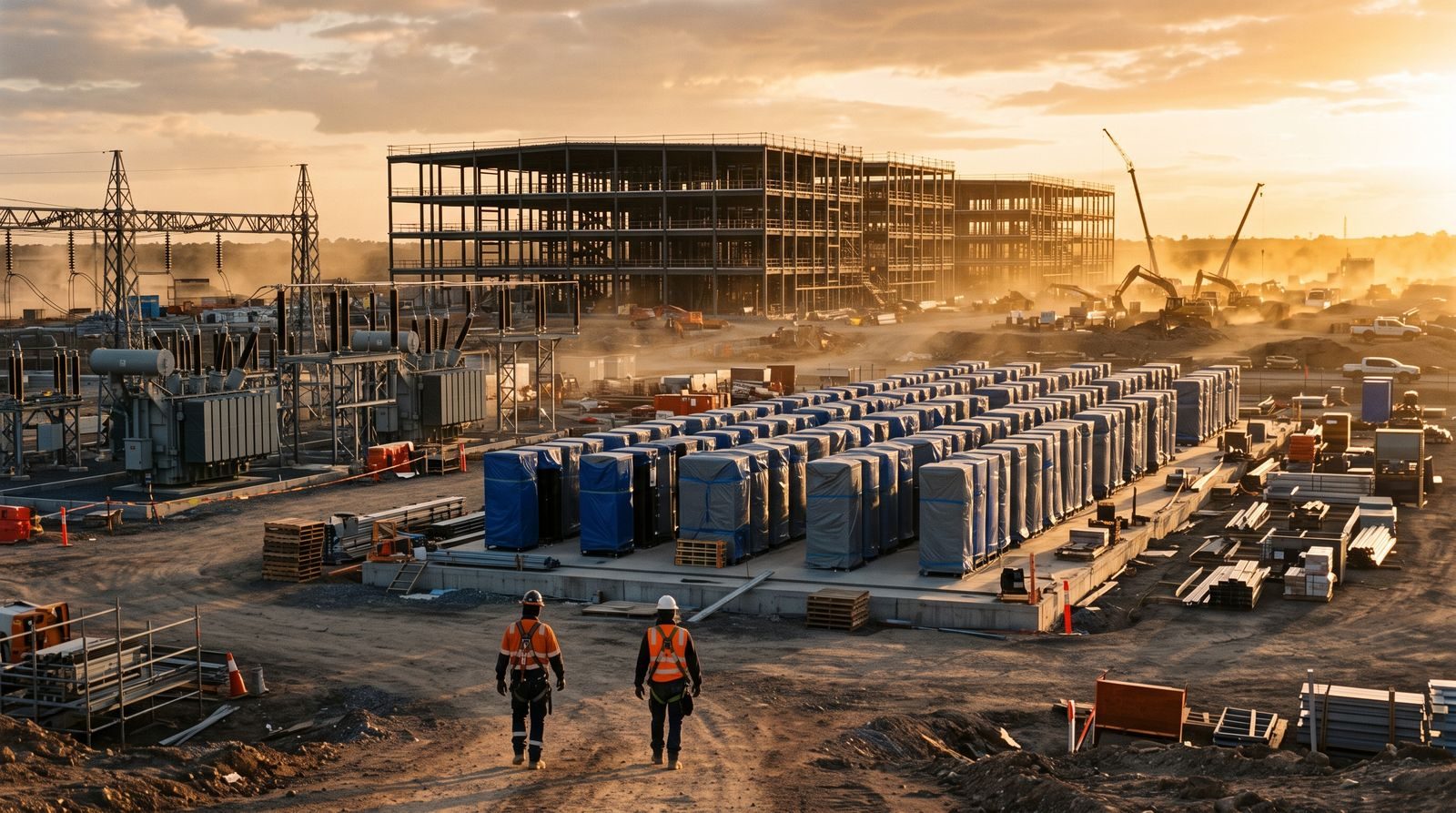
Andreessen Horowitz has closed a $1.1 billion fund that will not buy a single line of software. The Machine Age Fund, announced Friday, is the firm’s first vehicle dedicated to hardware — processors, memory, networking gear, storage, data centres and the robots that will eventually work inside them. The stated purpose is to “accelerate the physical buildout of AI.”
Five partners put their names to it: Ben Horowitz, Martin Casado, Raghu Raghuram, David Ulevitch and David George. That is not a junior team running an experimental sleeve. That is the firm signalling where it thinks the next decade of returns lives.
The irony is not subtle. This is the firm that built its brand on the argument that software would eat the world, raising a fund to buy the things software has to run on.
The margin has moved
Strip the framing away and this is a bet on a supply chain that has stopped behaving like a commodity. Memory is the clearest case: DRAM contract prices have risen more than 400% since the start of 2024, and high-bandwidth memory now absorbs roughly 23% of global wafer capacity. When the input to a business becomes scarce and priced by the seller, the profit pool migrates upstream.
Venture capital has spent three years funding the application layer of AI on the assumption that compute would be abundant and cheap. It has been neither. Every model company that has tried to scale has run into the same wall in the same order: chips, then power, then memory, then the physical building. Those are not software problems and they do not respond to software timelines.
Our take: A hardware fund is an admission about duration. Software venture works because you can find out in eighteen months whether something is working. Substations, fabs and data centres run on five- to ten-year clocks and consume capital the entire way. Raising a dedicated pool for that is the correct structural response — you cannot fund a transformer order out of a fund that needs to return capital in seven years. The read for everyone else is simpler: the constraint on AI is no longer talent or ideas. It is atoms, and the people with the most capital have now said so in writing.
What $1.1 billion actually buys
Less than it sounds. For scale, a single hyperscale data centre campus routinely runs past $1 billion on its own, and Nvidia has disclosed supply commitments in the hundreds of billions. A16z is not going to out-spend the hyperscalers on infrastructure and is not trying to.
What venture money is good for in this category is the component layer — the cooling company, the interconnect startup, the power-electronics business, the robotics firm — where a $20 million cheque still moves a company and where the hyperscalers would rather buy than build. That is a real gap, and it has been badly under-funded relative to the demand sitting on top of it.
It also happens to be a category where the buyers are already known, already desperate and already writing multi-year commitments. Selling into a market that has publicly announced it cannot get enough of what you make is an unusually forgiving place to start a hardware company.
What to watch
- Cheque size. A $1.1 billion hardware fund writing $50 million cheques is a growth fund. Writing $5 million cheques is a seed fund. The two strategies have almost nothing in common.
- Whether other multi-stage firms follow. A16z moving first on a category is usually a leading indicator, not an isolated event.
- Power, specifically. Chips get the headlines; interconnection queues and transformer lead times are what actually stop projects.
- Exit paths. Hardware companies have historically exited to strategic acquirers at modest multiples. If that does not change, the fund maths is harder than the narrative.