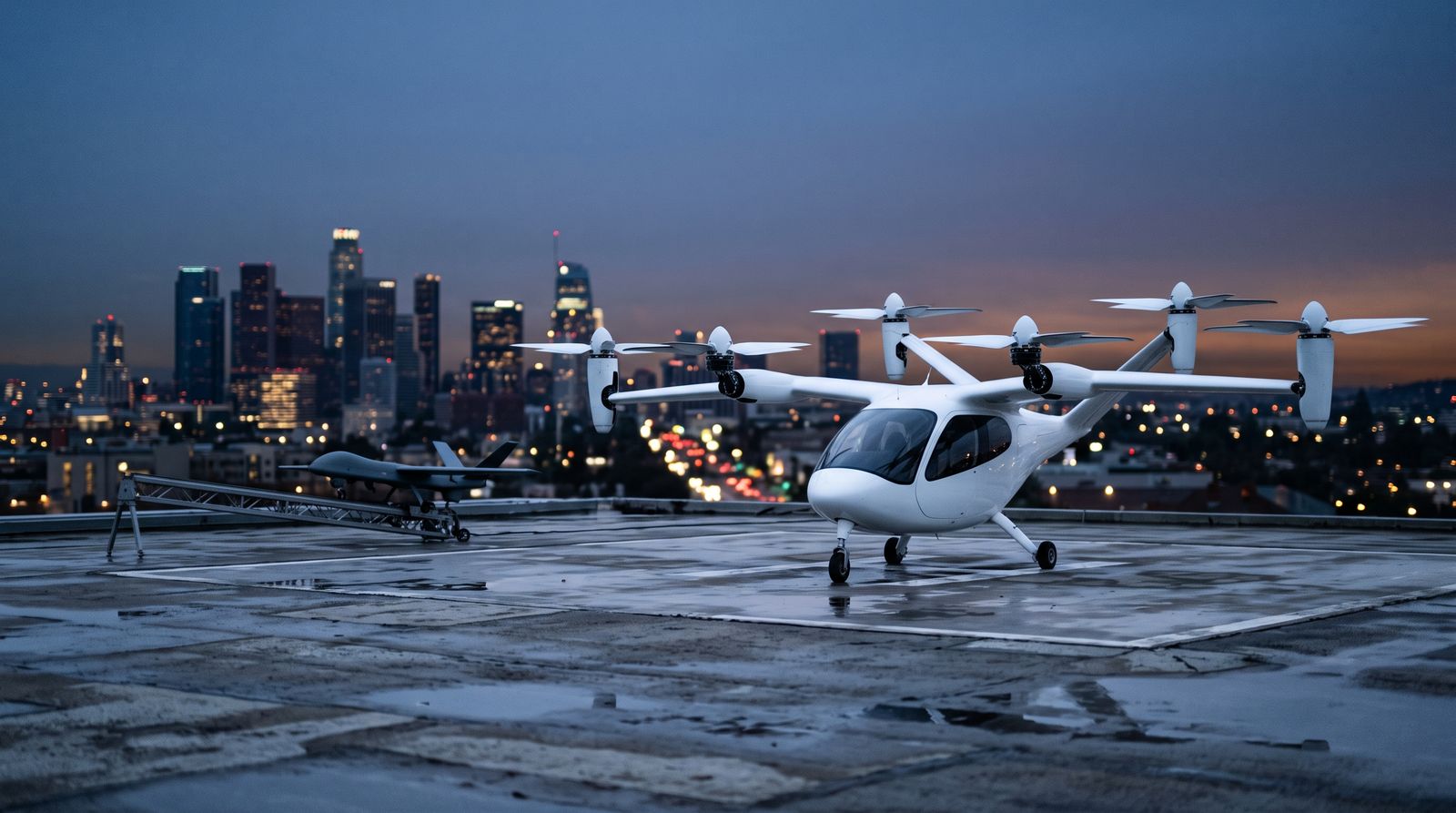
Archer Aviation announced a definitive agreement Monday to acquire three Boeing subsidiaries — Wisk Aero, the autonomous air-taxi programme Boeing has funded since 2019; Insitu, a military drone maker with more than $200 million in annual revenue; and SkyGrid, an airspace-management software business. Archer is paying entirely in paper. Boeing walks away with Class A shares equal to 19.75% of Archer’s pre-close count, a seat on the board, and warrants on another $200 million of stock.
Archer disclosed the deal in the same release as its second quarter. That quarter: $5.0 million of revenue, an adjusted EBITDA loss of $177.1 million, and a net loss of $263.2 million. Third-quarter guidance is another $170–200 million of EBITDA burn. The company has never flown a paying passenger, because the FAA has not certified its aircraft.
So the arithmetic is blunt. Archer is buying a business with $200 million of revenue using a currency it prints, and paying for it with roughly a fifth of the company. Shares rose as much as 20% on Monday and settled up about 12% at $6.26. The market liked it, which tells you what the market thought of Archer’s revenue line before today.
What Boeing is actually doing
Boeing has spent seven years and an undisclosed pile of cash on Wisk without producing a certified aircraft. Rather than write that down or keep funding it, Boeing converted it into equity in the company most likely to certify first — and kept cross-licence rights to Wisk’s autonomous flight systems for its own commercial and defence platforms. It gets the technology and stops paying for the burn. That is a good trade if you have decided eVTOL is a real market but not your market.
The sweeteners tell you how the two sides priced the risk. Boeing agreed to invest up to $55 million in an upcoming Archer round. Its two warrants carry strikes of $13.00 and $17.88 — roughly double and nearly triple Monday’s close. Boeing only makes money on that slice if Archer becomes a materially different company. There is a 12-month lock-up and a 19.9% cap on beneficial ownership from exercises, which keeps Boeing just under the thresholds that would trigger consolidation and a longer list of regulatory questions.
Insitu is the part of this deal that changes Archer’s financial character. It is an established defence supplier with revenue and customers today, bolted onto a pre-revenue aircraft developer. Archer has been drifting toward defence for a while — it co-developed an autonomous attack aircraft with Anduril that turned heads at Farnborough this summer. This is the same pivot, executed with a balance sheet instead of a partnership.
Our take: Read this as Boeing triaging, not Archer conquering. Boeing’s own quarter was a record backlog and a wider-than-expected loss; its scarce resource is management attention on the 737 and 787 lines, not optionality on flying taxis. Handing three non-core units to a buyer who pays in equity converts a cost centre into an asset it can mark, sell or exercise later. Archer, meanwhile, has bought itself revenue and roughly 18 months of a better story while it waits on the FAA. Neither of those is the same as a certified aircraft, and the certification clock is the only clock that ends this.
What to watch
- Antitrust review. The deal is expected to close by the end of 2026 with an outside date of 9 May 2027. Insitu is a defence supplier; that review is not a formality.
- The cash adjustment. The 19.75% is “subject to cash adjustments.” What Boeing leaves in these subsidiaries determines what Archer actually paid.
- Insitu margins under new ownership. A profitable drone business inside a company burning $180 million a quarter is a governance question as much as an accounting one.
- Whether Boeing exercises. $13.00 and $17.88 strikes are the cleanest public signal of what Boeing thinks Archer is worth. Watch the first window after the lock-up.
- FAA type certification. Everything above is financing. In aerospace, the product is the certificate and the production rate — not the announcement.
Archer ended Monday worth a few billion dollars on $5 million of quarterly revenue. It now owns a real defence business and answers to a shareholder that builds actual aircraft for a living. That is a sturdier company than it was on Friday. It is not yet a certified one.