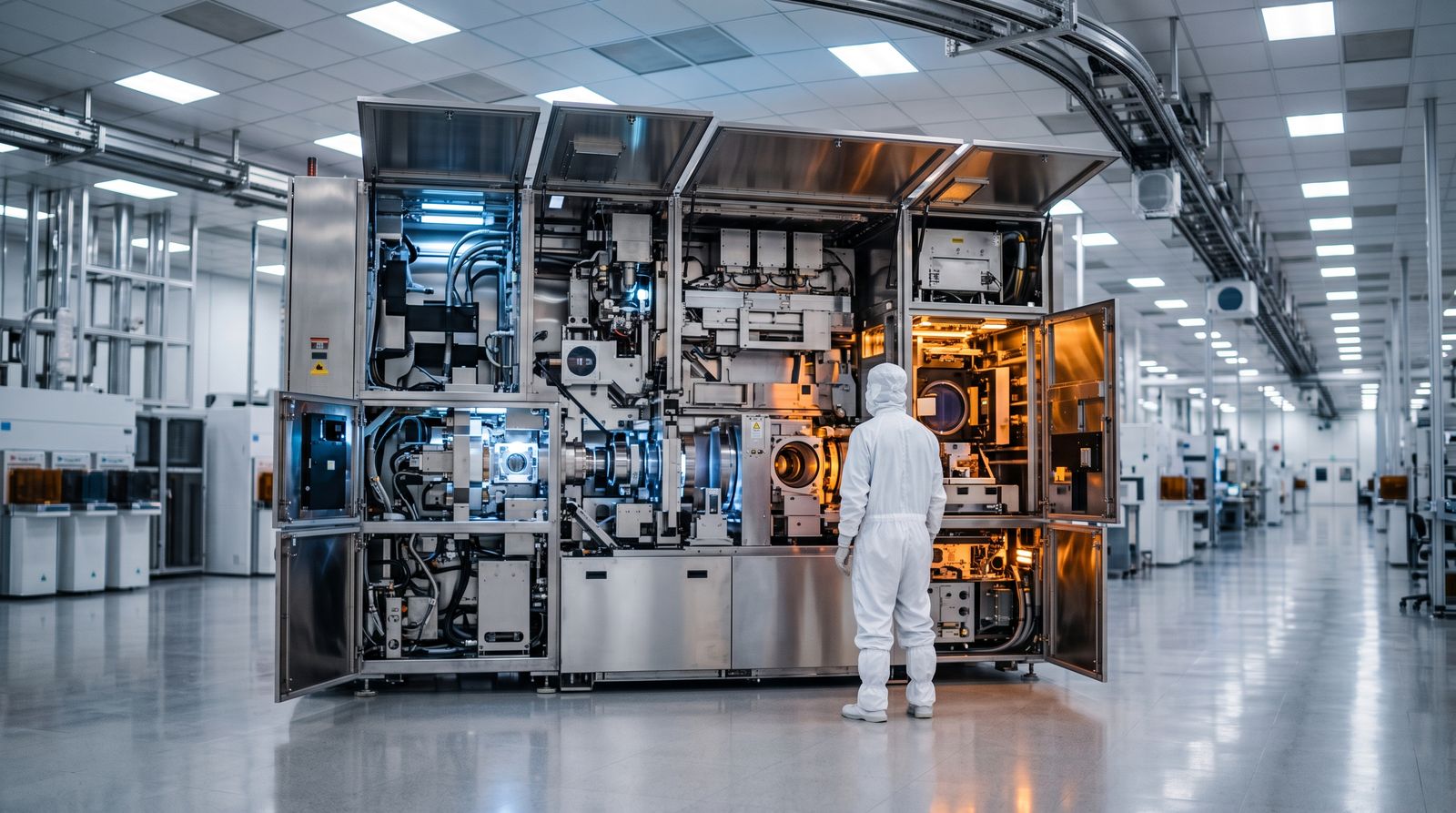
A Shanghai-based, state-backed company has begun mass-producing domestically developed immersion deep-ultraviolet lithography machines for the first time, The Information reported Monday. Bloomberg carried the same report. Chip equipment stocks, which had opened green on the Iran ceasefire, reversed inside an hour.
ASML gave up a gain of more than 2% and traded down more than 6%. Nvidia fell 5.02% to $196.46 by late morning. Applied Materials, Lam Research, KLA and AMD all followed it down. The Nasdaq surrendered its open and traded lower; the S&P 500 sat roughly flat; the Dow, which carries almost none of this, held a small gain. One report, one sector, one afternoon.
The distinction that matters here is DUV versus EUV, and it is not pedantry. Extreme-ultraviolet machines — the leading-edge tool, the one that makes the most advanced logic possible — have been banned from export to China for years, and nothing today changes that. Immersion DUV is the generation below: older, slower to the smallest nodes, and the workhorse behind an enormous share of the chips actually in production. It is also what Chinese fabs spent the export-control era stockpiling, and what turned China into one of ASML’s largest revenue lines.
The chokepoint theory, marked to market
The entire architecture of Western chip controls rests on one claim: that lithography is a bottleneck nobody can replicate on a policy-relevant timeline. That claim is what makes export controls a strategy rather than a tax. Monday was the market marking that claim down — not to zero, but down.
Skepticism is warranted, and it should be specific. “Mass-producing” a first domestic tool is not the same as matching ASML on throughput, yield, overlay accuracy or uptime, and those four numbers are the entire product. A machine that images wafers in a demonstration bay and a machine a fab will bet a $10 billion production line on are different objects. None of that detail was in Monday’s report.
Our take: ASML’s order book did not change today. What changed is the runway investors were assuming underneath it — and when a stock is priced on a moat, the moat is the earnings report. Note the symmetry: this is the second time in one session the market repriced Chinese semiconductor independence. CXMT opened in Shanghai up roughly 472% this morning, valued near $487 billion. Same thesis, two prints, opposite directions. The buyers in Shanghai and the sellers in Amsterdam agreed on exactly one thing.
What to watch
- Specs, not headlines. Independent confirmation of throughput, yield and overlay accuracy is what separates a production-grade tool from a milestone announcement. Until those land, this is a report about a private company that does not publish.
- ASML’s China line. The next quarterly disclosure of China as a share of system sales is now the single most-read number in the company’s deck. Its last guidance raise assumed that line held.
- The policy response. If whole machines can be built domestically, controls shift to components, optics and servicing. Watch The Hague as closely as Washington.
- Wednesday and Thursday. The Fed decides Wednesday, and Microsoft, Meta, Apple and Amazon report into the same 48 hours. Either can bury this story or double it.
Export controls were never designed to stop China permanently. They were designed to buy time — years of it — while the West compounded a lead. The open question has always been how many years were actually in the account. Washington has been trading that balance down all year, licence by licence. On Monday the market took its own look at the ledger and came back with a smaller number than it had on Friday.