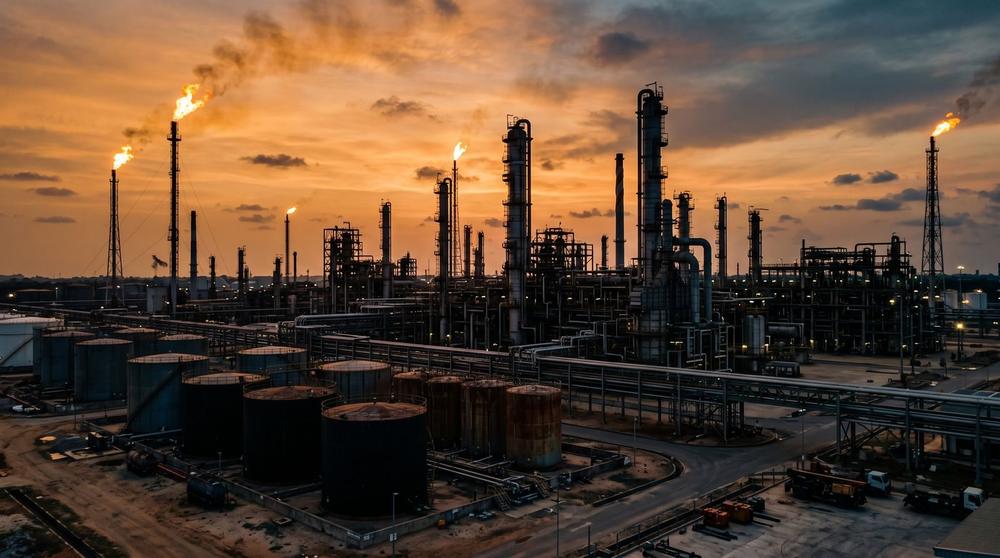
Nigeria’s Securities and Exchange Commission has cleared Dangote’s refinery business to sell shares, opening the largest public offering the continent has attempted. The company will offer 4.1 billion ordinary shares at 525 naira each — about 2.15 trillion naira, or roughly $1.6 billion, if the book fills. The order book is expected to open on 14 September, with a greenshoe allowing about 15% more stock if demand runs over.
The regulator registered 120.13 billion existing shares alongside it. At the offer price that marks the whole company at about $47 billion.
The number worth sitting with is not the raise. It is what a fully subscribed deal does to the exchange listing it: estimates put the increase in total Nigerian Exchange market capitalisation at 30% to 40%. One company. One listing.
This is a refining-margin IPO
The 650,000-barrel-a-day plant outside Lagos cost roughly $20 billion to build and has spent the past two years rewiring where West African fuel comes from. It has also been an unusually direct beneficiary of the supply disruption running through the crude complex since the Iran conflict, shipping jet fuel across Africa and into Europe.
We wrote earlier this week that the record in diesel was a refining story, not a crude story — the barrel was not the constraint, the capacity to turn it into distillate was. Dangote is that thesis with a share price attached. Investors are not being asked to underwrite oil. They are being asked to underwrite the spread between crude and product, at a moment when that spread is historically wide.
Our take: Cyclical assets list at the top of their cycle because that is when they price well, and buyers at the top are underwriting the peak as if it were the average. The proceeds here are earmarked for doubling capacity to 1.4 million barrels a day — which would make it the largest refinery in the world, ahead of Jamnagar. That is a coherent use of money and also the mechanism that compresses the margin funding it. Every barrel of new distillate capacity that comes online is a vote against the crack spread in the prospectus.
The concentration problem nobody is pricing
An index that gains a third of its value from a single admission is not a deeper market. It is a more concentrated one. Nigerian pension funds, domestic institutions and retail buyers who track the exchange will wake up with meaningful single-name exposure to one refinery’s operating uptime, one family’s governance, and one commodity spread — whether or not they bought a share.
That is the same structural issue we flagged when Vale shelved its base metals listing, only running in the opposite direction: there, a government wanted the asset kept close. Here, a national market is about to become a proxy for one plant.
Timing cuts both ways too. The refinery’s recent economics lean on disrupted supply routes, and war-risk premiums that repriced tanker traffic through Hormuz are part of why product cracks look the way they do. Those premiums are a condition, not a moat.
What to watch
- 14 September, and how fast the book builds. Domestic demand versus foreign demand is the real signal — $1.6 billion is a large ask of local liquidity alone.
- Whether the greenshoe gets exercised. It is the cleanest read on whether $47 billion was priced to sell or priced to clear.
- Disclosed utilisation and uptime. A prospectus for a single-asset industrial business lives and dies on run rates, not capacity nameplate.
- Product crack spreads through the fourth quarter. The investment case is the spread. If it normalises before the shares settle, the marks move fast.
- Index weighting rules at the NGX. Whether the exchange caps single-name weight will determine how much forced buying — and forced concentration — passive money has to absorb.