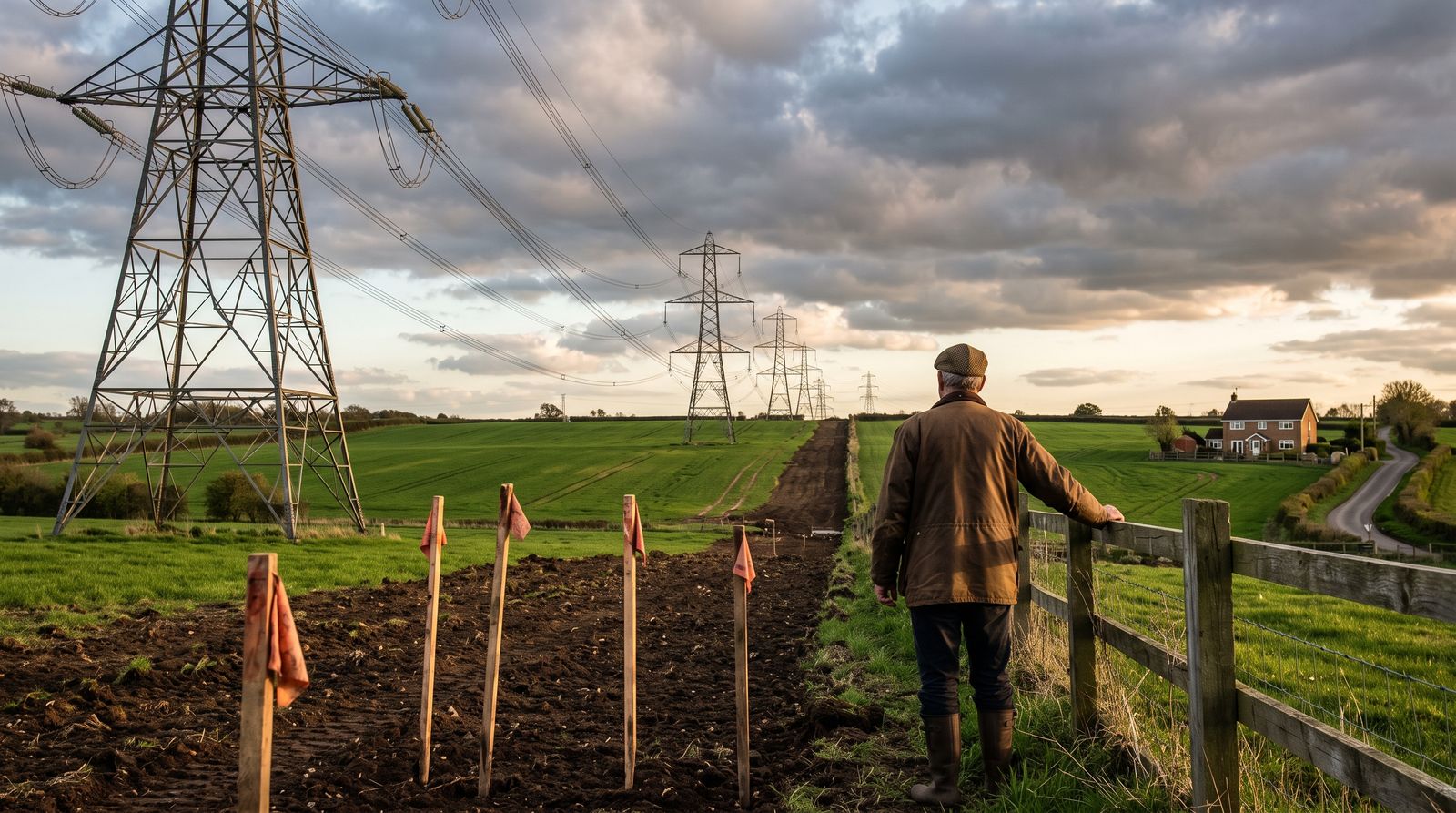
The AI buildout has moved past buying chips and signing power deals. It is now taking land. When owners won’t sell voluntarily, power companies in states including Georgia and Pennsylvania are invoking eminent domain — the government’s power to force a sale — to clear corridors for the high-voltage transmission lines new AI data centers require, Fortune reported Sunday. Data centers already draw more than 4% of US electricity, and the lines that feed them have become the buildout’s most visible — and most resented — footprint.
Georgia is the sharpest case. Georgia Power’s “Project Wansley,” a 500-kilovolt line cutting roughly 35 miles through Coweta and Fayette counties south of Atlanta, targets more than 330 property owners for easements, with 20 to 30 homes slated for outright demolition, per the Atlanta Journal-Constitution and CBS News. It anchors a grid expansion of roughly $16 billion; the utility says it needs about 10,000 megawatts of new capacity, and roughly 80% of that demand comes from data centers — not households. The tenants stay hidden behind code names like “Project Wansley” and “Project Sail,” citing security. One family facing displacement gave CBS its verdict: “It’s theft.”
The timing is combustible. Gallup polling now puts opposition to a nearby data center above 70% — up from 42% nine months earlier — and a data center next door now polls worse than a nuclear plant. In Pennsylvania, farmers in Union and Lycoming counties are fighting a proposed PPL transmission line meant to serve a planned data-center campus, posting signs that read “No eminent domain for corporate gain” while the utility building the line floats condemnation if voluntary deals fail.
Our take: The AI trade prices chips, power and capex — it does not yet price land, courts and county commissions. Utilities usually win eminent domain fights, but supreme courts in Michigan, Ohio and Oklahoma have barred takings that hand property to private parties for economic development, and a line built to feed a handful of private data centers invites exactly that challenge. New York already froze new hyperscale builds when the ratepayer bill came due. The buildout’s binding constraint is shifting from GPUs to consent.
What to watch
- The public-use test. The first state supreme court ruling on whether a line serving private data centers counts as “public use” will echo through every corridor fight in the country.
- Georgia’s statehouse. More than 330 easement fights across two fast-growing counties is how utility corridors become election issues — watch for legislation and Public Service Commission pushback.
- The Gallup trendline. From 42% to above 70% in under a year. If it keeps climbing, New York’s freeze won’t stay unique.
- Disclosure as the price of the corridor. Secrecy about who the lines actually serve is feeding the backlash; naming tenants may become the cost of getting them built.
The megasites keep getting bigger — Meta’s Louisiana campus alone is now 5 gigawatts — and every added gigawatt needs wire strung across somebody’s land. The companies building that wire are consolidating to meet the demand. Whose backyard it crosses just became the AI buildout’s hardest negotiation.