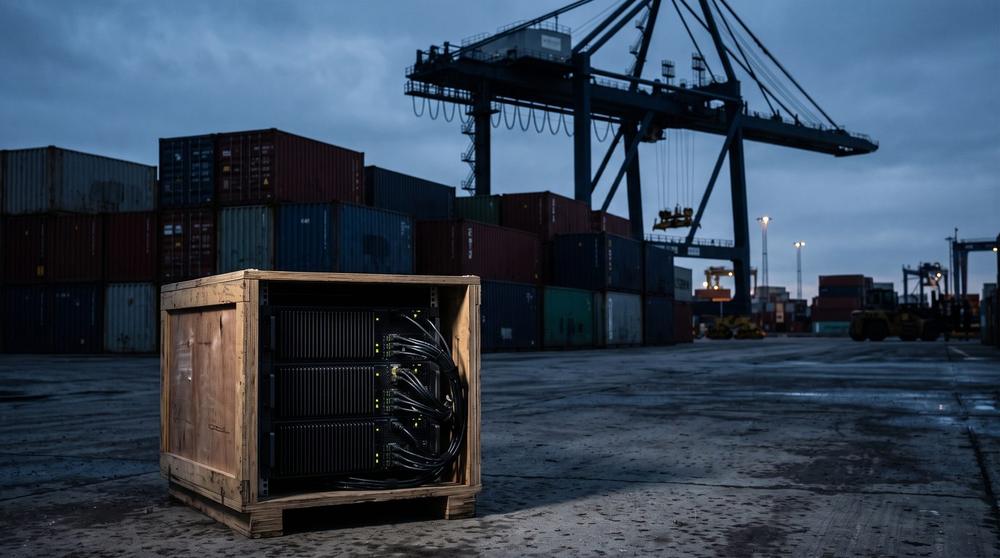
The Justice Department arrested a California businessman on Thursday and charged him with moving more than $300 million of export-controlled computer servers to China. The route, according to the complaint, ran through Malaysia and Singapore before the hardware was illegally re-exported.
Greg Lui, 38, of San Gabriel — also known as Yiu Kong Lui — owns Earthmade Computer Inc. of City of Industry, California. Prosecutors charged him with conspiracy to violate the Export Control Reform Act, outbound smuggling, and conspiracy to commit money laundering. The first and third carry up to 20 years each; the smuggling count carries 10.
The number that makes the case concrete is not the $300 million. It is $7.6 million — the value the department attaches to a single purchase order for 27 servers. Another shipment in the filing references 70. This was not one container. It was a running business with invoices.
The money arrived by wire, from companies that existed
Between January and October 2024, the department says, Earthmade received more than $176 million from Malaysia-based companies. That is the part worth sitting with. The alleged scheme did not depend on forged documents or a hidden compartment. It depended on a buyer in a permitted jurisdiction placing a normal order, paying by normal wire, and then shipping the goods somewhere else.
Export controls on advanced chips restrict the destination, not the product. A server that is legal to sell in Kuala Lumpur and illegal to sell in Shenzhen is the same server. Every control of that shape creates the same arbitrage, and the enforcement burden lands on whoever can prove where the box ended up.
The FBI, the Defense Criminal Investigative Service and the Commerce Department’s Bureau of Industry and Security ran the investigation. FBI Assistant Director Roman Rozhavsky said controlling the export of advanced technology “is critical to safeguarding our national security.”
Our take: The headline figure is the least useful part of this filing. The useful part is the shape — a US reseller, a Malaysian counterparty, ordinary purchase orders, $176 million of clean-looking wires. If you sell anything on a control list, your own order book looks like that too. The question enforcement will ask is not whether you intended to breach a control. It is what you did to find out where the hardware went, and whether you wrote any of it down.
Why the intermediary is the whole problem
Allegations are allegations, and Lui is entitled to a defence. But the structure described in the complaint is not exotic, and that is precisely why it matters commercially. Controlled hardware is high-value, fungible and in acute demand. A compliant sale into a permitted country is one freight booking away from a non-compliant re-export, and the seller usually learns about the second leg from a subpoena.
Two things follow for anyone in that chain. First, a customer’s jurisdiction is not a control — it is the start of one. Second, the distance between “we asked” and “we asked and kept the answer” is the distance between a documented defence and a bad week.
What to watch
- Whether BIS names the downstream buyers. Entity List additions, not the criminal case, are what change other companies’ screening obligations.
- Whether the Malaysian counterparties face action. Enforcement that stops at the US exporter leaves the route open.
- Whether resellers start demanding end-use certificates as standard. Contract language moves faster than regulation, and it is the cheapest available fix.
- The transshipment hubs. Malaysia and Singapore appear here; controls tend to push the route rather than close it.
Nothing in the filing suggests the manufacturers did anything wrong. That is rather the point. The control sits at the border, the demand sits on the other side of it, and the paperwork in between is doing more work than most companies realise.