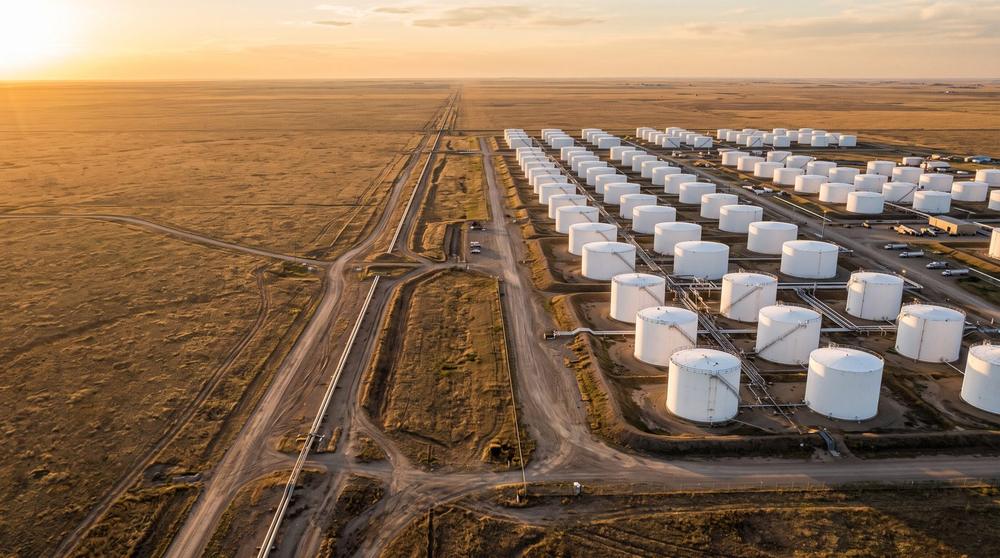
Enbridge agreed to acquire Tallgrass Energy’s crude transportation business for $2.55 billion in cash, the company announced Wednesday. The package: a 75% interest in the 1,050-mile Pony Express Pipeline, a 51% interest in the Powder River Gateway system, and roughly 8.4 million barrels of crude storage spread across nine terminals.
Pony Express moves about 460,000 barrels a day from Rockies production into Cushing, Oklahoma, where it reaches roughly 500,000 bpd of refining capacity. Powder River Gateway adds two lines and about 240,000 bpd of feeder capacity upstream. Bundled in is PXP2, a roughly $300 million expansion that lifts Pony Express to about 515,000 bpd, underpinned by take-or-pay contracts and slated for service in late 2027.
The deal is expected to close later this year subject to US antitrust clearance. Enbridge said an equity offering will partly fund this and a second acquisition, with the balance kept as flexibility for future growth.
Why buy instead of build
A 1,050-mile interstate crude line is, in 2026, effectively unbuildable. Permitting timelines, litigation risk and landowner opposition mean the replacement cost of Pony Express is not a construction estimate — it is infinity, because you cannot get one approved. That is what Enbridge is really paying for: a route that exists.
The economics follow. Take-or-pay contracts on an expansion into an existing right-of-way is about the lowest-risk capital deployment in energy infrastructure: the shippers commit before the steel goes in, and the corridor is already permitted. Compare that with the return profile of anything requiring a new easement.
There is a second read. Rockies production needs a path to Cushing regardless of what crude does, and Cushing is where price discovery happens for WTI. Owning the tollbooth on that road is a volume business, not a price business — which is precisely the exposure you want when crude is being whipped around by Middle East supply scares and refining bottlenecks rather than by demand.
Our take: Funding a cash acquisition with equity is the part investors will grumble about, and they are not wrong to — issuing shares to buy fee-based cash flow only works if the multiple you pay is below the multiple you trade at. But the strategic logic is hard to argue with. In a permitting environment where nobody can build a new long-haul crude line, the existing lines become scarce assets with pricing power, and the only way to grow the network is to buy someone else’s. Expect more of these. The scarcity is structural, and every midstream operator with a balance sheet knows it.
What to watch
- Antitrust. Enbridge already has substantial US liquids capacity. A Cushing-adjacent consolidation invites a closer look than the headline size suggests.
- The equity offering. Size, timing and pricing will tell you what Enbridge thinks its own currency is worth against the assets it is buying.
- PXP2 in late 2027. Take-or-pay contracts convert a construction project into an annuity. Watch whether the shipper list is investment grade.
- Rockies volumes. The whole thesis rests on barrels continuing to need a road east. A production decline in the basin is the one thing a toll road cannot hedge.
Infrastructure companies grow two ways: build new, or buy old and expand it. One of those options has been closed for a decade. This is what the other one costs.