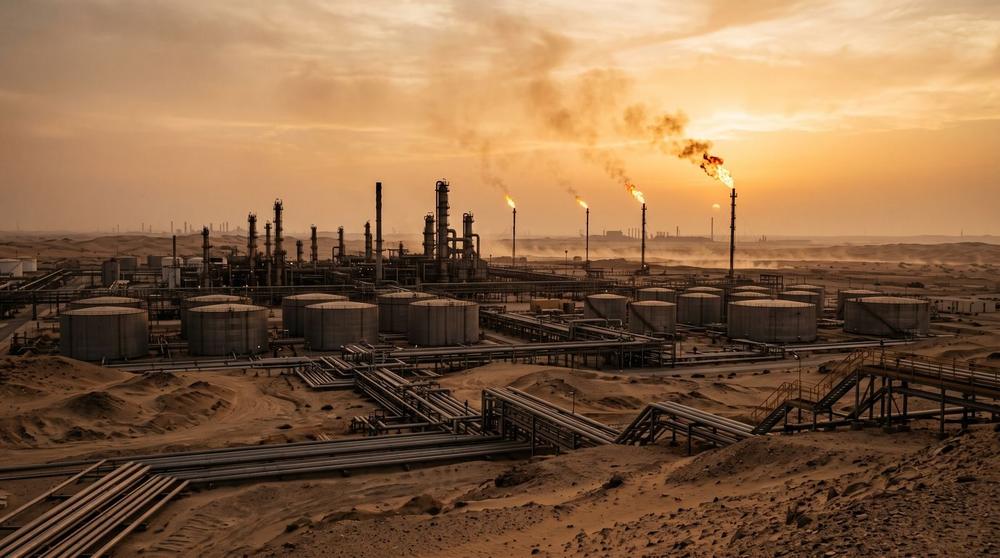
Saudi Arabia halted operations at some energy facilities on Tuesday after Houthi drones and ballistic missiles struck Aramco sites, wounding 73 people. The Houthi military spokesman described it as a broad offensive, naming Aramco facilities at Abha, Najran and Jizan and an air base at Khamis Mushait.
Brent rose 1.67% to $98.61 a barrel in Tuesday morning trade, having earlier touched $99.46 — its highest since 24 July. WTI reached $94.73, the highest since 8 June. US index futures went the other way: Nasdaq 100 futures were off 0.06%, S&P 500 futures 0.28% and Dow futures 0.78% at 5:40am ET.
A two-dollar move in Brent is not the story. The calendar is.
The timing is the whole trade
The FOMC meets on 15–16 September. Going into this week, market-implied odds of a 25bp hike sat around 58–60% on CME FedWatch pricing, lifted by August payrolls of 162,000. An energy supply shock landing six trading days before that meeting does not arrive into a neutral policy backdrop. It arrives into a market already arguing about whether the Fed tightens.
This is the inversion that has defined 2026 and that most positioning still has not fully absorbed. In an easing cycle, an oil spike is disinflationary at the margin because it is demand destruction — equities sell off, bonds rally, the Fed looks through it. In a cycle where the committee is weighing a hike against an inflation print that energy feeds directly, an oil spike is not a hedge. It pushes the front end and the equity market the same direction: down.
Our take: Watch which facilities were named before you price the barrel. Abha, Najran and Jizan sit in the southwest, near the Yemeni border — that is refining and domestic distribution geography, not the Eastern Province crude export backbone. A refinery outage tightens product cracks; a terminal outage tightens export crude. Those are different trades with the same headline. The market has so far moved about a dollar and a half, which suggests it is pricing disruption risk rather than an actual loss of export barrels. That is the right first read. It is also the read that changes fastest if the target list moves east.
Products, not crude, is where the tightness shows first
Distillate has been the pressure point all year — the constraint has been refining capacity rather than the availability of crude. A strike that halts operations at southwestern Saudi refining and distribution assets lands directly on that constraint, in a market that has almost no spare refining slack to absorb it.
The insurance market has been telling the same story for weeks. War-risk cover for tankers through the Strait of Hormuz has repriced from 1–3% of hull value to 7.5–10%, and several P&I clubs have withdrawn from the trade entirely. Underwriters do not price temporary disruptions at fortyfold pre-crisis levels. They price a regime.
Equities are, so far, treating this as a Dow problem rather than a Nasdaq problem — the 0.78% futures drop in the Dow against 0.06% in the Nasdaq 100 is the cyclicals-and-industrials complex reacting to input costs, not a growth-multiple repricing. That split holds until the rate path moves. If Brent clears $100 and stays there into the FOMC, it stops being a Dow problem.
What to watch
- Whether Aramco confirms the scale and duration of the outage. “Operations halted at some facilities” covers everything from a precautionary shutdown to weeks of repair.
- Product cracks versus crude. If diesel and jet cracks widen faster than Brent, the market has correctly identified this as a refining event.
- Whether hike odds move with the barrel. If FedWatch pricing pushes meaningfully past 60% on an oil move alone, the committee's energy pass-through assumption is being repriced in public.
- The target list. The single variable that separates a two-dollar move from a ten-dollar one is whether anything east of Riyadh is hit.
Oil at $98 with the Fed leaning hawkish is a materially different market from oil at $98 with the Fed leaning dovish. Same barrel, opposite hedge.