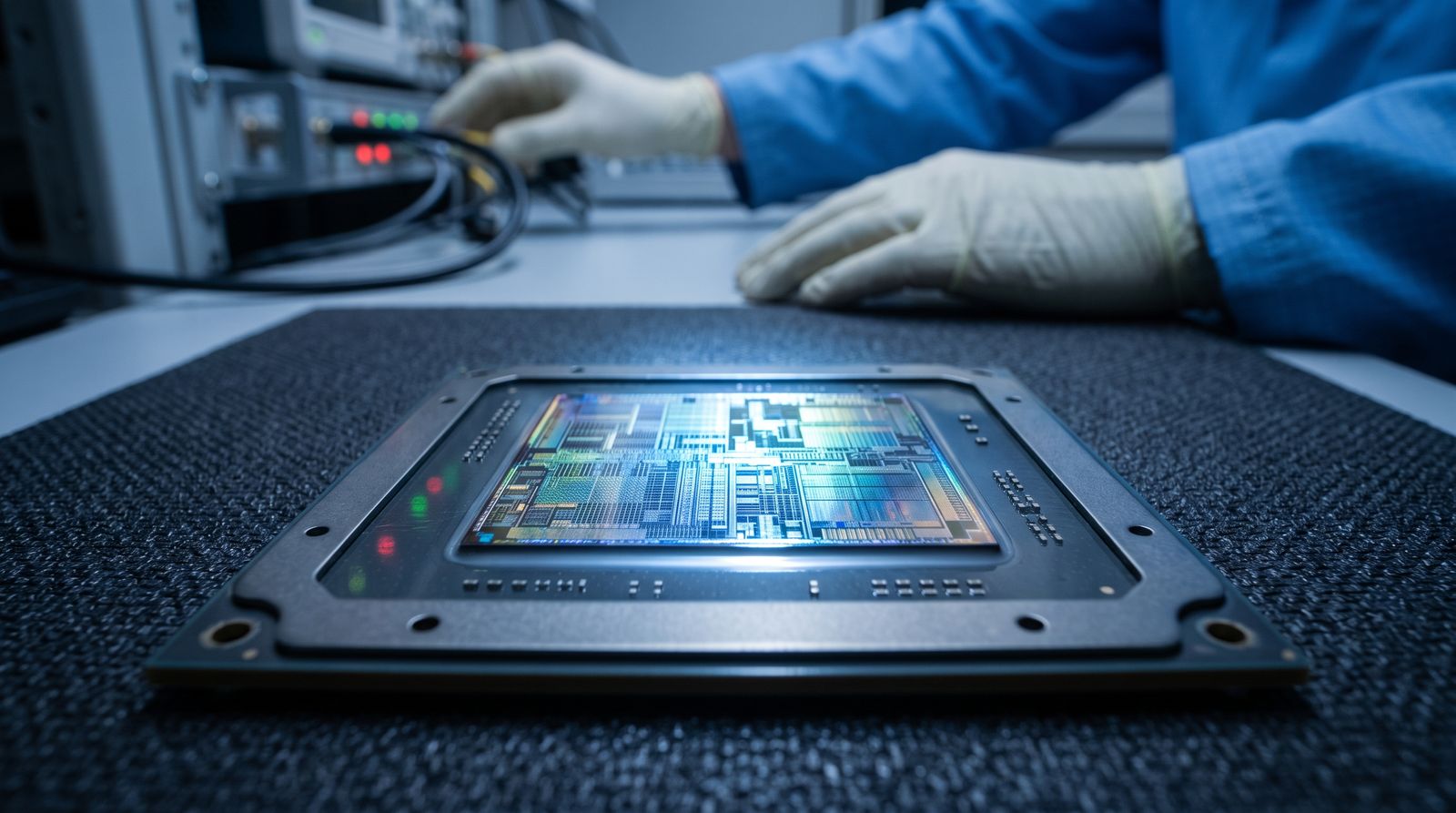
Etched raised $300 million in a Series C at a $10.3 billion valuation, co-founder and COO Robert Wachen confirmed to TechCrunch on Thursday. Sequoia led. Andreessen Horowitz, SK Hynix, Jane Street and Diffusion Capital came in alongside earlier backers. The company says it is the highest valuation Sequoia has ever led a Series C at.
The number that matters more is the slope. Etched was worth $5 billion in December, when it raised $500 million. Seven months later it is worth $10.3 billion, which takes total funding past the billion mark. Last month it said its first homegrown silicon had come back from TSMC successfully, that early customers were testing full systems, and that it had booked roughly $1 billion in orders. Four hundred people now work there. It runs a 2-megawatt data center of its own.
Founded in 2022 by CEO Gavin Uberti, Wachen and CTO Chris Zhu — all three left Harvard to do it — Etched spent most of its life as the company people wrote skeptical posts about. Building a chip for one model architecture was considered, in the polite version, wild.
The bet is that generality is overhead
A GPU is a general-purpose machine. It can run anything, which means it carries transistors, scheduling logic and data paths that a given workload will never touch — and it burns power moving data around to preserve that optionality. Etched’s argument is that inference has hardened enough to stop paying for the option.
Its systems split the job the way inference actually splits. Wachen describes two stages: prefill, where the model reads the prompt and its context, which is compute-heavy math; and decode, where it emits the answer token by token, which is light on math and brutal on memory bandwidth. Etched built separate hardware for each. The prefill chip runs at unusually low voltage — less heat per operation, so more transistors fit in the same thermal budget. For decode it built its own memory and interconnect, letting many chips share one low-latency pool.
Note what this is not. Etched sells full systems, not loose chips, and Wachen says they run any model — mixture-of-experts designs like DeepSeek and Qwen, and non-transformer architectures like Mamba included. The persistent belief that these are single-model boxes is the perception the company is still fighting.
Our take: The idea that got Etched mocked in 2022 is now the consensus play at the top of the industry. TechCrunch itself notes the parallel: Google is reportedly building Frozen v2, a chip with Gemini’s architecture etched into silicon, targeting six to ten times the tokens per watt of its current TPUs. DeepSeek is designing its own inference silicon. AMD is shipping rack-scale Helios systems against Nvidia’s fabric. Every one of these is the same wager — that inference is now a big enough, stable enough workload that specialization beats flexibility. The reason it is happening now is arithmetic, not fashion. When a single hyperscaler guides to $195–205 billion of capex and posts negative free cash flow, tokens-per-watt stops being an engineering metric and becomes the P&L. A 30% efficiency gain at that scale is worth more than most companies. That is what a $10.3 billion valuation on a pre-scale hardware company is actually pricing: not chips, but the cost curve of everyone else’s AI bill.
What to watch
- Orders converting to revenue. A billion dollars in bookings is a promise until racks ship and run in customer data centers. Wachen’s own line is the honest one: they still have to be humbled by what getting to scale takes.
- Who has actually used it. Access has been limited to investors and early customers, largely through private demos. That is a fine way to raise money and a weak substitute for independent benchmarks. Watch for third-party numbers on cost per million tokens.
- SK Hynix on the cap table. A memory maker investing in a company whose whole decode thesis is custom memory and interconnect is not a passive check. Supply access is the scarce input in this build.
- Architecture risk, still. Specialization only pays if the workload holds still. Etched says its systems run non-transformer designs too — the claim to test is how much of the efficiency edge survives when they do.
- The read-across on price. If specialized inference lands where its backers think, the floor under token pricing drops again — and the pressure lands on whoever is renting out general-purpose compute at today’s margins.