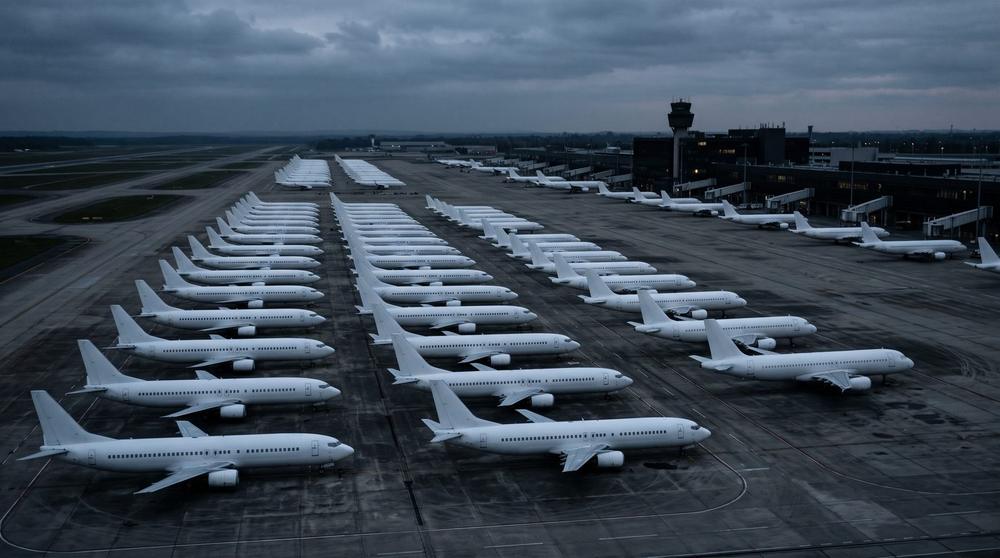
The Federal Aviation Administration ordered a ground stop on every departing flight in the United States on Friday afternoon. The alert, addressed to all aircraft operators by the FAA Command Center, said departures were halted “due to extraordinary circumstances and for reasons of safety,” and that all departing traffic should remain stopped until further notice. Inbound international flights were to be handled case by case.
Transportation Secretary Sean Duffy said the order followed a communication issue affecting all Air Route Traffic Control Centers — the regional facilities that hand aircraft between airports once they are above the terminal area. FAA technicians were investigating. Duffy’s statement did not name the system involved, did not identify a cause, and did not give a time for flights to resume.
Reuters called it the second nationwide ground stop of all departures since September 11, 2001. The first was January 11, 2023, when the Notice to Air Missions system failed; that one lasted roughly 90 minutes, and the FAA later traced it to contract personnel deleting files during a database sync.
What is confirmed, and what isn’t
Confirmed across multiple outlets: the order itself, its wording, its nationwide scope, Duffy’s “communication issue” framing, and that aircraft already airborne were allowed to continue and land. AeroTime, citing Flightradar24, put roughly 3,100 aircraft in the air and bound for US airports during the stop — a count of flights aloft, not of flights delayed.
Not confirmed, and worth holding loosely: the start time. AeroTime placed the order shortly before 4pm Eastern. One aviation outlet reported, on an unnamed source, that the problem surfaced around 3:30pm at Kansas City Center and spread outward, and described it as a radio equipment outage — wording that conflicts with the FAA’s own. Neither claim has a second source.
Also absent, at the time of writing: a delay or cancellation count from any tracking service, a statement from any airline, a named cause, a restart time, and — notably — any statement ruling a cyberattack in or out. Nobody has alleged one. Nobody has excluded one either.
Our take: The detail that matters is not the outage. It is the timing. Hours before departures stopped, OMB Director Russell Vought and Secretary Duffy sent Congress a request for $30.1 billion to modernise the air traffic system. The failure then demonstrated the case for the cheque on the same news cycle the cheque was asked for. That is an argument that writes itself — which is exactly why the next two weeks deserve scrutiny rather than sympathy. A system that fails nationwide is evidence of underinvestment or of fragile change management, and the difference between those two decides whether $30.1 billion fixes anything.
The ask
The request breaks down into three lines: $10.1 billion for air traffic control modernisation — $7.2 billion of it for a common automation platform and controller workstations, $2 billion for cloud computing — plus $2 billion to replace control towers and $18 billion for airports, including $10 billion for aging terminals. American, Delta, United and Southwest back it.
The letter claims the FAA has replaced 68% of its legacy copper telecommunications network with fibre. Reuters notes the agency still runs decades-old computers, sources replacement parts from auction sites, and said last week it would retire the floppy disks used for critical information at more than 400 facilities — by the end of 2028.
This is not the first tranche. Congress approved $12.5 billion over five years in July 2025 for the same system and for controller hiring. Last December, then-administrator Bryan Bedford committed $6 billion to new telecom and radar surveillance infrastructure, for deployment by end-2028, and said the administration wanted $19 billion more to finish the job. The arithmetic of those overlapping figures has never been published in one place.
Why the timing is awkward in both directions
The administration wants the Republican-led Congress to pass this in the final weeks of the year. Democrats take control in January. A nationwide outage three days into that push is either the strongest possible argument or the most convenient one, and the honest answer is that it is too early to know which.
What is knowable is the pattern. September brought failures at a Philadelphia control facility and a fibre cut in New Jersey that disrupted thousands of Northeast flights. The January 2025 midair collision at Reagan National killed 67 people. Friday makes a third category of event in under a year, and the first that touched every centre at once.
For operators, the distinction between a local failure and a universal one is the whole point. A regional outage routes around. A failure in every en-route centre has no alternate, because there is no second system — a dependency problem we have written about in other infrastructure contexts, where the backup and the primary share a root.
What to watch
- The cause, named and dated. Equipment failure, telecom vendor, software change or something else. The 2023 outage took weeks to attribute properly. Treat early explanations as provisional.
- Whether the FAA publishes an affected-flight count. Its absence on the night is normal. Its absence next week would not be.
- Airline cost disclosures. A lost Friday in November is not a lost Friday in July, but crew legality and aircraft positioning cascade into the weekend. Watch for Q4 commentary rather than press releases.
- Whether the $30.1 billion moves before January. If it passes quickly, note which line items survive. The $18 billion for airports is the part least related to Friday.
- Any revision to the 68% fibre figure. It is the administration’s own number and currently uncorroborated.
One nationwide outage does not prove a system is broken. It does prove there is no second one.