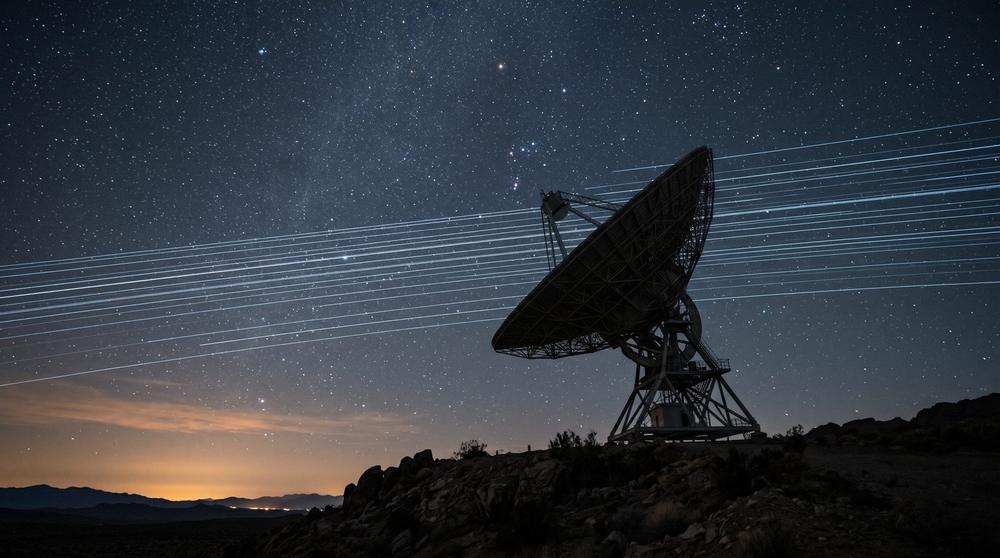
The Federal Communications Commission granted SpaceX authority to deploy up to one million satellites. Not a petition, not a notice of inquiry — a grant, signed under delegated authority as DA-26-1273 and published on Wednesday, the day before Thanksgiving. The constellation is called Starmind, and its purpose is to put AI compute in orbit.
SpaceX filed the application on 30 January. Ten months later it has the largest satellite authorization ever issued, and the staff-level docket number means no Commission vote on the record. Neither of the two detailed accounts we read reports a vote count or a dissent.
Then there is the deadline. One million satellites, and the first binding milestone is that SpaceX must have one of them operating by 25 November 2033.
The three dates — or two, depending who you read
- 25 November 2033: first satellite deployed and in operation.
- 25 November 2038: 50% of the constellation deployed.
- 25 November 2040: full constellation operating.
That is the schedule as Spaceflight Now reports it from the order. GeekWire's account of the same grant carries the 2033 and 2040 dates and no 50% milestone at all. We cannot reconcile that from the coverage, and the order's own text is the only place it can be settled.
Either way the shape is the same: a seven-year runway to a single spacecraft, and nothing enforceable about scale until the late 2030s. Musk told Spaceflight Now he expects a first launch in the third quarter of 2027, with volume through '28 and '29. That is a chief executive's forecast, not a licence condition, and the two should not be filed in the same drawer.
What is actually authorized
The satellites sit in orbital shells each spanning 50 km, at altitudes from 500 to 1,002 km, at 30-degree and sun-synchronous inclinations. Communications are primarily optical. The Ka-band grant is narrow on purpose — telemetry, tracking and command only, and only if the optical links fail, on 18.8–19.3 GHz down and 28.6–29.1 GHz up. That narrowness is how the FCC disposed of interference objections from Viasat, Amazon Leo and the American Astronomical Society.
One condition deserves more attention than it is getting. SpaceX asked to dispose of retired satellites into heliocentric orbit, which is what you need above roughly 600 km where atmospheric re-entry stops doing the work for you. The FCC deferred that request. Before deploying or operating any satellite that will not be disposed of by re-entry, SpaceX has to file for a modification of this authorization. The upper shells are drawn on the map; they are not cleared to fly.
The number nobody published
There is no power figure in the grant. The FCC licenses spectrum and orbits, not watts, so this is not an omission on its part — but it leaves the single most important question about an orbital data centre unanswered in the only document that binds anyone.
The closest thing to a figure is SpaceX SVP Michael Nicholls at October's IAC, describing each craft as "might be something like a 250 kilowatt satellite," roughly a rack of compute, in clusters of about ten with 10 Tbps interconnect. Run the authorized cap against that hedge and you get 250 gigawatts of orbital compute. We are showing that arithmetic to make a point about its inputs, not because it is a forecast: a maybe-number from a conference stage multiplied by a regulatory ceiling is not a capacity estimate.
Our take: The headline number and the operative number are seven orders of magnitude apart, and only one of them is enforceable. A million-satellite ceiling is an option on scale that costs SpaceX one satellite by 2033 to keep alive — which is the rational thing to ask for and the wrong thing to read as a plan. The deferred disposal waiver is the tell: the agency cleared the easy half and sent the hard half back for a second filing.
What to watch
- The modification application for non-re-entry disposal. Nothing above 600 km operates as described until that clears, and it is a separate fight with its own record.
- Whether a 50% milestone exists. One account has it, one does not. The order settles it.
- The queue behind this one: Blue Origin has applied for 51,600 satellites, Starcloud 88,000, Cowboy Space 20,000. All three combined come to 159,600 — about a sixth of what one company just had approved.
- Any filed power or thermal figure. Heat rejection, not launch cost, is the constraint critics keep naming, and no public filing has put a number on it.
- Astronomy coordination. The FCC found optical-astronomy concerns "sufficiently addressed" and ruled non-spectrum impacts out of scope; the AAS says the licence lacks a formal coordination requirement. There is no referee between those two positions yet.