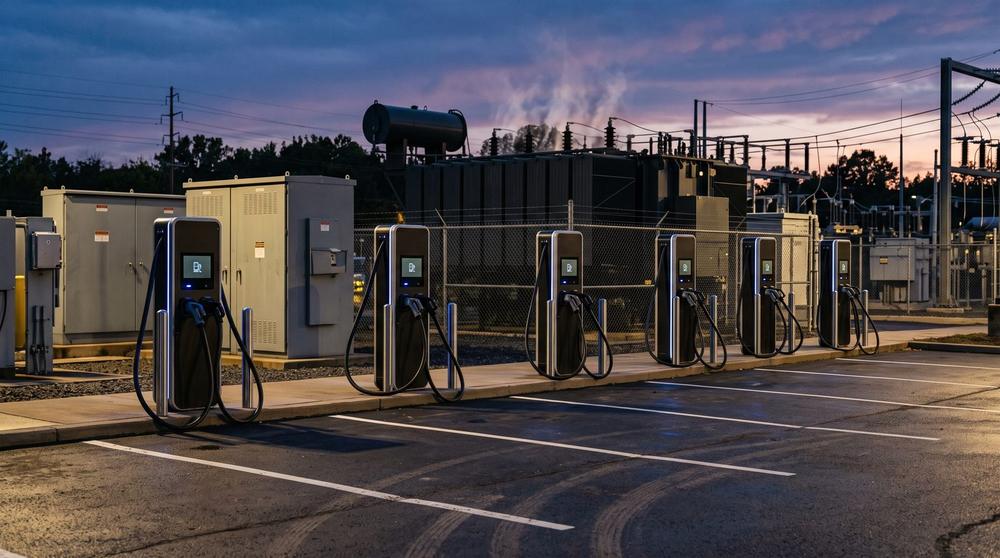
Geely Auto Group announced on Wednesday a charging system it says delivers 2.2 megawatts — roughly half again the 1.5MW of BYD’s Flash Charging 2.0, and the current high-water mark in China’s megawatt charging race. In company tests, a Zeekr 001 and a Lynk & Co 10 went from 10% to 70% state of charge in four minutes and 30 seconds, and from 10% to 97% in eight minutes 40 seconds.
The headline writes itself: a four-minute charge. The more interesting engineering is in what Geely had to solve to get there, because the cable was never the hard part.
Two claims carry the announcement. First, a five-point liquid cooling system that manages heat across the whole charging chain rather than at the pack alone, with AI thermal management holding average battery temperature at 55°C and capping the peak below 65°C. Second, lithium-ion pulse restoration — micro-pulse currents intended to reactivate lithium that accumulates at the negative electrode during repeated fast charging, which Geely says adds up to 20% of battery cycle life.
Degradation was the constraint, not speed
Pushing enormous current into a lithium-ion cell has always been technically straightforward and commercially stupid. Heat and lithium plating are what turn a fast-charging spec sheet into a warranty liability three years later. Every megawatt-class announcement to date has been implicitly a bet that the manufacturer can absorb that cost. Geely is claiming it has attacked the degradation directly instead — and the 20% cycle-life figure, if it survives independent testing, is a more consequential number than the 4:30.
Our take: This is a grid story with a car headline. A single 2.2MW stall draws roughly six to fifteen times a conventional 150–350kW DC fast charger. Put four of them on one forecourt and the site’s peak demand rivals a small industrial plant — which means the binding constraint on rollout moves from the vehicle to the interconnection queue, the transformer, and whatever buffer storage sits behind the stalls. Charging speed is now an electrical-utility procurement problem, and utilities move on a different clock than automakers.
Why the race is happening in China
Fast charging is the competitive axis where Chinese manufacturers can differentiate without waiting on battery chemistry breakthroughs, and it maps directly onto the one objection that still keeps buyers in combustion cars. BYD set the bar at 1.5MW. Geely has answered within months. That cadence — a major charging spec leapfrogged inside a single year — is the tell that this has become a marketing war as much as an engineering one.
The caution is the usual one with manufacturer-run tests: these are company figures, on company vehicles, at company chargers, under conditions Geely selected. The 10%–70% window is also the easy part of the curve. Nobody publishes the 80%–100% time because nobody wants to.
What to watch
- Site count, not stall specs. How many 2.2MW-capable locations actually get energised, and how fast.
- Independent cycle-life testing. The pulse restoration claim is the one that would genuinely change the economics.
- Grid buffering. Whether these sites need on-site storage to avoid demand charges that would swamp the margin.
- BYD’s response. The last leapfrog took months. The next number is the one that tells you whether this is converging or accelerating.