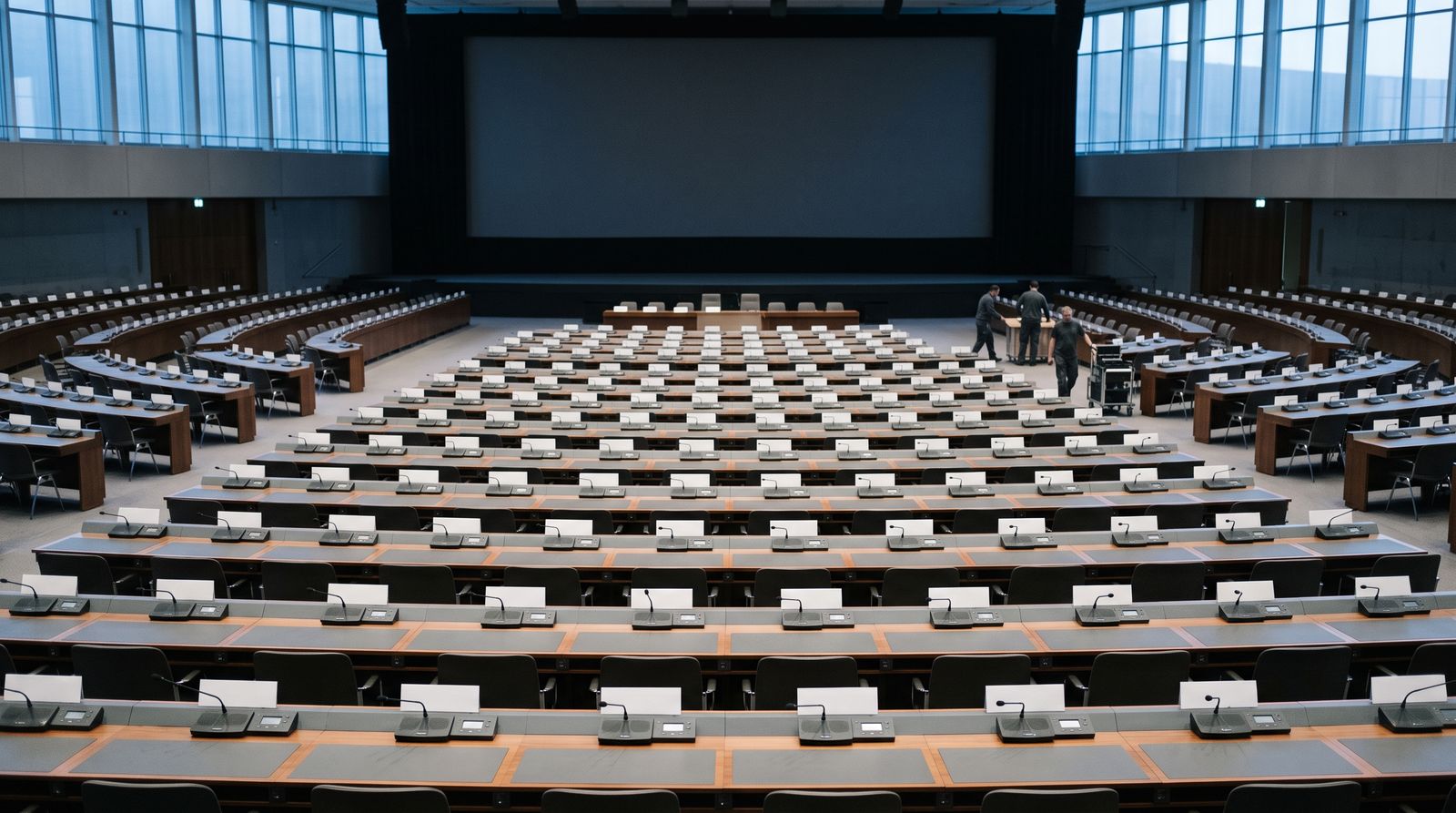
Hours before the United Nations’ first summit devoted to AI governance gavels in at Geneva’s Palexpo, the UN’s own newsroom published interviews with the four people running it. Read them closely: together they form a map of what Monday can deliver — and a quiet pre-brief on what it can’t.
The Global Dialogue on AI Governance, created by a General Assembly resolution, convenes all 193 member states on July 6–7 alongside tech companies, academics and civil society. On the agenda: a high-level segment featuring UN Secretary-General António Guterres, thematic sessions, and the formal presentation of the first report from the UN’s 40-expert scientific panel — the one whose bluntest line about AI agents we covered this morning.
Sunday’s quotes set the tone. Panel co-chair Yoshua Bengio: “With growing evidence of deceptive AI behaviour, science currently cannot guarantee that as capabilities continue to increase, AI will not cause catastrophic harm, either on its own or due to malicious users.” His fellow co-chair Maria Ressa calls AI-accelerated disinformation an “information Armageddon” and compresses the summit’s thesis into nine words: “The world cannot govern what it cannot understand.”
The two-country problem
Estonia’s Rein Tammsaar, who co-chairs the Dialogue with El Salvador’s Egriselda López, named the structural tension politely: frontier AI development is “basically concentrated in two countries.” The other 191 delegations are negotiating over a technology they neither build nor control, and developing countries fear the AI divide hardens into something permanent. That is the agenda under the agenda — not whether AI gets global rules, but whether anyone outside Washington and Beijing gets a hand on the pen. The US, for its part, isn’t waiting: the White House has been drafting release standards directly with its three frontier labs.
Our take: Nothing binding comes out of Geneva this week — no treaty, no enforcement, no deadlines. A “dialogue” is diplomacy’s lowest-stakes format, and that’s by design. Dismissing it would still be a mistake. Soft consensus is where hard rules get born: the panel’s report is about to become the citation base for every national AI bill drafted over the next year, much as IPCC assessments quietly wrote a decade of climate law. If you build or deploy AI, the sentence to price in isn’t in any communiqué — it’s 40 scientists agreeing, on the record, that safety can’t currently be guaranteed. Regulators will quote it back at the industry for years.
What to watch
- Monday’s report presentation. Do member states embrace the panel’s risk framing, or sand it down to applause lines? Sessions stream live on UN Web TV.
- Who the US and China send. Delegation seniority is the honest signal of how seriously the two frontier powers take a 193-country format.
- Money vs. language. A concrete capacity-building commitment for developing countries is the difference between a summit and a photo op.
- The Geneva stack. WSIS Forum (July 6–10) and AI for Good (July 7–10) run the same week in the same city. Expect companies to time announcements to ride one shared news cycle.
Geneva won’t produce rules this week. It will produce the vocabulary the rules get written in — and after a week in which Washington and the UN started sprinting in parallel, vocabulary is exactly where the race stands.