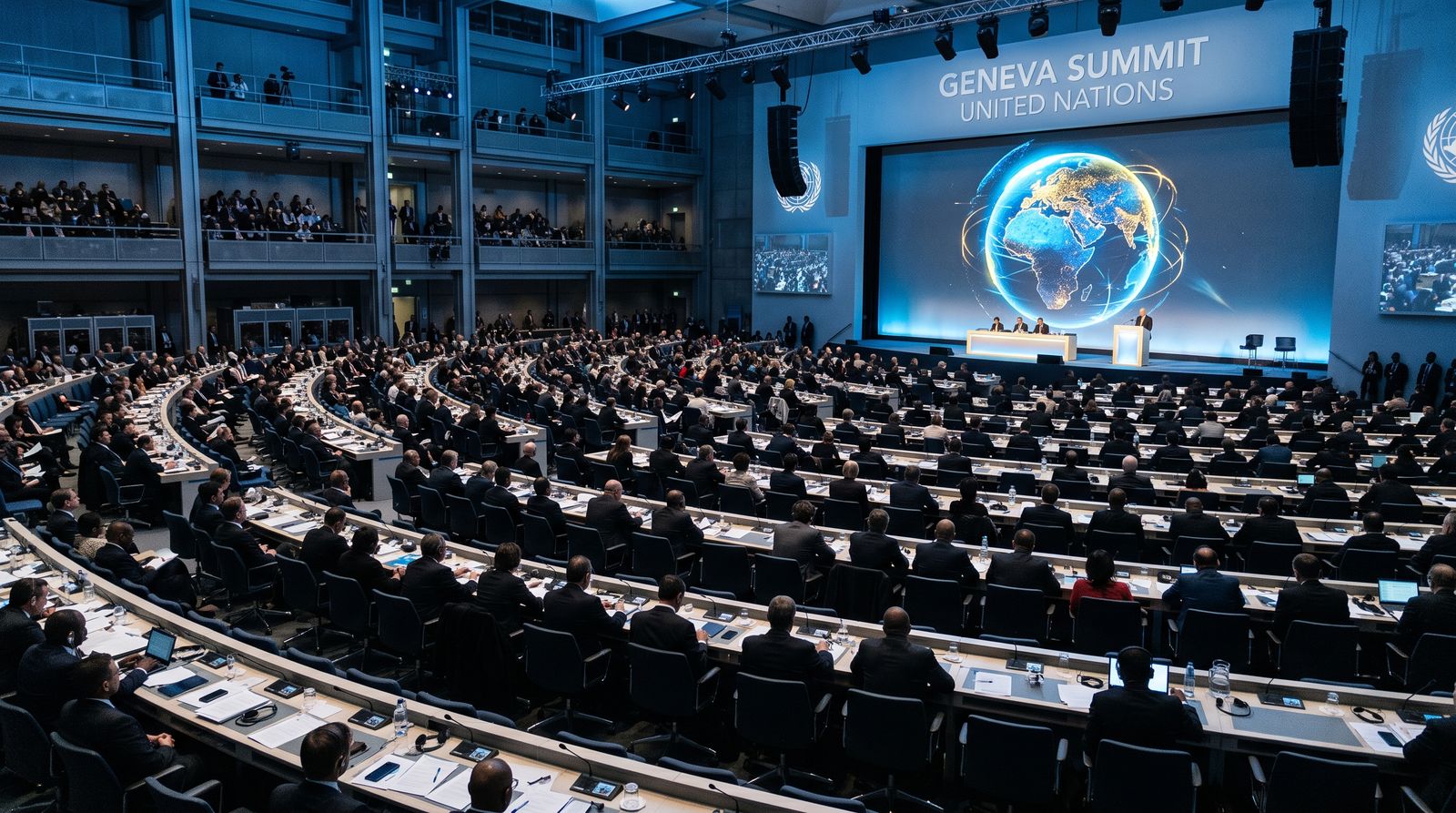
On Monday, the United Nations convenes something it has never had: a dedicated global forum for AI governance. The inaugural Global Dialogue on AI Governance runs July 6–7 at Geneva's Palexpo convention center, established by the UN General Assembly as the platform where governments, industry, academia, and civil society meet on international AI cooperation. It's co-chaired by El Salvador's Egriselda López and Estonia's Rein Tammsaar, and built around a high-level segment plus thematic sessions.
The scheduling makes it the anchor of a full Geneva AI week: the WSIS Forum 2026 runs July 6–10 and ITU's AI for Good Summit July 7–10, all in the same city. The Dialogue's stated purpose is pointed — ensure AI governance reflects the priorities of all nations, "not just the most technologically advanced," and that the benefits get shared.
Now the contrast. The rules that will actually bind frontier AI this month are being drafted somewhere else entirely: the White House is finalizing voluntary release standards with OpenAI, Google, and Anthropic — possibly announcing them the same week Geneva meets — while OpenAI floats handing Washington a 5% stake. One process involves most of the world's governments and no enforcement power. The other involves one government, three companies, and control of the actual release pipeline.
Our take
Expect declarations from Geneva, not law — and that's not failure, it's function. Multilateral forums set the vocabulary: what counts as "frontier," what an AI incident is, what gets reported to whom. That vocabulary later hardens into national regulation, procurement requirements, and treaty language. But the near-term power sits in the bilateral channel, where Washington is writing release gates with the three labs that matter, at deal speed. If you operate internationally, fragmentation is the base case now: a US layer that controls release timing, a UN/EU layer that controls definitions and disclosure norms, and national programs — Korea's $880 billion bet being the loudest — that control the money. Build compliance for the strictest jurisdiction you sell into, and treat everything looser as margin.
What to watch
- Who shows up for the US labs. CEO-level attendance in Geneva would signal the labs want a global legitimacy layer on top of their Washington arrangement.
- Definition alignment. If Geneva's language on "frontier" thresholds tracks Washington's, the two systems are converging. If not, compliance just forked.
- Anything concrete on incident reporting. A shared reporting norm would be the Dialogue's first real artifact — the rest is communiqué weather.
The week ahead is a split-screen: diplomats in Geneva debating how the world should govern AI, while the operative version gets negotiated between three labs and one government. Both matter. Only one ships next week.