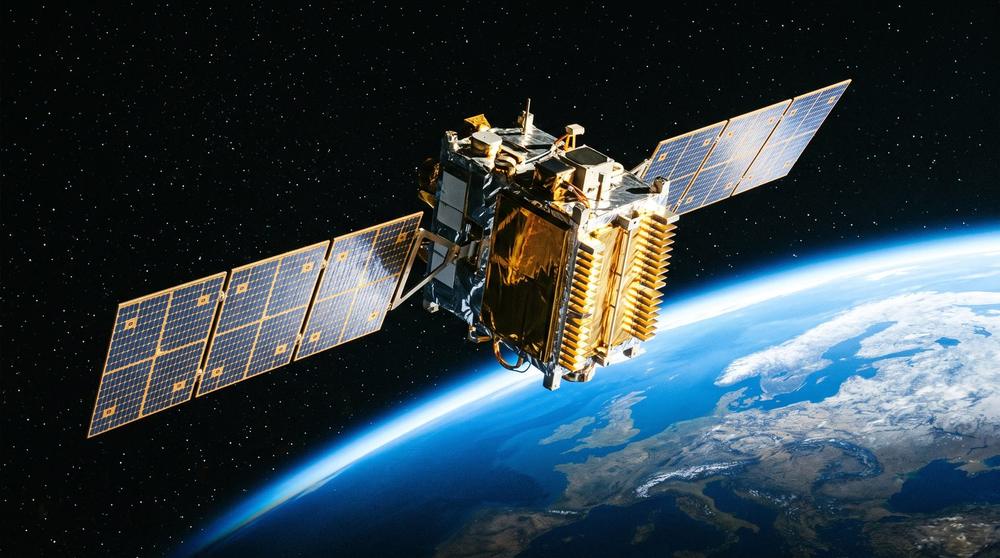
A Falcon 9 lifted off from Vandenberg on Thursday carrying the usual Transporter rideshare manifest — and one refrigerator-sized satellite that Google built with Planet Labs. Inside it: four Trillium-generation Tensor Processing Units, the same silicon Google runs in its terrestrial data centres. The craft, Project Suncatcher M1, separated about an hour after launch into a dawn-dusk sun-synchronous orbit at roughly 650km.
The headline writes itself: Google is building a data centre in space. The engineering tells a more interesting story. Google has already answered the question everyone assumed was the blocker — whether consumer-grade AI accelerators get cooked by orbital radiation. They tested a V6e Trillium part in a proton beam and found no hard failures from total ionising dose up to the maximum applied, with memory irregularities only appearing at roughly three times the estimated shielded dose for a five-year mission.
Radiation, in other words, is a solved-enough problem. Heat is not.
Vacuum has no air in it
On the ground, a rack of TPUs is cooled by moving fluid or air across it. In orbit there is nothing to move. The only way a satellite sheds heat is radiation — emitting thermal energy as infrared light from a surface — and that is a slow process governed by how much radiator area you can unfold and how hot you are willing to let it run. Google's own published work names thermal management as the unresolved engineering challenge and calls for advanced thermal interface materials to move heat from the chips to radiator surfaces.
That constraint is not a detail. It sets the duty cycle. A chip that can only run flat out until its radiators saturate is not a data centre; it is a batch processor with a cooling-down period. The whole economic case for orbital compute — free sunlight, no grid queue, no water — assumes the thing runs. M1's roughly year-long mission is there to find out what fraction of the time it actually can.
Our take: Everyone reporting this launch is reporting the radiation test, because that is the part Google has a clean answer for. The number that decides whether space compute is a business is the one Google has not published: the duty cycle. Until there is an on-orbit figure for how much useful compute a given radiator area supports, “orbital data centre” is a thermal-engineering research programme wearing an infrastructure costume.
The other number that has to move
Google's analysis puts cost parity with ground data centres somewhere in the mid-2030s, and only if launch costs fall below roughly $200 per kilogram. That is not a rounding error from today. The implied cadence — on the order of 1,800 Starship flights across a decade — is a trajectory nobody has demonstrated. The eventual architecture Google sketches is an 81-satellite cluster flying inside a one-kilometre radius, formations tighter than any constellation currently operating, because the satellites need optical links fast enough to behave like one machine.
So the project depends on two curves bending at once: somebody else's launch economics, and Google's own thermal design. Neither is in Google's control alone, and only one of them gets tested this year.
What to watch
- A published duty cycle. Compute-minutes per orbit, or watts sustained per square metre of radiator. That single disclosure turns this from a demo into a capex case.
- Whether the second prototype slips. Google has signalled a pair of test satellites; the gap between M1 and its sibling will say how much M1 taught them.
- Launch cost per kilogram, quarterly. The $200/kg threshold is the hinge. Track it as you would a commodity input, because that is what it is.
- Who else files. If a rival announces orbital compute without a thermal answer, that is marketing. If one announces a radiator architecture, that is a race.
Google has spent the last two years competing for grid connections, water rights and transformer lead times like everybody else building AI capacity. Suncatcher is a bet that the cheapest way around a permitting queue is 650 kilometres straight up. The bet is real. It is also, for now, a bet about heatsinks.