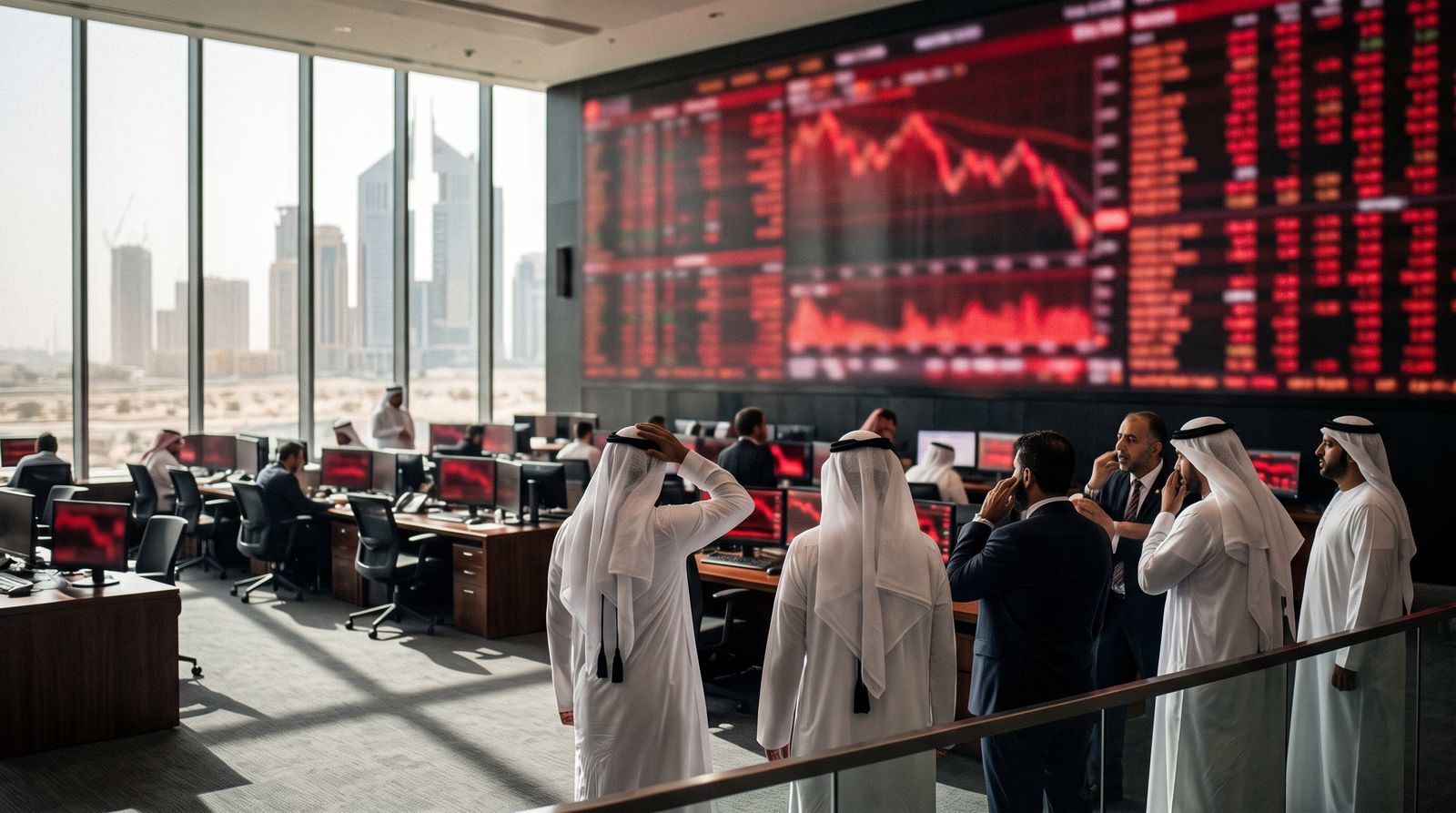
The only equity markets that trade on a Sunday happen to sit closest to the missiles — and they slipped. Most Gulf benchmarks declined Sunday as renewed US airstrikes and fresh warnings from President Trump pushed the US–Iran war into another week, Reuters reported, pinning the retreat on inflation worries and hardening expectations for higher US interest rates. Hold onto that last clause; it’s the tell.
The stranger story is Doha. The Qatar Stock Exchange came back online Sunday after going dark on July 13 for the official mourning period following the death of the country’s former Emir at 74 — a shutdown that swallowed the entire trading week. Which means Qatari investors slept through all of it: the infrastructure strikes that sent Brent up 4.6% Friday to $88.10, the tanker shootings in the strait, and Saturday’s confirmation of the first Americans killed by direct Iranian fire since the war’s opening days. On Sunday the bourse had to clear six days of war in a single session, and observers flagged exactly the volatility you’d expect from a market swallowing a week-long backlog in one gulp.
Why a modest regional session deserves your attention: it’s the only fresh price information anywhere between Friday’s close and tonight’s 6 p.m. ET futures reopen. US equities just logged their worst week in months, oil was the only trade working, and crypto sagged through the weekend with bitcoin in the $63,000s. Into that vacuum, the markets closest to the conflict — and most exposed to its outcome — cast the first vote. It was not a vote of confidence.
Our take: Petro-states selling off during a war-driven oil rally is the detail worth keeping. If $88 crude were being read as a durable windfall, Gulf indexes — heavy with energy names and state-adjacent balance sheets — would catch a bid. They didn’t, because the market’s actual read is disruption risk plus an inflation problem that keeps US rates pointed the wrong way for every risk asset from Riyadh to the Nasdaq. That’s the same math that made Friday ugly in New York. When even the sellers of $88 oil won’t buy their own rally, don’t expect Monday’s open to do it for them.
What to watch
- Tonight, 6 p.m. ET. Futures get their first print on the weekend. The Gulf supplied the direction; New York supplies the magnitude.
- Monday’s Gulf session. Day two is the real test — whether the region extends the slide once it’s trading alongside global markets instead of alone.
- Qatar’s catch-up trade. Reopened markets rarely clear a week’s backlog in one day. If Doha’s volatility bleeds into midweek, that’s a regional stress signal, not a footnote.
- The rate channel. If war inflation keeps pushing US rate expectations higher, the oil-exporter bid stays broken — and so does the rest of the risk tape. The Fed stays silent in blackout until July 28–29, so prices are the only commentary.