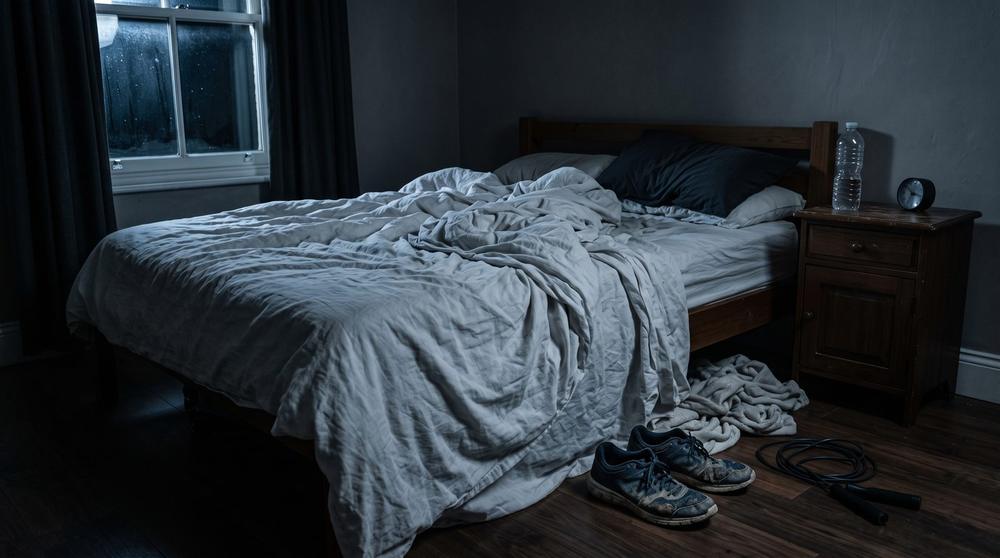
A small study out of the University of Trieste, published in the European Journal of Applied Physiology, monitored eight male hybrid athletes — Hyrox competitors, aged 23 to 32 — across four nights: two following a resistance session, two following an endurance session. The question was whether the type of training an athlete does in a day changes how they sleep that night.
It does, and not in one direction.
After lifting, the athletes took an average of 29 minutes to fall asleep. After endurance work, 10 minutes. That is a near-threefold difference and it was statistically solid. But once asleep, the pattern inverted: time awake after sleep onset was 31 minutes following resistance work versus 48 minutes following endurance. The researchers tied both effects to differences in cardiac arousal before and after sleep onset.
Why a single sleep score would miss this entirely
The two effects partly cancel. Lifting costs about 19 extra minutes at the front end and saves about 17 minutes of fragmentation in the middle. Averaged across all four nights the group looked unremarkable — roughly 6.6 hours of total sleep, 15 minutes to fall asleep, 39 minutes awake after onset, 86% efficiency.
That composite is what a wearable would have shown. It conceals two genuinely different nights with two different problems, and therefore two different interventions. If falling asleep is the issue, the lever is the wind-down after a lifting session. If staying asleep is the issue, the lever sits somewhere in endurance recovery — thermoregulation, fuelling, hydration. Treating them as one problem called “bad sleep” gets you the wrong fix half the time.
Our take: The finding is plausible and mechanistically sensible, and it is eight men over four nights measured with one armband. That is a hypothesis generator, not a protocol. The transferable lesson is the methodology, not the minutes: if you train in more than one modality and you track sleep, stop looking at the nightly score and start tagging nights by what you did. A number that averages two opposite problems is worse than no number, because it feels like information.
The figure nobody is discussing
Across every night, in both conditions, these athletes averaged 6.6 hours of sleep at 86% efficiency. For competitive hybrid athletes carrying both a strength and an endurance load, that is low — and it is low regardless of which session they did. The training-mode effect is interesting. The total is the actual problem, and no amount of sequencing fixes a volume deficit.
What to watch
- Replication at usable scale. Eight male participants cannot tell you whether this holds for women, for older athletes, or for anyone training at lower intensity.
- Session order within a day. Hybrid athletes routinely do both in one day. Whether lifting-then-running differs from running-then-lifting is the question that would actually change programming.
- Timing of the session. The 29-minute onset latency after lifting is the kind of effect that should shrink with a longer gap before bed. No one has tested the gap.
- Whether consumer wearables ever surface this. The split only appears if the device knows what you trained. Most score the night and stop.
It is the same pattern as the caffeine meta-analysis that found speed without accuracy and the creatine trial that separated muscle from training: the aggregate result is reassuring and the disaggregated result is the one you can use. Athletes like those racing at the sharp end win on the second kind.